EULAR 2019 begins today in Madrid and features over 2000 presentations. After an initial review of titles and abstracts, I’ve compiled a hit list of presentations of interest to me and hopefully other practicing rheumatologists.
All News
Hemophagocytic lymphohistiocytosis (HLH) is a severe hyperinflammatory syndrome induced by activated macrophages and cytotoxic T cells. HLH manifests recurrent fever, cytopenia, liver dysfunction, and a sepsis-like syndrome that may complicated by multiple organ failure.
Dr. Jack Cush reviews the news and journal articles of note from this past week on RheumNow.com.
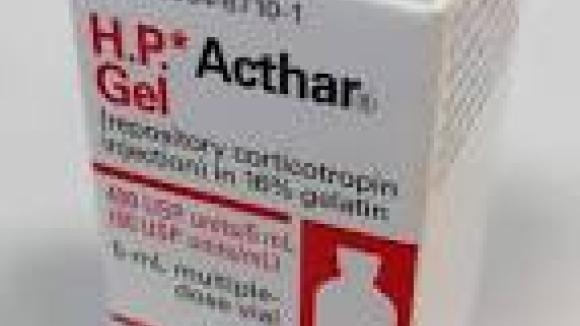
Reuters has reported that Mallinckrodt Plc has tentatively agreed to pay $15.4 million to resolve a US Justice Department investigation into company promotional practices for Acthar gel.
Despite the lack of good evidence, there has been great speculation about the role of diet in causing or alleviating inflammation. Now there's new research suggesting that proinflammatory diets can increase serum C-reactive protein levels and also the risk of rheumatoid arthritis onset.
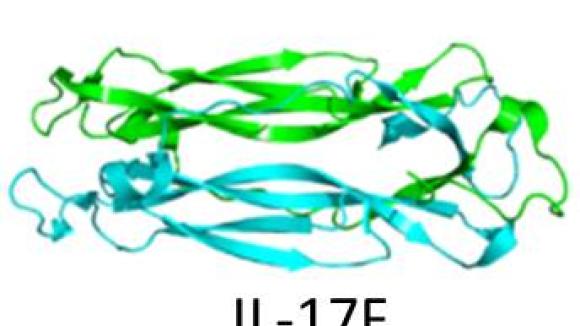
Interleukin 17 (IL-17) inhibitors are highly effective and FDA approved for use in psoriasis, psoriatic arthritis and ankylosing spondylitis. However, many of the initial trials were done in rheumatoid arthritis (RA) where it was projected to be effective, but was not. A recent metanalysis examines how effective IL-17 inhibition was in two RA populations: biologic-naïve or tumor necrosis factor inhibitor inadequate responders (TNF-IR).
A systematic review of the medical literature shows anterior cruciate ligament (ACL), meniscus or combined ACL and meniscus injury significantly increases the risk of future knee osteoarthritis (OA).
Dr. Jack Cush presents the news and best of rheumatology and medicine from the past week on RheumNow.com
Upadacitinib (UPA) is an oral, selective JAK1-selective inhibitor being developed for use in rheumatoid arthritis patients; Lancet has reported the SELECT-MONOTHERAPY trial showing that UPA is safe and effective in RA patients with an inadequate response to methotrexate (MTX).
The risk of serious infectious events (SIE) with rituximab (RTX) is similar to that seen in other biologics (e.g., RA: 2% or 4.3/100PY), but with prolonged use the risk may change. Recent research says that low IgG levels, RTX induced neutropenia, prior SIE and comorbidities can significantly augment this risk.
A retrospective longitudinal single center study of 700 rheumatic and musculoskeletal diseases (RMDs) treated monitored serum immunoglobulins (at baseline and 4–6 months after each cycle), clinical outcomes and SIE over time.

In August 2018, the CMS announced that Medicare Advantage (MA) plans would be allowed to utilize step therapy for Part B drugs. The American College of Rheumatology (ACR) expressed strong concerns about this proposal.
Among patients with rheumatoid arthritis (RA) who had interstitial lung disease (ILD), the pattern of ILD did influence mortality, but other pulmonary factors also contributed, a meta-analysis suggested.
Medicare and Truven MarketScan administrative data study (2006 through 2015) of rheumatoid arthritis (RA) undergoing arthroplasty found that while that the risks of perioperative infection was similar across biologics, the infection risk with glucocorticoid use, especially at
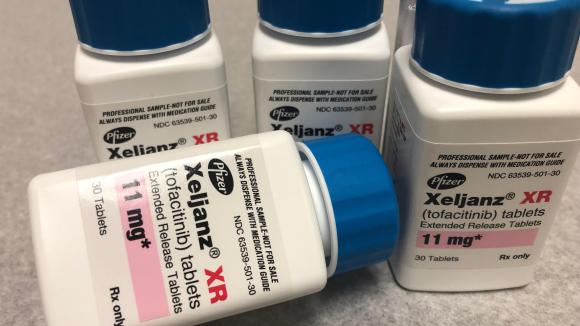
The Pharmacovigilance Risk Assessment Committee of the European Medicines Agency issued recommendations limiting the use of Xeljanz (tofacitinib) 10 mg twice daily in patients with ulcerative colitis in the EU.
The new recommendations are temporary while PRAC undertakes a review of all available evidence on the safety and efficacy of tofacitinib. The review follows warnings of an increased risk of pulmonary embolism (PE) and death from the U.S. Food and Drug Administration based on Pfizer's large post-marketing safety study (in high risk rheumatoid arthritis patients with one or more underlying cardiovascular risk factors) wherein those receiving in tofacitinib 10 mg twice daily in study A3921133 had more PE and mortalities than comparator groups (tofacitinib 5 mg bid or adalimumab).
Analysis of a large US observational rheumatoid arthritis (RA) patients finds that opioids, SSRIs and glucocorticoids were associated with increased risk of fracture in RA, whereas statins and TNFi had a decreased vertebral fracture risk.
Dr. Jack Cush reviews the news and journal articles from the past week on RheumNow.com
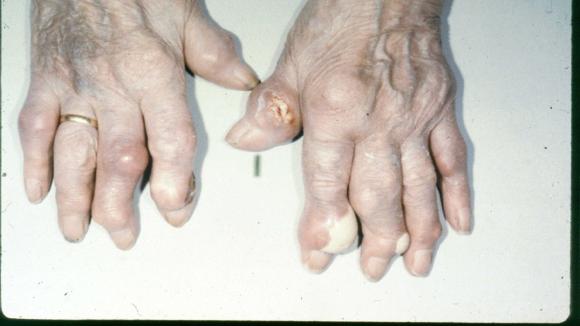
It his often said that gout and rheumatoid arthritis (RA) cannot coexist and where confusion exists, a good history and testing for serum urate (SUA) and rheumatoid factor (RF) can usually clarify the dominant disorders. A recent study shows that hyperuricemia and gout are uncommon in RA, but when present shows an increased risk of comorbidities and cardiovascular (CV) mortality.
The FDA has published an industry guidance document to define interchangeability as regards to biosimilar use in the United States under section 351(k) of the Public Health Service Act (PHS Act) (42 U.S.C. 262(k)).
People with rheumatoid arthritis have a significant risk of developing interstitial lung disease (RA-ILD), yet there is often a question as to whether methotrexate (MTX) exposure can cause or worsen ILD. A controlled cohort study suggests that MTX use is not associated with an increased ris