A significant proportion of patients with rheumatologic disease are of reproductive age, therefore, navigating reproductive health is now widely recognized as a fundamental component of modern rheumatology care.

Article
sheila
Tweet
Lupus/LN should not be a sole indication for a C-section
C-section should be reserved for obstetric indications.
Adapt a multidisciplinary approach.
@RheumNow #APLAR2026 https://t.co/vrXeNP9xLI
sheila
Tweet
There is physiologic proteinuria in pregnancy so be careful before attributing a rise of levels to active LN
LN flare vs. pre-eclampsia: both can present w/ HTN, edema, low plts and inc crea.
> monitor C3 changes during each trimester of pregnancy
@RheumNow #APLAR2026 https://t.co/Pp6GGeLPC6
Dr. John Cush
Tweet
Does IVIG have a Role in Scleroderma?
A recent systemic review and meta-analysis by Jozelio Freire de Carvalho and colleagues analyzed the available literature on this therapy. This study, published in Frontiers in Immunology in October 2026, evaluated the available evidence https://t.co/a8J2UT2I7Y
Dr. John Cush
Tweet
Long term F/U of 80 systemic sclerosis pts Rx w/ autologous HSCT. W/ Med. 9.2 yrs F/U progression-free survival = 81%, 72% @5 yrs, & 60% @10 yrs. 18 pts died; death due to HSCT in 6%, SSc progression in 11%, CA in 2 (3%), serious infx 2 (3%), 34 (43%) maintained remission without https://t.co/l6RUf2Zqyw
Dr. John Cush
Tweet
Japanese retrospective cohort systemic sclerosis study shows adjunctive tofacitinib improved ower esophageal sphincter pressures (LESP). 50 SSc pts w/ esophageal Sxs Rx w/ Tofa or PBO x 24 wks. Tofa assoc w/ signif LESP increases & lower mRSS & IL-6 levels https://t.co/NNREBddiOi https://t.co/p6VujI8HWA
sheila
Tweet
Prof. AHoi presented their study on ESR as potential source of risk info in SLE
48% discordance bet ESR & conv. serology
Isolated ⬆️ESR levels showed ⬆️ assoc with dse activity and flare; risk increases further if combi ⬆️ESR+low c3/4+antidsDNA
@RheumNow #APLAR2026 https://t.co/BvC0OZFjd5
Dr. John Cush
Tweet
Menopause Hormone Therapy Tied to Small Autoimmune Disease Risk
Estrogen-only menopausal hormone therapy was associated with a slightly higher incidence of autoimmune disease compared with estrogen-progestogen therapy, a retrospective cohort study suggested. https://t.co/kV4Y7tvpC8
Jiha Lee
Tweet
Case quiz: 38F fever, tetraparesis, hallucinations, slurred speech. Low C3, ANA 1:100, WBC 26,320, normal CSF/Ca/PTH. CT: basal ganglia calcification. Dx?
Answer: SLE with Fahr syndrome (focal NPSLE) plus urosepsis. Keep infection in rheum Ddx. P#325 #APLAR26 @RheumNow https://t.co/Gsb8dquwHL
Dr. John Cush
Tweet
JAMA Uveitis review: Uveitis peaks at 20–50 yrs; 41–60% is anterior. ~40 linked to systemic disease (HLA-B27=axSpA). 1st exclude infection (TB, toxo, herpes). Anterior UV: topical steroids. Posterior/pan UV: DMARDs first (MTX remission 52%, MMF 71%); adalimumab if refractory https://t.co/xTlr5lrwUz
sheila
Tweet
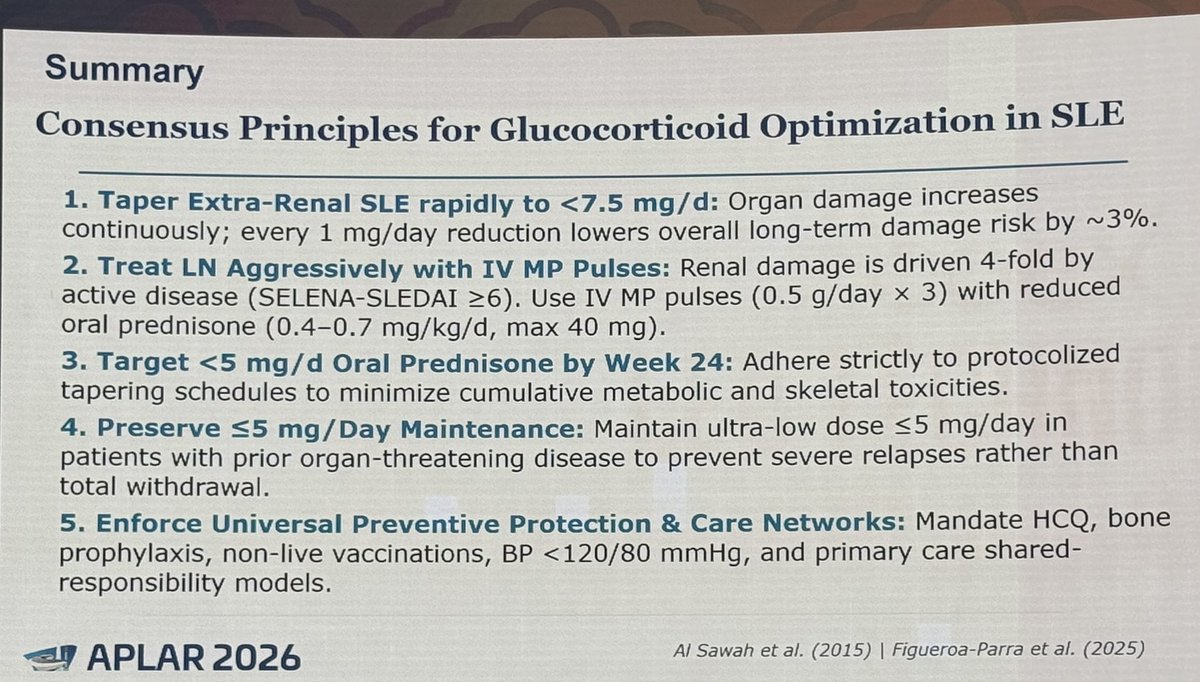
Optimizing GC use in SLE:
In arthritis, avoid oral GC - consider NSAIDS, csDMARDs, small molecules or biologics
On GC initiation, hit hard w/pulse MP then taper early and rapidly
In LN, treat aggressively bec damage is driven by dse activity, not meds
@RheumNow #APLAR2026 https://t.co/Q5gFpr8P9k
Dr. John Cush
Tweet
Dr. Cush reviews the news and journal reports from this past week on RheumNow. This week on the podcast: hopeful guidelines for PMR; certainty about good & bad beverages in gout; mixed results in Sjogren's; non-lupus drugs saves lupus lives; and big hips sink ships in psoriatic https://t.co/TPqPKP5MRl
Dr. John Cush
Tweet
Advances and Challenges in Lupus Care: Insights from RheumNow Survey Findings
Listen to leading rheumatology and dermatology experts for an engaging discussion on the evolving landscape of Cutaneous Lupus Erythematosus (CLE) and Systemic Lupus Erythematosus (SLE). https://t.co/lJOzeR81AS
Dr. John Cush
Tweet
The Efficacy of Ianalumab in Sjögren’s Disease
The NEPTUNUS-1 and NEPTUNUS-2 trials have showed that monthly ianalumab is superior of placebo at improving Sjögren’s disease activity at week 48, even though there was no significant ESSDAI response or in the change in SSSD or https://t.co/YStzIFq5Bx
sheila
Tweet
Patients with type 2 SLE present with fatigue, pain, brain fog and mood changes.
Type 1 & 2 often coexist but type 2 SLE impacts QOL.
@RheumNow #lupus #APLAR2026 https://t.co/aMtoIprPWG
Peter Nash
Tweet
“Complex to manage” in SLE not for biologics
APLAR Seoul 2026 Nikpour #SLE #RheumNow https://t.co/4qeRGEVijs
Peter Nash
Tweet
why biologics for “refractory”only - a life on steroids HCO MMF etc?
APLAR Seoul 2026 Nikpour #SLE #RheumNow https://t.co/Fa58nsF5Mk
sheila
Tweet
Prof. Sandra Navarra on GCs in #lupus : “There is NO safe threshold for Prednisone”
Pred use follows a linear risk: As the dose of prednisone increases, damage risk doubles - - - > higher cataract, fracture and CV risks!
@RheumNow #APLAR2026 https://t.co/8GGrwkcd8Q
Peter Nash
Tweet
evidence T2T in SLE is wortwhile
APLAR Seoul 2026 Nikpour #SLE #RheumNow
Peter Nash
Tweet
Saag Osteoporosis - what to do when stopping Denosumab ?
APLAR Seoul 2026 Nikpour #SLE #RheumNow https://t.co/skeONgWUpH
Peter Nash
Tweet
Schett - in remission : 14 normal pregnancies no SLE recurrence , babies normal b cells
APLAR Seoul 2026 #CART #RheumNow
sheila
Tweet
Cutaneous #lupus are classified into: acute, subacute and chronic.
Acute CLE is highly assoc’d w/ photosensitivity, +ANA and systemic involvement.
Chronic CLE develops scarring and pigmentation
CLE is an initial manifestation of SLE in 25% of pts
@RheumNow #APLAR2026 https://t.co/4GdyUuqlzH
Dr. John Cush
Tweet
Advances and Challenges in Lupus Care: Insights
https://t.co/qQ0kk3W80C https://t.co/xMCtvMKIem
Dr. John Cush
Tweet
Menopause Hormone Therapy Tied to Small Autoimmune Disease Risk
Estrogen-only menopausal hormone therapy was associated with a slightly higher incidence of autoimmune disease compared with estrogen-progestogen therapy, a retrospective cohort study suggested. https://t.co/g6BvYuBzVj
Article
The NEPTUNUS-1 and NEPTUNUS-2 trials have showed that monthly ianalumab is superior of placebo at improving Sjögren’s disease activity at week 48, even though there was no significant ESSDAI response or in the change in SSSD or ESSPRI symptom scores.