

Staying Ahead of Spondyloarthritis Save

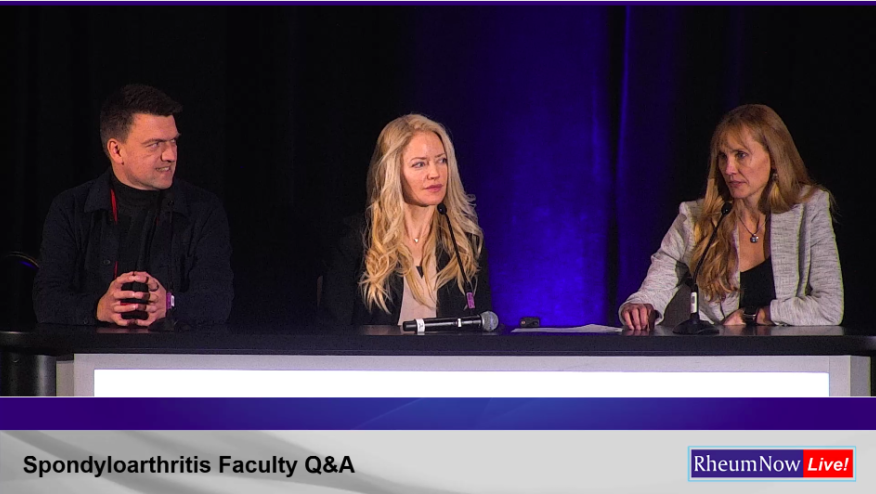
The diagnosis and treatment of spondyloarthritis can present challenging clinical scenarios for rheumatologists. At RheumNow Live, Pod IV focused on "Staying Ahead of Spondyloarthritis."
Dr. Denis Poddubnyy from the University of Toronto began the session by discussing making the diagnosis of axial spondyloarthritis (AxSpA). He noted "treating spondyloarthritis is easy, the challenge is when the diagnosis is not correct." Diagnostic delays remain common in AxSpA with a mean 5.7 year diagnostic delay according to data from the PROCLAIR study. The identification of this disease is challenging given the high prevalence of chronic back pain in the general population, with AxSpA representing only about 5% of these cases.
There have been recent updates to the 2025 ASAS-SPARTAN Revised Classification Criteria for AxSpA. The new criteria notes the importance of excluding mimicking diseases in patients being evaluated for spondyloarthritis. This criteria more strongly relies upon imaging findings, making it more difficult to meet classification on clinical criteria alone.
Dr. Poddubnyy described challenges in AxSpA. Bone marrow imaging can be seen in healthy athletes or postpartum individuals. Mimics such as osteitis condensans ilii should be evaluated as alternative etiologies, which have anterior localization and the absence of erosions. Due to non-specific features of bone marrow edema, this is no longer sufficient to meet imaging arm of the classification criteria, which now requires a global evaluation for active and structural lesions.
Next, Dr. Jessica Walsh at University of Utah reviewed large joint involvement of knee and hip disease in spondyloarthritis. Patients with radiographic axial spondyloarthritis have a 3-4x higher risk of hip arthroplasty and young patients under 50 years old have a 2.7x higher risk of knee arthroplasty. Inflammatory arthritis of the hip appears radiographically different than osteoarthritis with concentric joint space narrowing and a collar of osteophytes at the head-neck junction, appearing different than traditional superolateral joint space narrowing with marginal osteophytes.
Patients can have successful arthroplasty with 10-year implant survival of 90% for hip and 88% for knee arthroplasty. That said, however, complications are at higher rate for these patients with higher rates of prosthetic joint infection, dislocation, mechanical loosening and periprosthetic fracture. Additionally, higher complications of myocardial infarction, stroke, thrombosis, infection, kidney injury, transfusion and falls are seen in this patient population compared to patients with osteoarthritis undergoing hip and knee arthroplasty surgeries. Stiffer spines from AxSpA or spinal fusion are also known to affect post-surgical outcomes in hip arthroplasty. Surgical site infections are higher when biologics are continued peri-operatively and the 2022 ACR/AAHKS Guideline for Peri-Operative Medication Management in Patients Undergoing Total Hip or Total Knee Arthroplasty is an important tools in managing inflammatory arthritis around surgery.
Finally, Dr. Catherine Bakewell from Intermountain Health in Salt Lake City, Utah provided a whirlwind, high-yield talk on modern advances in spondyloarthritis. Dr. Blakewell reviewed treatment of extra-axial manifestations of AxSpA, particularly uveitis. Adalimumab, bimekizumab and upadactinib have been demonstrated to reduce uveitis flares compared to placebo, whereas etanercept does not penetrate eye tissue for a response. Both adalimumab and methotrexate have randomized controlled data supporting its use in non-infectious posterior uveitis. Dr. Blakewell highlighted favorable ASAS 40 responses across TNF inhibitors, IL-17 inhibitors and JAK inhibitors, and noted that treatment choices may be made by patient characteristics, extra-axial manifestations and co-morbid conditions. She reviewed the ASDA-CRP score to calculate disease activity level which includes back pain, duration of morning stiffness, patient global assessment, peripheral pain/swelling and CRP levels. Scores under 2.1 indicate low disease activity level, whereas higher numbers are in the high or very high disease range. Dr. Blakewell noted the absence of a moderate disease range, emphasizing that scores above low disease activity are inadequate and require optimization of care. The TICOPSA study, however, did not demonstrate superiority of treat to target approach for AxSpA and is not generally recommended for this rheumatic condition. Finally, Dr. Blakewell summarized the newest agents in development and trials for AxSpA including JAK inhibitors, Tyk2 inhibitors, and IL-17 fusion protein and nanobodies.
This busy POD session included several clinical pearls for the diagnosis and management of axial spondyloarthritis. These speakers highlighted the future of AxSpA includes refining our understanding in classifying the disease and the emerging treatment landscape of new therapeutics.




If you are a health practitioner, you may Login/Register to comment.
Due to the nature of these comment forums, only health practitioners are allowed to comment at this time.