0:03
Hi everybody, it's Mike Putman. I'm a rheumatologist at the Medical College of Wisconsin and today I'm coming to you from ACR 2026 to talk about abstract 0928 — CATCHER T cells for the antigen-specific treatment of ANCA-associated vasculitis.
0:17
Now I am not a big person to talk about basic science things, but I also love science fiction.
0:24
And if you want to know the number one science fiction cool thing that I saw in the basic science realm this meeting, this is definitely it.
0:32
So the problem today is that we are all about B cells.
0:36
We have CAR-T, we have BiTEs, we have all these ways of killing B cells more dramatically and broader and deeper, but a lot of those B cells are good.
0:44
One of the biggest problems that our patients face is actually infection, and killing all the B cells hurts the infection risk.
0:49
So the abstract that I just got back from — one of the ANCA-associated vasculitis abstract sessions — talked about these CATCHER cells that are
0:58
being developed by Max Konig's group at Hopkins, with the goal of targeting specifically the bad B cells, which are a tiny fraction of the
1:06
overall B cell population.
1:06
And if only we could fix them, maybe we could get all of the benefits with very few of the harms.
1:12
So this isn't a mouse model — full disclosure, this is still #InMice.
1:16
But what they did is they took and they edited human T cells to create these CATCHER PR3 T cells.
1:23
You can imagine that of all the B cells in your body, there are some that are making the PR3 antibodies that are causing a lot of the havoc in ANCA-associated vasculitis.
1:30
What if we could kill just those? They made CAR-T cells that will selectively go after just those.
1:38
So the presentation itself was super cool.
1:40
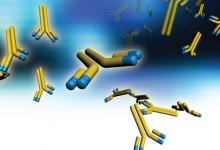
They have all these beautiful rotating antibody models and if you ever have a chance you should definitely drop by one of them.
1:47
They initially made cells that were not selective enough.
1:49
So then they used AlphaFold, and they restructured their molecule and they kind of evolved it over time — they engineered it to be more specific.
1:57
It's honestly pretty wild. At the end of it they had these cells that would specifically kill the PR3-producing B cells.
2:06
Now, after that they said, all right, let's validate in a mouse model.
2:11
And so they did that — they engineered some mice that expressed PR3, and then they gave them these cells, and they went in and
2:17
killed all the bad B cells in the bone marrow and the spleen and the liver — all of the tissues that we think are
2:22
sometimes hard to get to for our normal approach to B cell inhibition.
2:25
So this is still in mice — we're not there to human trials yet — but I love sci-fi, and if there's anything at the meeting where I say that is the thing that will eventually cure vasculitis, which is one of my favorite diseases to treat, this is the thing that would do it.
2:39
So keep your eye out for this. It's CAR-T, but a more specific version of it called CATCHER T cells.
2:44
And I think it was a really neat thing that I saw at the meeting this year.
2:48
Thanks so much for tuning in to all of our coverage.








If you are a health practitioner, you may Login/Register to comment.
Due to the nature of these comment forums, only health practitioners are allowed to comment at this time.