0:04
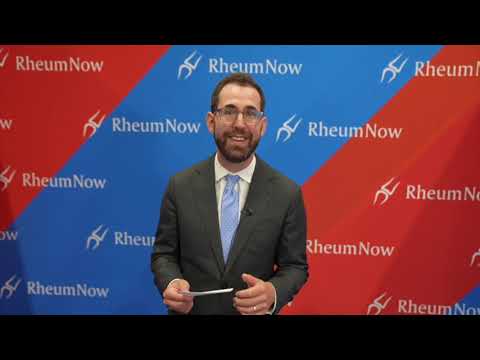
Hello, my name is Elena Jurns. I'm reporting live from Orlando, Florida, ACR 2026.
0:10
I want to talk to you about a session on autoimmune ILD that I saw today.
0:15
It was fantastic. It was delivered by a pulmonologist, Dr. Zaman from Cedars-Sinai and Dr. Castellino from Mass General Hospital.
0:23
And they talked about a few things — what we really want from autoimmune ILD, and I just really loved how they delivered that.
0:30
So first, they emphasized what physicians treating autoimmune ILD really want from the drugs and from the studies.
0:44
Many of the recent new drugs are being advertised as great because they slow down the rate of decline of FVC.
0:54
I mean, that is great — nobody argues about that.
0:58
But the excitement of that slowing down really comes from the data on idiopathic pulmonary fibrosis, where the disease is really relentless and we expect it to progress.
1:07
But the goals in SARD-ILD can be very different.
1:11
We actually want SARD-ILD to improve. We don't want merely stabilization or attenuation of the lung function decline.
1:20
The reason for that is a ton of SARD-ILD is inflammatory.
1:23
We can argue that all of it is inflammatory, because we have a start — right — something like myositis, for example: the patient may
1:33
decline fast and then stabilize, usually with the help of steroids, but we would strive to bring back the lung function with immunosuppressants, or maybe
1:41
a combination of drugs that include immunosuppressants.
1:44
The session even presented some data that fibrotic-looking — like a UIP, usual interstitial pneumonia pattern — might at the very least stabilize with immunosuppression, even though oftentimes we hear that oh, these patients just need anti-fibrotics.
1:58
But they probably need immunosuppressants as well.
2:02
So the takeaway point for that is that we can and we should strive for improvement in SARD-ILD.
2:09
The session also emphasized a gap in autoimmune ILD studies, and I think that's a big one.
2:15
Many medications, especially the newer ones, have focused on progressive pulmonary fibrosis, but SARD-ILD might not necessarily fall into that, at least not in the time frame that a lot of those studies used as inclusion criteria.
2:28
So we don't always know if the results of those studies are applicable to our SARD patients.
2:37
And also, the outcomes of those studies have focused on reduction in FVC decline.
2:44
But as we talked about, some SARD-ILD will not necessarily have that FVC decline — it might not be as relevant — and also SARD-ILD may not follow a linear course like a lot of patients with idiopathic pulmonary fibrosis can.
3:00
So again, not super relevant, and we are often left confused about whether to treat SARD-ILD that is not progressive, and what we should hope for.
3:09
We don't really often know that from the results of the studies.
3:13
I think that lecture emphasized that we need more studies that enroll all comers of SARD-ILD, and also with outcomes that really focus on many
3:21
aspects of the disease and patient outcomes, because sometimes we can help the patient with those even if we don't necessarily improve the numbers on
3:30
pulmonary function tests — but we need to prove that.
3:34
So my takeaway point is to design studies of ILD that include non-progressive fibrosis and power for improvement.
3:42
And the third takeaway point is that rheumatologists should be actively involved in SARD-ILD management.
3:49
Our patients with SARD have many aspects to their disease that we need to balance treatment for — for each of them against others, and also against the risk for infection.
3:59
And we have so many drugs, luckily, that can help with many manifestations of that disease.
4:06
But sometimes one that is more effective for one manifestation may not be as effective for others.
4:11
So we still end up combining them, and this is complicated and it requires careful rheumatological expertise.
4:18
So we should not leave the SARD-ILD to the pulmonologist — even though they're of course wonderful, and many of them can treat SARD-ILD just fine — but SARD is more than just lungs.
4:31
In rheumatology, we need to treat the whole patient and all the extra-pulmonary manifestations, and we as rheumatologists should be well versed in drugs that can help the whole patient while helping the lungs.
4:45
I guess the takeaway point is that SARD-ILD is a team sport.
4:47
If we were to go with a soccer analogy — which I don't play soccer at all — I would say that a rheumatologist may
4:54
take more the role of the offense, kind of putting all those drugs out there, and the pulmonologist may be more like a goalie, making
5:03
sure that the lungs don't fall through the cracks. Thank you.








If you are a health practitioner, you may Login/Register to comment.
Due to the nature of these comment forums, only health practitioners are allowed to comment at this time.