Patients with inflammatory/autoimmune diseases who initiated treatment with interleukin (IL)-17 inhibitors did not have a higher risk for the development of inflammatory bowel disease (IBD), but only after taking into account the severity of their underlying disease, French investigators reported

All News
The U.S. Food and Drug Administration (FDA) has approved Octagam 10% [Immune Globulin Intravenous (Human)], as the first and only intravenous immunoglobulin (IVIg) formulation to be approved for adult dermatomyositis (DM).
JAMA has published the findings of trial wherein the anti–interleukin-1β antibody canakinumab (CAN) failed to improve survival in patients hospitalized with severe COVID-19.
The ACR and the Vasculitis Foundation have published their evidence-based recommendations and expert guidance for the management of GCA and Takayasu arteritis. These recommendations address a variety of clinical questions and scenarios including diagnostic testing, imaging, treatments, and surgical interventions. Recommendations for GCA and TAK include support for the use of glucocorticoid-sparing immunosuppressive agents and the use of imaging to identify large vessel involvement. Recommendations for TAK include the use of glucocorticoids as initial therapy.
Dr. Jack Cush reviews the news and journal reports from the past week on RheumNow.com.
Chung et al have published the 2021 treatment guielines for the management of antineutrophil cytoplasmic antibody–associated vasculitis, including granulomatosis with polyangiitis, microscopic polyangiitis, and eosinophilic granulomatosis with polyangiitis. These guidelines are put forth by the ACR and the Vasculitis Foundation as benchmark guidance to assist health care professionals in managing AAV.
Dr. Jack Cush reviews and discusses the news and journal reports from the past week on RheumNow.com.
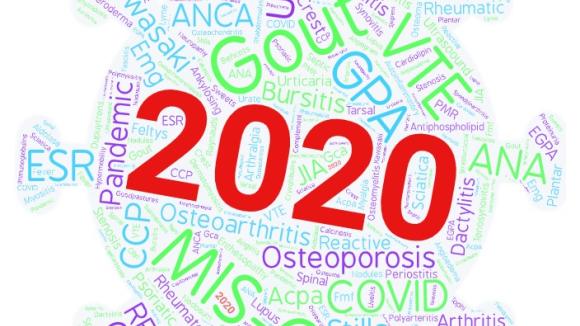
2020 was historic, memorable and game-changing. Under the cloud of COVID-19, there were many significant and memorable advances and setbacks for the rheumatology world. In our accounting of most read articles for 2020, (not surprisingly) 17/20 were COVID-related.
This year’s coverage of psoriatic arthritis was once again, both exciting and informative. Topics included an overview of the latest therapeutic options, an excellent discussion on psoriasis specifically, and the epidemiology of psoriatic arthritis.
The evidence-based recommendations from the Group for Research and Assessment of Psoriasis and Psoriatic Arthritis were presented at #EULAR2021. The goal (as per 2009 recommendations) was “To develop recommendations, based upon the best scientific evidence, for the optimal treatment of patients with PsA” Dr. Laura Coates, Oxford detailed in abstract #OP0229. Since the last update in 2015, there have been multiple changes, which are highlighted here.
Genentech announced Thursday that the US Food and Drug Administration approved tocilizumab (Actemra) for the treatment of Systemic Sclerosis-associated Interstitial Lung Disease (SSc-ILD), specifically indicated for slowing the rate of decline in pulmonary function in adul
The FDA has notified healthcare professionals of a safety alert concerning tofacitinib (Xeljanz), noting that preliminary results from a long-term safety clinical trial show an increased risk of serious heart-related problems and cancer with tofacitinib (compared to adalimumab) when given to at-risk rheumatoid arthritis patients. These findings are in addition to the thrombotic risks (added to the label), potential risks including blood clots in the lungs and death.
Pfizer announced results Wednesday from its FDA-mandated postmarketing safety study of tofacitinib (Xeljanz), and they don't bode well for the drug and possibly others in its class.
Dr. Jack Cush reviews the news and journal reports from this past week on RheumNow.com.