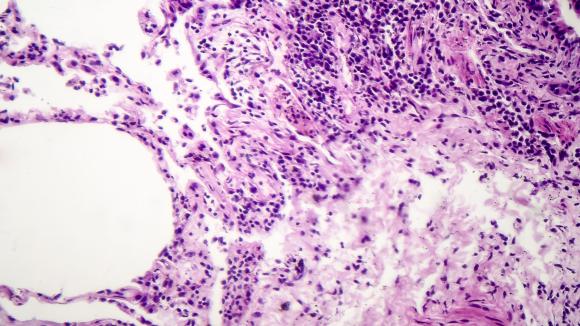
A network meta-analysis in the Journal of Autoimmunity reviews the pharmacologic options for rheumatoid arthritis–associated interstitial lung disease (RA-ILD). RA-ILD guidelines were recently presented by ERS/EULAR, but these were mainly conditional, low-certainty recommendations.

All News
Almost everyone will deal with back pain at some point in their lives.
In 2024, the Canadian Rheumatology Association (CMA) and the Spondyloarthritis Research Consortium of Canada (SPARCC) published a comprehensive set of 56 treatment recommendations for the management of axial spondyloarthritis. This first update is focused on the reassessment of IL-17i recommendations.
EULAR26: ANCHOR-RA Study of RA-ILD
People with rheumatoid arthritis are at risk of developing interstitial lung disease (RA-ILD), which is associated with high mortality.
EULAR recommends a combination of glucocorticoids with either rituximab or cyclophosphamide for remission induction in life-threatening or organ-threatening AAV, followed by gradual tapering of glucocorticoids.
EULAR26: GLP-1 Agonist Use in the RISE Registry
At EULAR 2026, McCormick and Curtis et al presented data from the American College of Rheumatology’s (ACR) Rheumatology Informatics System for Effectiveness (RISE) registry on the use of GLP-1 agents in rheumatic diseases (RMD).
Beck et al has published a review of the VEXAS syndrome in The Lancet, focusing on the pathogenesis, spectrum, and treatment strategies.
Spotlight on Comorbidities from EULAR 2026
Systemic autoimmune diseases are associated with increased cardiovascular morbidity and mortality – possibly through autonomic imbalance, myocardial inflammation, or fibrotic infiltration of the conduction system. A team in Colombia have been looking into the risk of
A current review of eosinophilic granulomatosis with polyangiitis (EGPA) provides current recommendations on diagnosis and management.
EULAR26: Reports on Systemic Sclerosis
In an oral abstract presentation at EULAR 2026, results were shared from a longitudinal observational analysis of the EUSTAR database. The aim was to characterise organ involvement and disease progression – and time to these events – stratified by having a modified disease activity index (mDAI) score of less than 2.5 at baseline (inactive), versus those with 2.5 or higher (active).
Dr. Jack Cush reviews the news and journal articles from RheumNow.com. Updates on tofacitinib, CAR-T therapy and AI.