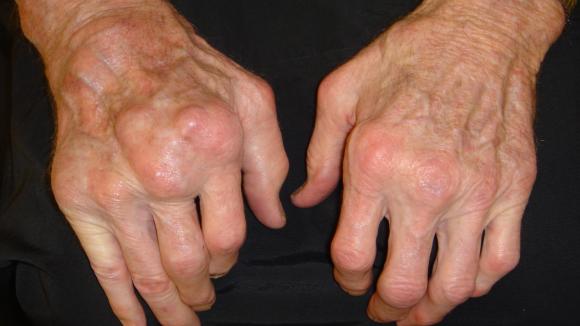
Based on clinical trial data, patients starting tumour necrosis factor-alpha inhibitors (TNFi) have roughly a two-thirds chance of achieiving a good clinical response. French investigators have studied a series of potential biomarkers and surmised that the combination of baseline prealbumin, platelet factor 4 and S100A12 can predict a 78% response to TNFi in rheumatoid arthritis (RA) patients.
All News
The progress that has been seen in the management of many aspects of rheumatoid arthritis (RA) has not been paralleled for the pulmonary disease that remains the second most common cause of death among these patients, an Australian expert reported here at the annual meeting of the Florida Society
Ambien (zolpidem) is the most widely used prescription hypnotic sedative since its introduction in 1992 and is currently the fourth most frequently prescribed psychiatric drug (2013). Recent US Food and Drug Administration Drug Safety Communications suggest limitations on use to reduce adverse effects. A study of the Medical Expenditures Survey in 2015 revealed that over 3.8 million adults reported using one or more prescriptions for zolpidem.
Gout may be an ancient disease, with arthritis of the big toe having been described in Egypt in 2,600 BC, but only now are the underlying pathophysiologic events being elucidated and understood.
Musculoskeletal ultrasound (US) has become a more widely used tool in rheumatology clinical practice. This study of early inflammatory arthritis patients shows that US-defined digit flexor tenosynovitis was more predictive of subsequent rheumatoid arthritis than findings of ACPA positivity or US-defined joint synovitis.
On July 12th the Centers for Medicare & Medicaid Services (CMS) released its proposed rule changes for the 2019 Medicare physician fee schedule. This year, CMS has combined the Medicare physician fee schedule proposed rule with recommendations for the Quality Payment Program (QPP), whic
New research from a UK study suggests that nonresponse to oral or subcutaneous MTX was seen in 43% and is predicted by seronegativity, higher disease activity measures and higher anxiety scores.
Dr. Jack Cush reviews the news and journal articles from the past week on RheumNow.com. Fateful outcomes in Rheumatology, what happens to Seronegatives, IL-23 fails, MRI progression, Not all inflammatory back pain becomes SpA:
A Finnish Rheumatology Center followed 435 early, seronegative rheumatoid arthritis (RA) patients for 10-years and found that only 3% became erosive or seropositive RA.
A study from the British Society for Rheumatology Biologics Register (BSRBR) has shown that biologic refractory disease is seen in at least 6% of patients who have ever received a biologic DMARD (bDMARDs).
An observational case-control study has shown that psoriasis is associated with an increased prevalence of nonalcoholic fatty liver disease (NAFLD).
A study of the IL-23 risankizumab in active ankylosing spondylitis (AS) patients failed to show efficacy and did not meet primary efficacy endpoints in a 6-month trial.
A recent metanalysis suggests that obesity, hypertension and diuretic use are associated with a two-fold increased risk of incident gout.
From a potential of 9923 articles, researchers analyzed 11 studies with data suitable for the meta-analysis.
Hydroxychloroquine retinopathy prevention guidelines have revised from ideal body weight-based dosing to actual body weight-based dosing; the question remains whether these have been adopted in clinical practice.
A database of nearly 21,000 new HCQ users from a UK general population database studied HCQ dosing and use between 2007 and 2016. Specifically they examined whether users were subjected to excess HCQ dosing per ophthalmology guidelines (defined by exceeding 6.5 mg/kg of IBW and 5.0 mg/kg of ABW).
A French population based study of ankylosing spondylitis (AS) was report in the Journal of Rheumatology.
They analyzed the death certificates and cause of death in 2940 AS patients over 3 different decades (1969-78; 1979-99; 2000-2009).
The Annals of Internal Medicine reports that despite improving trends in mortality, death rates from systematic lupus erythematosus (lupus) remain high compared to those in the general population, and disparities persist between subpopulations and geographic regions. Underreporting of lupus on death certificates may have resulted in underestimates of mortality rates.
Pisetsky and colleagues have reported in the Annals of Rheumatic Disease that ANA tests done on established SLE patients may yield surprisingly disparate results.
While ANA negative lupus was a problem of old assays and the loss of ANA positivity may be seen with chronicity or age, most rheumatologists believe that ANA positivity is an absolute requirement for the diagnosis of systemic lupus erythematosus.
Dr. Jack Cush reviews selected news and journal reports from the past week on RheumNow.com.
Eli Lilly announced today the results of the COAST-W trial showing that ixekizumab (Taltz) was effective in a Phase 3 study Ankylosing Spondylitis (AS) patients who had an inadequate response or intolerance to tumor necrosis factor (TNFi) inhibitor therapy.