


Obesity and Gout: An Old Relationship with New Thoughts Save


The close relationship between obesity and gout has been known for a long time. Benjamin Franklin had his first gout attack in 1780. He had a body mass index (BMI) of 32.5 (>30 defines obesity) and then wrote the “Dialogue Between Franklin and the Gout.” Here he commented on his thoughts about the risk factors for gout referring to himself asking “what have I done to merit these sufferings?” He described himself: “you have ate and drank too freely”, “you eat and drink an inordinate breakfast….immediately afterwards you sit down to write at your desk….thus, time passes without any kind of bodily exercise”, you are a “glutton and a tippler.”
Two hundred years later, in 1988 in his Banting lecture for the American Diabetes Association, Gerald Reaven, a famous Stanford Endocrinologist who studied insulin resistance, described the metabolic syndrome. His description included an increased waist circumference, glucose intolerance, high triglycerides with low high density lipoprotein cholesterol, hypertension and elevated uric acid. He observed that hyperinsulinemia could reduce renal excretion of uric acid, increasing serum uric acid levels. Indeed, insulin sensitizing interventions such as low energy diet and glitazones have been shown to decrease serum uric acid.
However, in 1998 the World Health Organization’s definition of the metabolic syndrome did not include hyperuricemia. The syndrome has now evolved to include metabolic associated fatty liver disease (MAFLD) and renal dysfunction. 53% of patients with gout are obese; each 1 unit increase in BMI, correlates with an 8% higher risk of hyperuricemia and a 5% higher risk of gout (Mao, Diabetol Metab Syndr, 2024). Moreover, hyperuricemia predicts the development of obesity, type 2 diabetes, hypertension, and atherosclerosis. A study from the National Health and Nutrition Examination Survey (NHANES) investigated the prognostic value of incorporating hyperuricemia into the definition of metabolic syndrome. Among more than 36,000 participants, inclusion of hyperuricemia in the metabolic syndrome criteria could identify a larger proportion of individuals at metabolic risk (4.2% or ~150 people), thereby facilitating early management to prevent long-term adverse events (Zhang, BMC Cardiovascular Disorders, 2025).
One potential issue is the obesity paradox: although obesity is strongly associated with incident gout risk and is the strongest modifiable risk factor for gout, its association with recurrent gout attacks is weak.
However, a later analysis of the Multiple Risk Factor Intervention Trial (MRFIT) included nearly 12,000 individuals without gout, in which 21% were normal BMI, 53% were overweight, and 23% were obese followed for 7 years. 408 developed incident gout and 132 developed recurrent attacks; baseline obesity was associated with a 2.6 odds ratio (OR) of increased risk of incident gout, but not with recurrent gout. Compared with those whose BMI was stable, those whose BMI decreased by >5% had a 40% decreased risk of recurrent gout, while those whose BMI increased by >5% had a 60% increased risk of recurrent gout (Nguyen, Arthritis Care and Research, 2017). These results were consistent with previous reports that substantial weight loss with either bariatric surgery or diet was associated with lowering of serum uric acid levels. Moreover, obesity reduces the efficacy of urate-lowering therapies in patients with gout.
These observations have led to the suggestion that weight loss should be an important component in the management of gout in patients with overweight or obesity. Low calorie and low-purine diets are associated with significant reductions in serum uric acid and lower risk of gout flares. Increased consumption of vegetables, dairy products, and foods rich in omega-3 polyunsaturated fatty acids can lead to better metabolic profiles and reduced gout attack recurrence. Bariatric surgery is associated with a transient increase in serum uric acid levels and a rise in gout attacks in the immediate post-op period, possibly due to the post-op catabolic state, followed by a sustained decrease in serum uric acid after 3 months (Yeo, Obes Rev, 2019). 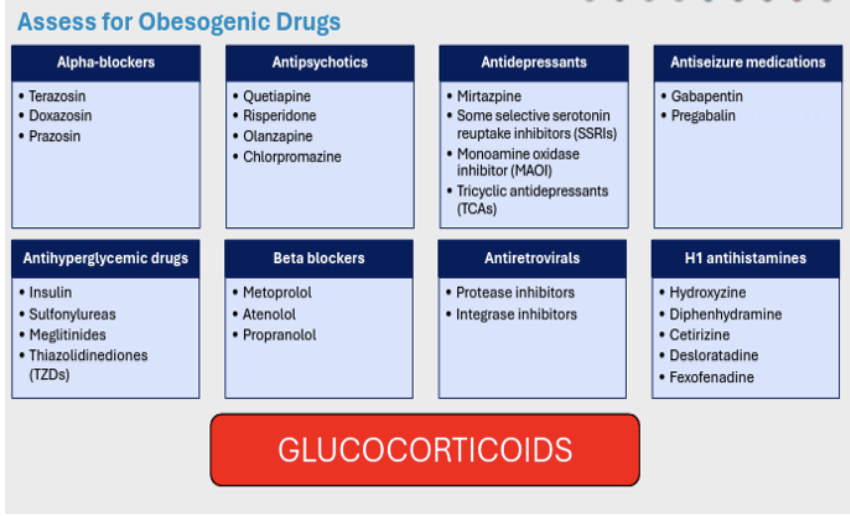
More than ever before, obesity is modifiable. It is important to identify risk factors for obesity. Is the patient postmenopausal or does she have polycystic ovarian disease (now called Polyendocrine Metabolic Ovarian Syndrome, PMOS, which affects 1 in 8 women worldwide)? There are a large number of drugs that are obesogenic; if possible, switch to alternatives that do not increase appetite or cause weight gain. Glucocorticoids are a common offender, as are anti-depressants and insulin. Nutritional knowledge can empower patients to avoid weight gain and promote weight loss; part of any weight loss journey should include nutrition education. Calorie deficit, while maintaining good nutritional intake, is critical. Physical activity to increase calorie deficit and, importantly, to prevent loss of muscle mass with weight loss is also critical.
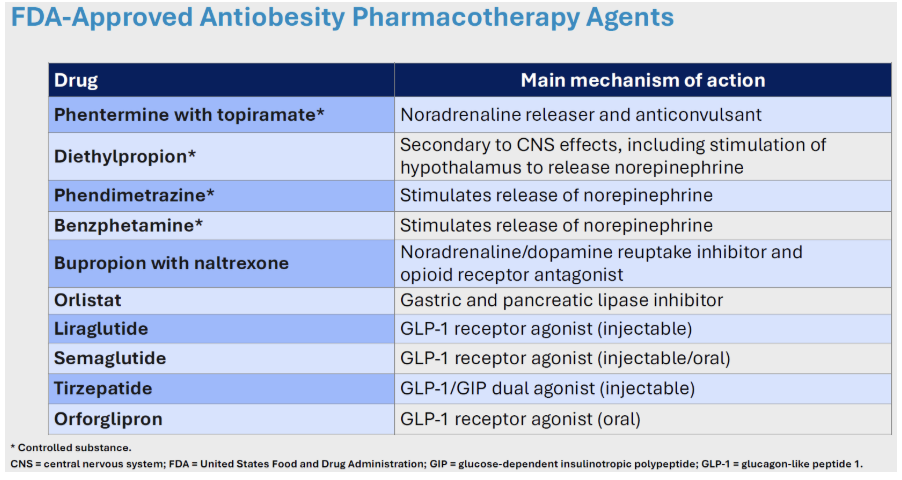
Patients often have food noise, cravings, and stress that make it difficult to enter and maintain calorie deficit. Now we have powerful drugs to aid in weight loss that can overcome these deterrents.
Before glucagon like-1 receptor agonists (GLP-1s), the most powerful anti-obesogenic agent was the phentermine/topiramate combination which suppresses appetite and burns fat. This combination is particularly useful in people who are “slow-burners”, ie have difficult weight loss despite maintaining an appropriately low caloric intake, often seen in PMOS. At its maximum dose the phentermine/topiramate pill is associated with ~10% loss in body weight. An early GLP-1 injectable, liraglutide decreases body weight by ~6% at its highest dose. Today the new GLP-1s are game changers. Semaglutide injection induces a 19% decrease in body weight at its highest dose of 7.2 mg, and tirzepetide injection, a single molecule that activates both the GLP-1 and the gastric inhibitory peptide (GIP) receptors, can decrease body weight by ~22% at its highest dose of 15 mg. Semaglutide is also available in pill form. Orforglipron is another GLP-1 available in pill form which decreases weight by ~11% at its highest dose of 36 mg. Unlike the semaglutide pill, which must be taken 1st thing in the morning on an empty stomach with 4 ounces or less of water, orforglipron can be taken with food. Patients with diabetes lose less weight than those without diabetes, but GLP-1 increases insulin and decreases glucagon in a glucose-dependent manner to improve blood glucose without hypoglycemia. There are extensive GLP-1 receptors in the brain that suppress appetite and cravings and potentially decrease addictions to alcohol, drugs, and smoking. They also appear to mediate anti-inflammatory effects of GLP-1s that may be helpful in psoriatic and other forms of arthritis. GLP-1s also slows gastric emptying through receptors in the GI tract, so patients feel full longer.
Most of the side effects of GLP-1 are gastrointestinal including nausea, vomiting, constipation, diarrhea, heartburn, and abdominal pain. General effects of any method of weight loss include muscle loss, hair thinning, cold intolerance, dizziness, menstrual shifts, and loose skin. Too rapid a weight loss increases the risk for a gout attack, development of a gall stone, and loss of essential vitamins and minerals. Breakdown of fat tissue can increase purines, thus, increasing uric acid and the potential for an acute gout attack. Dehydration from decreased oral intake can concentrate uric acid and further provoke an attack. Therefore, it would be important to ensure that urate lowering therapy is used in patients with a tendency for gout attacks at the start of GLP-1 treatment. However, long term GLP-1 receptor agonist use is associated with a modest reduction in serum uric acid and an overall lower risk of developing gout.
For example, in SURMOUUNT 1, a randomized placebo-controlled study involving 2539 participants, treatment with tirzepatide was associated with significant dose-dependent reductions in serum uric acid levels compared with placebo (Sattar, Ann Rheum Dis, 2026). At week 72, mean changes in serum uric acid were 0.69 mg/dL, 0.92 mg/dL, and 0.95 mg/dL in the 5 mg, 10 mg, and 15 mg treatment groups, respectively (all P <0.001), compared with 0.18 mg/dL in the placebo group. Importantly, mediation analyses suggested that 73% of the reduction in serum uric acid was explained by weight loss. Preclinical evidence suggests that GLP-1RAs may enhance renal urate excretion through natriuretic and diuretic effects, partly mediated by inhibition of the sodium–hydrogen exchanger type 3 in the proximal renal tubule, leading to increased urinary pH and urate clearance (Carraro-Lacroix, Am J Physiol Ren Physiol, 2009).
Current recommendations are that obesity management is an integral component of gout treatment and that, in parallel, gout awareness is an important component in the treatment of the metabolic syndrome. Future studies investigating the impact of GLP-1s in lowering uric acid and decreasing recurrent gout attacks will help to determine whether this specific approach should be recommended for weight loss in obese patients with high serum uric acid and gout.
Related Content







If you are a health practitioner, you may Login/Register to comment.
Due to the nature of these comment forums, only health practitioners are allowed to comment at this time.