

Hydroxychloroquine: 5 mg/kg/day Is Only the Starting Point Save
Hydroxychloroquine (HCQ) is one of the most important drugs in rheumatology, especially for systemic lupus erythematosus (SLE). It reduces flares, organ damage, cardiovascular events, and pregnancy complications, and it improves survival. Yet many clinicians still prescribe HCQ as if body weight reliably predicts drug exposure. It does not.
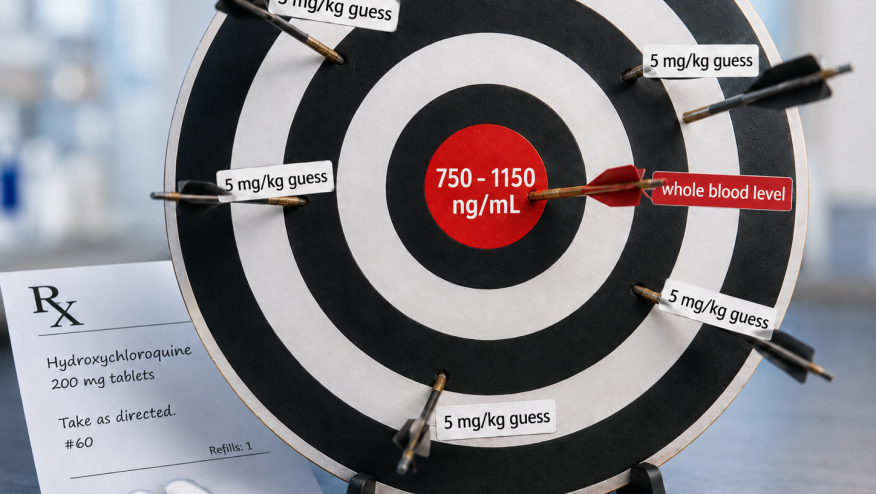
The American Academy of Ophthalmology recommends HCQ dosing at ≤5 mg/kg/day based on actual body weight to reduce the risk of retinopathy. This is a reasonable starting point, but it is not precision medicine. Weight-based dosing cannot tell us who is underexposed, overexposed, or not taking the medication consistently. For a drug as important as HCQ, weight-based dosing is no longer good enough.
Body Weight Does Not Equal Drug Exposure
The problem is simple: body weight does not tell us how much HCQ a patient absorbs, distributes, clears, or stores in tissues.
The Plaquenil package insert states that HCQ absorption ranges from 30% to 100%. Formal pharmacokinetic studies confirm wide absorption rates ranging from 61% to 87%. Two patients of the same weight may take the same 400 mg dose, yet one may absorb only a fraction of the dose while the other absorbs nearly all of it. Treating them identically because they weigh the same makes little pharmacologic sense.
Other factors also influence HCQ exposure, including renal clearance, body composition, malabsorption, pediatric physiology, tissue binding, intracellular accumulation, drug interactions, and adherence. Weight-based dosing cannot reliably account for these.
Whole Blood HCQ Levels Offer a Better Strategy
Therapeutic drug monitoring is the recommended strategy by drug metabolism experts when a medication, such as HCQ, exhibits wide pharmacokinetic variability. Whole-blood HCQ levels tell us what we need to know: how much drug the patient is exposed to. They help identify patients who are underdosed, overdosed, or taking HCQ inconsistently.
The emerging practical whole-blood HCQ target is approximately 750–1150 ng/mL. This range is not perfect, and more research is needed, but it is currently the most useful guide. Levels below 750 ng/mL are associated with higher SLE activity, flares, and hospitalizations. Levels above approximately 1150 ng/mL appear to provide little additional disease-control benefit while increasing toxicity risk, especially retinopathy.
While we usually aim for 750–1150 ng/mL, for patients with difficult-to-control SLE, we often aim for 1000–1150 ng/mL, as several studies suggest better protection against flares and thrombosis at higher therapeutic levels.
Practical HCQ Drug-Level Guide | Suggested Approach |
|---|---|
Whole-blood HCQ goal | 750–1150 ng/mL |
Hard-to-control SLE | Consider 1000–1150 ng/mL |
Level >1150 ng/mL | Assess drug interactions, kidney function; ensure HCQ was taken after labs; if persistently high, then consider a lower dose |
Level <750 ng/mL | Assess adherence barriers, drug interactions; if persistently low, then consider a higher dose with close monitoring |
Very low level, especially <200 ng/mL | Start a supportive adherence conversation by reviewing barriers and systematically addressing them |
Timing of blood levels draw (relative to last dose) | Have patients take HCQ at night to ensure accurate morning/afternoon levels |
After dose adjustment | Repeat level in 1–3 months |
Early loading option | Consider 600 mg/day during the first few months when appropriate |
CPT code | 80220 |
Correct assay | Ensure order & result specify whole blood/WB (not serum/plasma) |
Labs offering WB HCQ levels | LabCorp, Quest, ARUP Laboratories, NMS Labs, Exagen, Mayo Clinic, and other academic labs |
A Practical Dosing Approach
When starting HCQ in appropriate patients, one option is to cautiously use 600 mg daily, unless patient-specific risk factors (such as lower kidney function, GI intolerance) make that unwise. The Plaquenil label includes an initial rheumatoid arthritis dose of 400–600 mg daily, and clinically, this is a reasonable framework when used carefully.
We do this because HCQ works slowly. Loading strategies can accelerate the onset of action, which is helpful in active disease. After 1–3 months, we usually transition toward approximately 5 mg/kg/day and then adjust based on whole-blood HCQ level, disease activity, and tolerance.
If the level is low, first ask whether the result makes clinical sense. Was the patient taking the medication? Is there malabsorption, obesity, renal function fluctuations, drug interactions, or an overly complex schedule? Consider discussing with the patient and rechecking the levels. If consistently low, then discuss next steps with the patient.
Alternating schedules can be a problem. A 200-400-200-400 mg pattern may work mathematically but can fail practically. A consistent 300 mg daily regimen may be easier. Compounded HCQ suspension may also help select patients.
If the level is high, especially above 1150 - 1200 ng/mL, consider whether the patient took HCQ shortly before the lab draw, whether drug interactions are present, or whether the dose is excessive for that individual. Consider discussing with the patient and rechecking the levels. If still high, then adjust the timing, interacting medications, or HCQ dose accordingly.
Low Levels Should Start a Conversation, Not an Interrogation
Very low HCQ levels, especially below 200 ng/mL, suggest very poor adherence. But the level should never be used punitively. A low level should start a problem-solving conversation.
A useful approach is: “Your level is much lower than expected. This is common, and there are many reasons it can happen. How can I help make this medication easier for you to take?”
That question often reveals cost barriers, side effect fears, misunderstanding, pill burden, refill delays, depression, nausea, or simple forgetfulness. Consider using a team-based approach by involving pharmacists, social workers, and nurses. Drug levels can transform adherence from an accusation into problem-solving.
Early in our HCQ monitoring, several patients with moderate-to-severe SLE activity had very low HCQ levels. We had previously cycled through immunosuppressants and used intermittent moderate- to high-dose steroids during flares. Each patient admitted to taking HCQ inconsistently because they did not believe it helped.
After re-education about HCQ, regular drug-level monitoring, and dose adjustment, these patients became highly adherent, discontinued steroids, and required fewer immunosuppressants. That experience changed our practice.
“Rheumatologists who do not use HCQ drug levels may be missing a major cause of persistent disease activity and exposing some patients to unnecessary prednisone and inappropriate additional immunosuppression.”
Practical Ordering Issues Matter
We measure whole-blood HCQ levels several times yearly. Regular monitoring helps identify subtherapeutic and supratherapeutic exposure, allowing intervention before flares or toxicity occur.
Timing matters. Ideally, levels should be drawn at least 6–8 hours after the last dose. In real life, asking patients to take HCQ at night makes morning or afternoon blood draws easier to interpret.
The commonly used CPT code is 80220. Each laboratory has specific test numbers for whole blood, serum, and plasma, so the order must specify “whole blood” or “WB.” When results return, confirm that they clearly state “whole blood” or “WB.” We have seen laboratories mistakenly perform serum or plasma HCQ testing when whole-blood HCQ testing was ordered. Serum and plasma levels are lower than whole-blood levels. Using the wrong assay can falsely label a patient as nonadherent or underexposed.
What About Long-Term Doses Above 5 mg/kg/day or 400 mg Daily?
The FDA-approved 400 mg daily dose was not established by modern dose-ranging trials, and therapeutic drug monitoring was not available.
Most of our patients remain at or below 5 mg/kg/day and 400 mg/day, but some require higher doses to reach therapeutic whole-blood levels.
One of the authors, Donald Thomas, MD, first encountered this in patients after gastric bypass surgery. Despite confirmed pharmacy fills and adherence, they had uncontrolled disease and subtherapeutic HCQ levels. They required 500–600 mg daily to reach target levels. Their disease improved, and years later, they have maintained therapeutic levels without needing stronger immunosuppression.
This approach requires judgment, shared decision-making, and communication with the ocular specialist. It also requires more research. But we feel more comfortable adjusting HCQ using measured drug exposure than blindly following weight alone.
The reverse is also true: some patients develop supratherapeutic levels despite “appropriate” weight-based dosing. We have observed whole-blood HCQ levels in the 2000–3000 ng/mL range in some patients who were dosed according to weight-based guidelines, necessitating dose reductions. For these patients, drug-level–guided dosing to keep exposure below 1150 ng/mL seems more defensible than continuing blind weight-based dosing.
Eye Screening Still Matters
Drug-level monitoring does not replace retinal screening. Patients still need appropriate ophthalmologic monitoring, especially optical coherence tomography and whole-field fundus autofluorescence. These tests can detect subclinical retinopathy, and vision loss should be rare when patients follow recommended screening. Combining modern eye screening with a goal of keeping whole-blood HCQ levels below approximately 1150 ng/mL should further improve safety.
The Bottom Line
A practical whole-blood HCQ target of 750–1150 ng/mL offers a useful balance between efficacy and safety. In difficult-to-control SLE, levels of 1000–1150 ng/mL may be appropriate, while levels above 1150 ng/mL warrant caution, reassessment, and dose adjustment.
The 5 mg/kg/day rule is a reasonable starting point, but it is an imprecise substitute for measured exposure.
Start thoughtfully, monitor carefully, and adjust deliberately.
HCQ is too useful and too variable in its pharmacokinetics to be dosed solely by body weight.
REFERENCE:
Balevic S, Thomas D, Garg S. Toward Optimal Dosing in Systemic Lupus Erythematosus: The Case for Hydroxychloroquine Blood Level Monitoring. Arthritis Care Res (Hoboken). 2026 Feb 16. doi: 10.1002/acr.80020. Epub ahead of print. PMID: 41693630.
Join The Discussion
Rheumatologists have long known this, and I routinely employ whole blood HCQ testing, and push back against Ophthalmology if they suggest otherwise based upon body weight (the ones I work with, are very reasonable, and accept by whole blood HCQ levels monitoring, and put that in their notes).
Disclosures
Disclosures
The author has no conflicts of interest to disclose related to this subject




If you are a health practitioner, you may Login/Register to comment.
Due to the nature of these comment forums, only health practitioners are allowed to comment at this time.