

QD Clinic: Can RA and Gout Manifest Simultaneously? Save

Dr. Janet Pope presents this QD Clinic.
Case
54 year old man with sero+ RA (strongly +RF and +CCP)
Nodular, erosive, onset when he was 22 years old
Stable on MTX and HCQ for years
Lost his job 10 yrs ago with downsizing factory
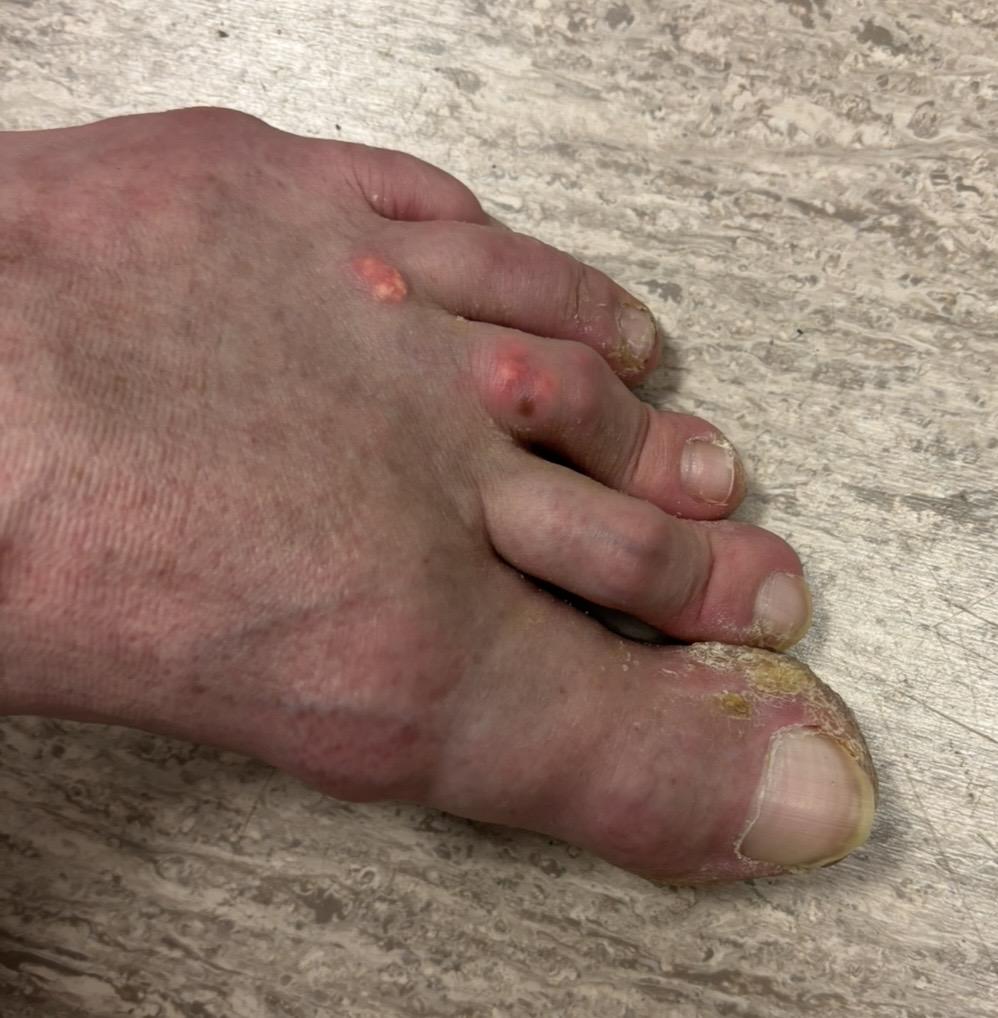
More complaints of Achilles nodules and toe lumps
O/E tophi on a couple of toes, 1st MTP sl chronic swelling
No pink or red joints
See the picture of his foot.
On further questioning, since his job loss he admits to drinking 10 to 12 beers a day.
Uric acid level very high
Questions:
1. Does he have RA?
2. Is beer worse than other ETOH?
3. Is there a negative association between RA and gout?
1. Yes, he has had RA for decades, no previous uric acid on chart but Xrays from many yrs ago showed classic small erosions at ulnar styloid and radial side of R 2nd MCP
F/u Xrays showed no further erosions (yrs ago)
RA stable X decades
I was very concerned about his ETOH use and also about high ETOH and MTX
Pt admitted to very poor compliance with MTX as he has been in remission for yrs.
Recent change in status
Heavy ETOH for a decade
He also has gout
Tophi seen, recent worsening of joints, heavy ETOH for a decade, feet involvement and other joints are great
2. Why is beer worse than other alcohols for gout?
Beer is rich in purines, so consuming beer may worsen gout. Alcohol increases urate levels by reducing renal excretion. Beer and other ETOH can have a diuretic effect and thus more flares after binge drinking and a concomitant purine load.
Is non-alcoholic beer OK if the pt has significant gout?
Not really. Non-alcoholic beer still contains purines from yeast and fermentation, and those purines increase serum uric acid. The sugar in non-alcoholic beer contributes to weight gain, insulin resistance, and metabolic stress that can worsen gout.
ALCOHOL TYPE | PURINE CONTENT | IMPACT ON URIC ACID | RISK FOR GOUT |
BEER | High (yeast-based) | Strong increase | High risk of flare-ups |
WINE | Low | Moderate increase | Moderate risk of flare-ups |
SPIRITS | Low | Moderate increase | Moderate risk of flare-ups |
3. Yes RA and gout can co-exist and it is becoming more frequent
We used to think that RA and gout did not co-exist (except rarely). RA more common in females (less likely to have gout if premenopausal vs men). Less ETOH in people taking MTX.
Why would this be different now? Previously RA onset in women of child bearing age. Now, the population is aging and age of onset of RA is early 50s – postmenopausal women have more gout than premenoupausal, less estrogen use now vs a generation ago. More metabolic syndrome.
Patients increase comorbidities over time with RA and living longer
- HTN v common in RA vs gen pop’n – Rx diurectics
- CHF increased – diuretics
- CAD increased so ASA use (starting ASA may exacerbate gout)
- CKD increased sl in RA – NSAIDs, comorbidities
- ETOH mild became fashionable so more baby boomers consuming ETOH than previous pop’n – including women –but trend may be decreasing
- Metabolic syn with high BMI (2/3 of ERA are overweight, 1/3 obese and 1/3 over wt and not obese) and more DM so more SGLT2i which initially increase gout (they act the way allopurinol does)
- More seroneg RA - ?misclassification (are some of those pts actually having gout)
- PseudoRA (pt has gout ex from diuretics and has polyarticular hand joints involved)
Frequency of gout in RA
RA may be an independent risk factor for the development of gout, with a 2.7-fold higher risk in a nationwide cohort study in South Korea1
Israeli RA cohort where the proportion of patients with gout were increased compared to non-RA controls (1.61% vs. 0.92%)2
We studied a large RA registry to look at frequency of gout in pts with RA and associations (OBRI) 3
3590 RA pts without gout, 113 with RA+gout
More males in gout group (79%F in no gout vs 52%F in gout group)
Older 58yrs vs 66 yrs if gout
More CVD, DM, HTN in gout group, 1.8X more likely to be obese if gout
Some take home messages from our study:
Gout coexists with RA in approximately 3% of a prevalent RA population and is concentrated among patients with traditional gout risk factors.
RA pts with gout have more steroid use (1.7 X more but P=0.07)
Comorbidities associated with gout may adversely affect RA outcomes – but confounding by other diseases and even by flares of gout thought to be from RA
References
- Kang S, Eun Y, Han K, Jung J, Kim H, Lee S, et al. Risk of incident gout in rheumatoid arthritis from a nationwide cohort study in South Korea. Sci Rep 2025;15:26970.
- Merdler-Rabinowicz R, Tiosano S, Comaneshter D, Cohen AD, Amital H. Comorbidity of gout and rheumatoid arthritis in a large population database. Clin Rheumatol 2017;36:657–60.
- Timothy Kwok, et al. Impact of Coexisting Gout on Disease Activity in Rheumatoid Arthritis: Data from the Ontario Best Practices Research Initiative (OBRI). Submitted for publication, 2026
Transcription
Hi, it's Dr. Janet Pope. This is a QD clinic talking about gout. So, this is entitled, can rheumatoid arthritis and gout manifest simultaneously? I hope you like this case and if you do, you can follow me as well at Janet Berdo on X.
So, this is a true case — a 54-year-old man with seropositive RA. In past, he was strongly seropositive and active. He had nodular erosive rheumatoid arthritis onset when he was 22 years old. He was stable on methotrexate and hydroxychloroquine for years as back then we didn't have advanced therapies. However, we will fast forward. So he's 54.
When he was 44, he lost his job. There was downsizing at his factory and he became a bit depressed. He said that he was getting more complaints recently of Achilles nodules and lumps on his toes. On exam he had what appeared to be tophi over some MTPs and on his toes proximally, and his first MTP on one foot was slightly chronically swollen. He denied any pink or red joints and none were pink or red today. Other joints are all excellent. So it was a swollen joint count of one.
So being the detective, I asked what's been going on. So he's had this poor mood. He hasn't been working for 10 years. He admitted to drinking 10 to 12 beers a day for probably the last eight or 10 years. He had a high uric acid level when I ordered it. And we certainly gave a lot of counseling about methotrexate and he did admit to being fairly non-compliant with methotrexate because he had been in remission with RA for years.
So the questions are: does he have RA? Is there a negative association between RA and gout, or is it actually contrary to what we were taught way back when — is it actually an increased association? And is beer worse than other alcohol?
So yes, he had RA for decades. I went back and confirmed his positive serology. I couldn't find old X-rays but we did new X-rays that showed a classic first MTP erosion. Old X-rays were reported but not viewable from years ago as having a small erosion at the styloid and second MCP on the radial side, which would go with RA, and RA was stable for years. So I'm concerned about his alcohol use and abuse and obviously his mood and the use of methotrexate.
So, is this gout? Yes. He's had a recent change in his status — heavy heavy alcohol use and very high uric acid. He has tophi and he's been a heavy drinker. His feet are involved and not other areas.
So, why would beer be causing worse problems? Beer is rich in purines. Consuming beer we know can worsen gout. So can other alcohols. But there is data that basically alcohol from beer is worse for gout, and it might be the yeast, it might be the amount of purine load and the fermentation — it's really hard to know. It's also the sugar content. So I did look it up. Beer has the highest purine content, and in wine and spirits it's low. The impact on uric acid for beer is far stronger than wine or spirits.
So we used to think that rheumatoid arthritis and gout did not coexist, or existed rarely. Why? RA more common in women — back in the day it was women of childbearing years, so premenopausal. Now our population is older and living longer. And also women back in the day drank less alcohol, and in general we advise against alcohol use, or certainly any moderate alcohol use, when people are taking methotrexate.
So what's different now is women are often onset perimenopausal in our early rheumatoid arthritis or CATCH cohort. The mean age of onset is 55. That's the same with the US cohort BRASS, and it's fairly similar in the UK, and in France it's early 50s. So it's a different age distribution. Our patients used to be mostly normal weight. Now the whole population has more metabolic syndrome, and two-thirds of our patients with rheumatoid arthritis in many studies — including our early arthritis study — two-thirds of our patients are overweight. So one-third obese, one-third overweight, one-third normal weight.
The other thing is our patients are getting more comorbid as they live longer. Hypertension is increased in patients with RA — probably two-thirds of RA patients over time will develop hypertension. Our guidelines say use diuretics as first line. There's more heart failure as they get older and more coronary artery disease. Starting aspirin might exacerbate gout, and also if not in steady state, going up and down on the doses. CKD is slightly increased in RA but also increased if using NSAIDs and from the comorbidities. Also, alcohol became fashionable in the baby boomers having their red wine — a drink a day — and it's going down again in usage, but that could increase gout.
The other thing is with metabolic syndrome, there's more SGLT2 use if they have concomitant type 2 diabetes. SGLT2 inhibitors act like allopurinol — they break down purines, so you get more gout before you can get less gout over time. Also maybe there's misclassification because we have more seronegative RA, about 30 to 40%, in many
early RA cohorts, and it can present as pseudo-RA. So what about the frequency of gout in RA? So there are some studies — there's a study out of Korea, a population cohort, and they found that gout was almost three-fold higher in RA than the general population, age and sex matched. Similar from Israel, it was about a double prevalence compared to non-RA patients. So we have a large rheumatoid arthritis registry, the Ontario Best Practice Research Initiative, or OBRI. So almost 3,600 patients, 113 with gout plus RA. And how are they different, the gout plus RA patients? They're more common in men. So women are overall about 79%, whereas it's only 52% women in the gout group. They're older. The gout patients on average in a prevalent cohort were 66 years old. The other RA patients were 58 years old. And not surprisingly, they had more metabolic-type problems — cardiovascular disease, diabetes, hypertension — and they were 1.8 times more likely to be obese.
So what are the take-home messages? Gout can coexist in RA. It's approximately 3% of our prevalent RA population. There's more of the traditional risk factors in those who have gout. And there's a little bit more glucocorticoid use in those who have concomitant gout, and that might be because they have two kinds of inflammatory arthritis instead of one. Address the comorbidities, but think of safe treatments if your patient with RA does have gout.
I hope you enjoyed watching our program on so many topics, including gout this month. Thank you.
So, this is a true case — a 54-year-old man with seropositive RA. In past, he was strongly seropositive and active. He had nodular erosive rheumatoid arthritis onset when he was 22 years old. He was stable on methotrexate and hydroxychloroquine for years as back then we didn't have advanced therapies. However, we will fast forward. So he's 54.
When he was 44, he lost his job. There was downsizing at his factory and he became a bit depressed. He said that he was getting more complaints recently of Achilles nodules and lumps on his toes. On exam he had what appeared to be tophi over some MTPs and on his toes proximally, and his first MTP on one foot was slightly chronically swollen. He denied any pink or red joints and none were pink or red today. Other joints are all excellent. So it was a swollen joint count of one.
So being the detective, I asked what's been going on. So he's had this poor mood. He hasn't been working for 10 years. He admitted to drinking 10 to 12 beers a day for probably the last eight or 10 years. He had a high uric acid level when I ordered it. And we certainly gave a lot of counseling about methotrexate and he did admit to being fairly non-compliant with methotrexate because he had been in remission with RA for years.
So the questions are: does he have RA? Is there a negative association between RA and gout, or is it actually contrary to what we were taught way back when — is it actually an increased association? And is beer worse than other alcohol?
So yes, he had RA for decades. I went back and confirmed his positive serology. I couldn't find old X-rays but we did new X-rays that showed a classic first MTP erosion. Old X-rays were reported but not viewable from years ago as having a small erosion at the styloid and second MCP on the radial side, which would go with RA, and RA was stable for years. So I'm concerned about his alcohol use and abuse and obviously his mood and the use of methotrexate.
So, is this gout? Yes. He's had a recent change in his status — heavy heavy alcohol use and very high uric acid. He has tophi and he's been a heavy drinker. His feet are involved and not other areas.
So, why would beer be causing worse problems? Beer is rich in purines. Consuming beer we know can worsen gout. So can other alcohols. But there is data that basically alcohol from beer is worse for gout, and it might be the yeast, it might be the amount of purine load and the fermentation — it's really hard to know. It's also the sugar content. So I did look it up. Beer has the highest purine content, and in wine and spirits it's low. The impact on uric acid for beer is far stronger than wine or spirits.
So we used to think that rheumatoid arthritis and gout did not coexist, or existed rarely. Why? RA more common in women — back in the day it was women of childbearing years, so premenopausal. Now our population is older and living longer. And also women back in the day drank less alcohol, and in general we advise against alcohol use, or certainly any moderate alcohol use, when people are taking methotrexate.
So what's different now is women are often onset perimenopausal in our early rheumatoid arthritis or CATCH cohort. The mean age of onset is 55. That's the same with the US cohort BRASS, and it's fairly similar in the UK, and in France it's early 50s. So it's a different age distribution. Our patients used to be mostly normal weight. Now the whole population has more metabolic syndrome, and two-thirds of our patients with rheumatoid arthritis in many studies — including our early arthritis study — two-thirds of our patients are overweight. So one-third obese, one-third overweight, one-third normal weight.
The other thing is our patients are getting more comorbid as they live longer. Hypertension is increased in patients with RA — probably two-thirds of RA patients over time will develop hypertension. Our guidelines say use diuretics as first line. There's more heart failure as they get older and more coronary artery disease. Starting aspirin might exacerbate gout, and also if not in steady state, going up and down on the doses. CKD is slightly increased in RA but also increased if using NSAIDs and from the comorbidities. Also, alcohol became fashionable in the baby boomers having their red wine — a drink a day — and it's going down again in usage, but that could increase gout.
The other thing is with metabolic syndrome, there's more SGLT2 use if they have concomitant type 2 diabetes. SGLT2 inhibitors act like allopurinol — they break down purines, so you get more gout before you can get less gout over time. Also maybe there's misclassification because we have more seronegative RA, about 30 to 40%, in many
early RA cohorts, and it can present as pseudo-RA. So what about the frequency of gout in RA? So there are some studies — there's a study out of Korea, a population cohort, and they found that gout was almost three-fold higher in RA than the general population, age and sex matched. Similar from Israel, it was about a double prevalence compared to non-RA patients. So we have a large rheumatoid arthritis registry, the Ontario Best Practice Research Initiative, or OBRI. So almost 3,600 patients, 113 with gout plus RA. And how are they different, the gout plus RA patients? They're more common in men. So women are overall about 79%, whereas it's only 52% women in the gout group. They're older. The gout patients on average in a prevalent cohort were 66 years old. The other RA patients were 58 years old. And not surprisingly, they had more metabolic-type problems — cardiovascular disease, diabetes, hypertension — and they were 1.8 times more likely to be obese.
So what are the take-home messages? Gout can coexist in RA. It's approximately 3% of our prevalent RA population. There's more of the traditional risk factors in those who have gout. And there's a little bit more glucocorticoid use in those who have concomitant gout, and that might be because they have two kinds of inflammatory arthritis instead of one. Address the comorbidities, but think of safe treatments if your patient with RA does have gout.
I hope you enjoyed watching our program on so many topics, including gout this month. Thank you.





If you are a health practitioner, you may Login/Register to comment.
Due to the nature of these comment forums, only health practitioners are allowed to comment at this time.