


Uric Acid: Is Lower Better? Save
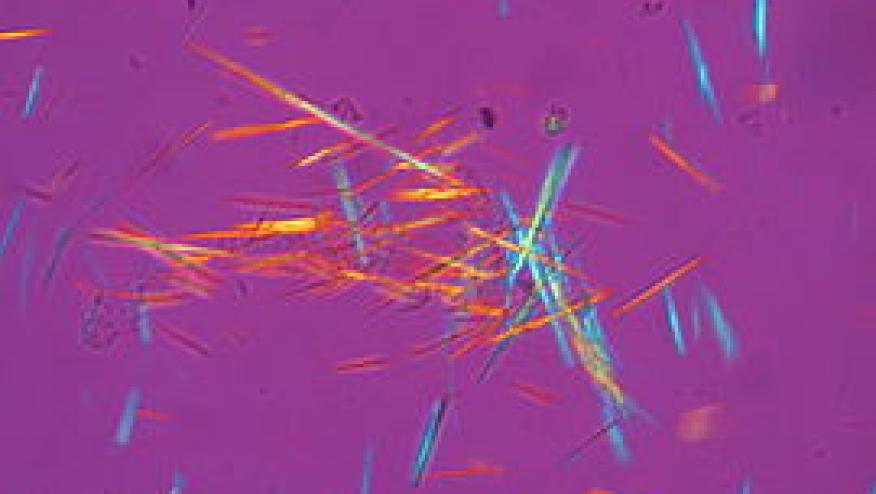
Lowering serum urate and urate crystals in the body is indispensable for long-term management of gout. The pathophysiology is simple and powerful: no urate crystals, no gout flares. However, this simplicity in goal belies a nuanced consideration in management: how low should serum urate be maintained to improve outcomes for our patients with gout? There is good evidence that a serum urate less than 6 mg/dL is required to meaningfully reduce urate crystal and gout flare burden, but is even lower better and are there any tradeoffs?
Multiple guidelines suggest that patients with tophi or more severe gout may benefit from a lower serum urate goal of <5 mg/dL. If indicated, this is a realistic goal with appropriate dose titration of allopurinol or febuxostat for nearly all patients. We know that a lower serum urate hastens urate crystal dissolution. Trial-level evidence to support a specific lower goal is limited, however. One trial comparing an intensive goal of <3.4 mg/dL to a goal of <5 mg/dL showed no difference in clinically important outcomes (bony erosions, gout flares, tophi, quality of life) over 2 years despite greater crystal dissolution as measured by dual-energy CT. Similarly, in trials of pegloticase plus methotrexate, during which many patients with gout have an undetectable serum urate (<1.5 mg/dL), less than half of the patients with tophi had complete resolution of the tophus at 6-12 months. Overall, while targeting a lower serum urate leads to more significant crystal dissolution, evidence thus far suggests that clinical benefits may take time, and are not clearly observed in short-term studies.
A common question from patients and doctors alike is whether there are any additional benefits from intensive urate lowering.
Patients with gout and hyperuricemia are more likely to have adverse cardiovascular events and premature mortality, but this may be related to gout-associated comorbidities rather than a direct effect of uric acid. To date, there has been little convincing evidence that lowering urate reduces cardiovascular risks among patients with gout or heart failure. Multiple well-designed observational studies showed no cardiovascular or mortality benefits to urate lowering among patients with gout, though, each was limited by suboptimal urate lowering observed in practice. Intensive urate lowering is uncommon in real-world practice which further limits our ability to study the full impact of urate lowering on cardiovascular outcomes. While it is likely to remain unclear if intensive urate lowering has cardiovascular benefits, rheumatologists and patients with gout have some encouraging news on the cardiovascular front. For patients with a history of recent myocardial infarction or stable coronary artery disease, daily low dose colchicine is associated with reduced major adverse cardiovascular events. This is especially encouraging for patients with cardiovascular risk factors who may need gout flare prophylaxis. Additionally, rheumatologists can play an important role encouraging the use of medications like sodium-glucose cotransporter-2 inhibitors (SGLT2i) and losartan. If indicated, these medications can improve both cardiovascular and gout outcomes.
Rheumatologists should also be encouraged that intensive urate lowering is unlikely to cause harm. Concerns have been raised about some epidemiologic associations, but thus far these have proven more likely epiphenomena than representative of a causal process involving changing urate levels. For instance, most observational studies that report a lower risk of neurodegenerative diseases among patients with gout and hyperuricemia fail to adequately account for the increased risk of premature mortality among patients with gout. In studies that account for premature mortality, there is limited or no association. Indeed, a randomized trial designed to increase serum uric acid showed no benefit in Parkinson’s disease further emphasizing that pharmacologic interventions to lower uric acid levels are unlikely to cause adverse outcomes including neurologic outcomes.
Overall, there is strong evidence that intensive urate lowering (any level <5 mg/dL) leads to more rapid reduction in urate crystal burden. When accomplished using pegloticase or the start low, go slow dose escalation recommended by major guidelines, there is little evidence of harm related to the urate lowering itself. If tophi or the physical crystal burden is directly causing patient discomfort or harm, rheumatologists should be confident that a lower uric acid will more rapidly reduce the urate crystal burden without notable harms. Intensive urate-lowering to reduce non-articular risks such as reducing the risks of cardiovascular disease is probably not appropriate, though recent studies suggest that the use of colchicine prophylaxis, SGLTis, or losartan may have dual benefits.
References for Further Reading
- Dalbeth N, Doyle AJ, Billington K, et al. Intensive serum urate lowering with oral urate‐lowering therapy for erosive gout: a randomized double‐blind controlled trial. Arthritis Rheum 2022;74:1059–69.
- Kelly B, Gamble GD, Horne A, et al. Relationship between serum urate and changes in dual-energy CT monosodium urate crystal volume over 1 year in people with gout: an individual participant data analysis. Ann Rheum Dis 2025;84:136–42.
- Botson JK, Saag K, Peterson J, et al. A randomized, Placebo‐Controlled study of methotrexate to increase response rates in patients with uncontrolled gout receiving pegloticase: primary efficacy and safety findings. Arthritis Rheum 2023;75:293–304.
- Wei J, Choi HK, Dalbeth N, et al. Gout flares and mortality after sodium-glucose cotransporter-2 inhibitor treatment for gout and type 2 diabetes. JAMA Netw Open 2023;6:e2330885.
ADD THE FIRST COMMENT
Disclosures
Disclosures
The author has received research/grant financial support on this subject





If you are a health practitioner, you may Login/Register to comment.
Due to the nature of these comment forums, only health practitioners are allowed to comment at this time.