

QD Clinic: Pegloticase Immunomodulation: What’s on the Menu? Save

Daric Mueller, PA-C, discusses a gout case.
Transcription
Hi there and welcome to RheumNow Gout QD Clinic. My name is Derek Mueller PA from St. Clair Shores, Michigan and my case today is titled Pegloticase Immunomodulation. What's on the menu?
So the patient I saw recently, a 64-year-old black male with a past medical history of end-stage renal disease secondary to hypertension and diabetes, presented for management of uncontrolled gout. So this patient had typical episodes of acute gout for the last 20 years involving his MTP joints initially with progressive ascension into his ankles, his knees, his wrists and elbows throughout the subsequent years. The patient had a remote history of treatment with allopurinol, was previously treated with prednisone and colchicine as needed for flares.
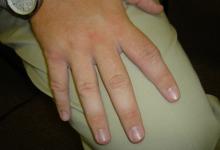
At the initial visit when I saw this gentleman he was on the combination of colchicine and probenecid — the Col-Benemid combination pill — it's 500 milligrams of probenecid and 0.5 milligrams of colchicine. He was on this medication daily by an outside center despite his current GFR being at 15. When I examined this man he had marble-sized tophi all over the place involving his toes, ankles, elbows and wrists, and he had reported for the past few years about three to four flares on average. His baseline serum uric acid at the time of the initial visit was 11.4 milligrams per deciliter.
So very uncontrolled gout in this patient, and to throw a wrench in it too — the end-stage renal disease — his nephrologist was also talking about starting dialysis in the very recent future. So there was already a surgery date for his fistula creation. We deemed it necessary that this patient was a candidate for uricase therapy and of course the addition of immunomodulation would be the best chance of success for this patient to control his gout and sustain a serum uric acid level of less than six.
So in this case we're thinking what's the next best step with his end-stage renal disease and plan for dialysis. This may narrow our options for immunomodulation.
With that being said, let's go ahead and quickly review the options that we have on the table. It's certainly apparent that immunomodulation drastically increases the success of uricase therapy. Our biggest evidence basis for this is with the use of methotrexate, and specifically the more recent MIRROR trial that included a comparison of patients treated with pegloticase plus 15 milligrams of methotrexate weekly versus pegloticase alone without methotrexate. The dose utilized in this trial was 15 milligrams of methotrexate with a run-in of about 4 weeks prior to first infusion. That was a trial of 152 patients and the primary outcome was a six-month responder rate — so serum uric acid of less than six at 80% of visits throughout six months — and that responder rate was 71% in the methotrexate and pegloticase treatment arm versus 39% on pegloticase alone.
One thing of note was that in the MIRROR trial patients with an eGFR of less than 40 were excluded from the trial. However, some analyses have shown in that trial that there were similar responder rates in those with mild CKD, so between 40 and 60.
In this case methotrexate is really not an option for our patient with end-stage renal disease and that plan for dialysis. Given the significant risk of toxicity with methotrexate, that's a no-go here.
So what else is on the menu? Mycophenolate mofetil. This is another potentially useful option that we do have some data for to improve the success of uricase therapy. This is based on a smaller trial, the RECIPE trial, and this was published back in 2021. Small trial of about 32 patients — one group treated with pegloticase and MMF 1,000 milligrams twice a day with a two-week run-in prior to infusion number one, versus monotherapy with pegloticase. The end point was the persistent achievement of serum uric acid of less than 6 milligrams per deciliter at the 12-week point — that was 86% achieved in the MMF arm versus 40% no MMF — and then at the 24-week end point this was 68% in the MMF arm and 30% in the pegloticase alone.
Other options — azathioprine — the data for this is very weak; only small case studies suggest its efficacy as an immunomodulating agent.
And then the last option on the menu here that I want to bring attention to is leflunomide. There are also small case reports suggesting that this is an effective immunomodulator. One of the key benefits of leflunomide as an immunomodulator is that this is a medication that is not necessarily heavily renally metabolized. This medication also does have a very long half-life. The active metabolite of leflunomide is teriflunomide, and this has an 18 to 19 day half-life — quite impressive — and I know that patient compliance is sometimes an issue. This is also a patient who is on a plethora of other drugs for
controlling his diabetes and hypertension and manifestations of end-stage renal disease. So a single dose pill that if potentially missed a few doses could confer a very substantial advantage if we're trying to maximize the effectiveness of uricase therapy.
So some cons — there is some concern that because leflunomide does have uricosuric properties that this may impact the monitoring of serum uric acid on pegloticase treatment. We really don't know the magnitude of the uricosuric effect of leflunomide. This could potentially be mitigated by having a run-in period of leflunomide prior to treatment, seeing where that serum uric acid lies after a month of treatment so we have an understanding of the magnitude of that decrease while we are monitoring patients moving forward.
So in this case the patient ended up starting on hemodialysis and in the meantime he was treated with — we had a plan to institute leflunomide as an immunomodulating agent. So we started leflunomide at 20 milligrams once a day. The serum uric acid was then checked a few weeks later. There was not a significant change in his serum uric acid. He then successfully went on to receive a total of 14 pegloticase infusions with an undetectable serum uric acid less than 1.0 milligrams per deciliter at every single infusion.
And essentially he had some mobilization flares from the get-go as one would expect. These were managed with intraarticular steroids and at one point a single dose of canakinumab. This patient was deemed a success after 14 infusions with great control of his flares and the resolution of his tophus burden. The patient was later transitioned from this combination to allopurinol, which was titrated to a goal of maintaining his serum uric acid at less than six.
So this was a big-time success. Maybe not a very conventional approach, but in this case the importance was to maximize this therapy. And although methotrexate remains the most evidence-based option, the patient's past medical history and comorbidities were such that we needed to think outside the box. So yes, MMF does have the second largest basis of evidence for immunomodulation, but this patient had a very large pill burden and for compliance reasons we had considered another option, which in this case was leflunomide — not as evidence-based, but I think that there are mechanistic advantages and compliance advantages to using leflunomide, and this is something that our clinic does have more experience with and hopefully something that can be replicated in formal trials moving forward.
So that's my case. Thank you so much for listening and tune in to RheumNow.com for more gout content just like this.
So the patient I saw recently, a 64-year-old black male with a past medical history of end-stage renal disease secondary to hypertension and diabetes, presented for management of uncontrolled gout. So this patient had typical episodes of acute gout for the last 20 years involving his MTP joints initially with progressive ascension into his ankles, his knees, his wrists and elbows throughout the subsequent years. The patient had a remote history of treatment with allopurinol, was previously treated with prednisone and colchicine as needed for flares.
At the initial visit when I saw this gentleman he was on the combination of colchicine and probenecid — the Col-Benemid combination pill — it's 500 milligrams of probenecid and 0.5 milligrams of colchicine. He was on this medication daily by an outside center despite his current GFR being at 15. When I examined this man he had marble-sized tophi all over the place involving his toes, ankles, elbows and wrists, and he had reported for the past few years about three to four flares on average. His baseline serum uric acid at the time of the initial visit was 11.4 milligrams per deciliter.
So very uncontrolled gout in this patient, and to throw a wrench in it too — the end-stage renal disease — his nephrologist was also talking about starting dialysis in the very recent future. So there was already a surgery date for his fistula creation. We deemed it necessary that this patient was a candidate for uricase therapy and of course the addition of immunomodulation would be the best chance of success for this patient to control his gout and sustain a serum uric acid level of less than six.
So in this case we're thinking what's the next best step with his end-stage renal disease and plan for dialysis. This may narrow our options for immunomodulation.
With that being said, let's go ahead and quickly review the options that we have on the table. It's certainly apparent that immunomodulation drastically increases the success of uricase therapy. Our biggest evidence basis for this is with the use of methotrexate, and specifically the more recent MIRROR trial that included a comparison of patients treated with pegloticase plus 15 milligrams of methotrexate weekly versus pegloticase alone without methotrexate. The dose utilized in this trial was 15 milligrams of methotrexate with a run-in of about 4 weeks prior to first infusion. That was a trial of 152 patients and the primary outcome was a six-month responder rate — so serum uric acid of less than six at 80% of visits throughout six months — and that responder rate was 71% in the methotrexate and pegloticase treatment arm versus 39% on pegloticase alone.
One thing of note was that in the MIRROR trial patients with an eGFR of less than 40 were excluded from the trial. However, some analyses have shown in that trial that there were similar responder rates in those with mild CKD, so between 40 and 60.
In this case methotrexate is really not an option for our patient with end-stage renal disease and that plan for dialysis. Given the significant risk of toxicity with methotrexate, that's a no-go here.
So what else is on the menu? Mycophenolate mofetil. This is another potentially useful option that we do have some data for to improve the success of uricase therapy. This is based on a smaller trial, the RECIPE trial, and this was published back in 2021. Small trial of about 32 patients — one group treated with pegloticase and MMF 1,000 milligrams twice a day with a two-week run-in prior to infusion number one, versus monotherapy with pegloticase. The end point was the persistent achievement of serum uric acid of less than 6 milligrams per deciliter at the 12-week point — that was 86% achieved in the MMF arm versus 40% no MMF — and then at the 24-week end point this was 68% in the MMF arm and 30% in the pegloticase alone.
Other options — azathioprine — the data for this is very weak; only small case studies suggest its efficacy as an immunomodulating agent.
And then the last option on the menu here that I want to bring attention to is leflunomide. There are also small case reports suggesting that this is an effective immunomodulator. One of the key benefits of leflunomide as an immunomodulator is that this is a medication that is not necessarily heavily renally metabolized. This medication also does have a very long half-life. The active metabolite of leflunomide is teriflunomide, and this has an 18 to 19 day half-life — quite impressive — and I know that patient compliance is sometimes an issue. This is also a patient who is on a plethora of other drugs for
controlling his diabetes and hypertension and manifestations of end-stage renal disease. So a single dose pill that if potentially missed a few doses could confer a very substantial advantage if we're trying to maximize the effectiveness of uricase therapy.
So some cons — there is some concern that because leflunomide does have uricosuric properties that this may impact the monitoring of serum uric acid on pegloticase treatment. We really don't know the magnitude of the uricosuric effect of leflunomide. This could potentially be mitigated by having a run-in period of leflunomide prior to treatment, seeing where that serum uric acid lies after a month of treatment so we have an understanding of the magnitude of that decrease while we are monitoring patients moving forward.
So in this case the patient ended up starting on hemodialysis and in the meantime he was treated with — we had a plan to institute leflunomide as an immunomodulating agent. So we started leflunomide at 20 milligrams once a day. The serum uric acid was then checked a few weeks later. There was not a significant change in his serum uric acid. He then successfully went on to receive a total of 14 pegloticase infusions with an undetectable serum uric acid less than 1.0 milligrams per deciliter at every single infusion.
And essentially he had some mobilization flares from the get-go as one would expect. These were managed with intraarticular steroids and at one point a single dose of canakinumab. This patient was deemed a success after 14 infusions with great control of his flares and the resolution of his tophus burden. The patient was later transitioned from this combination to allopurinol, which was titrated to a goal of maintaining his serum uric acid at less than six.
So this was a big-time success. Maybe not a very conventional approach, but in this case the importance was to maximize this therapy. And although methotrexate remains the most evidence-based option, the patient's past medical history and comorbidities were such that we needed to think outside the box. So yes, MMF does have the second largest basis of evidence for immunomodulation, but this patient had a very large pill burden and for compliance reasons we had considered another option, which in this case was leflunomide — not as evidence-based, but I think that there are mechanistic advantages and compliance advantages to using leflunomide, and this is something that our clinic does have more experience with and hopefully something that can be replicated in formal trials moving forward.
So that's my case. Thank you so much for listening and tune in to RheumNow.com for more gout content just like this.




If you are a health practitioner, you may Login/Register to comment.
Due to the nature of these comment forums, only health practitioners are allowed to comment at this time.