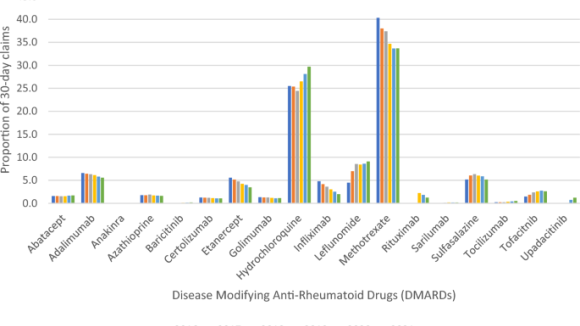
A trend analysis of DMARDs shows that only half of rheumatoid arthritis (RA) patients are taking DMARDs, and that the COVID-19 pandemic substantially affected DMARD use. Despite numerous DMARD advances and evolving treatment guidelines since 1990, older therapies are still commonly used and the latest agents make up a small percentage of overall DMARD use.
All News
Last week we reported on a Korean study showing a 66% elevated mortality risk in RA patients (n=38,487) with depression.
Medscape has published an informative review of leflunomide, drawn from Dr. Eric Ruderman’s recent lecture on the subject at the February RWCS meeting in Maui.
JAMA has reviewed the "2022 EULAR Recommendations for the Management of Rheumatoid Arthritis With Synthetic and Biological Disease-Modifying Antirheumatic Drugs".
Dr. Jack Cush reviews the news, journal reports and regulatory approvals from the past week.
A Korean nationwide cohort study found that both seropositive and seronegative rheumatoid arthritis (RA) patients have a significantly higher risk of depression.
While it is believed that autoimmunity follows autoantibody positivity, a Danish study shows the incidence of polyautoimmunity to be similar in rheumatoid arthritis (RA) patients who are either anticyclic citrullinated peptide antibody (ACPA)–positive or ACPA–negative.
According to the National Health Interview Survey (NHIS), in 2022, the prevalence of diagnosed arthritis in adults was 18.9% (women 21.5%, more than men 16.1%). These numbers are down since the CDC's MMWR report of 2019–2021, where is was estimated 21.2% of U.S.
COVIDs Extended Risk for Rheumatic Disease
Annals of Internal Medicine reports a large, binational study finding SARS-CoV-2 infection was associated with an increased risk for autoimmune inflammatory rheumatic diseases (AIRDs) that extends up to 12 months after infe