Article
Current therapies for rheumatoid arthritis rely on sustained immunosuppression rather than restoration of immune tolerance, with off-drug remission remaining rare.

Search for Terms or Answers
Current therapies for rheumatoid arthritis rely on sustained immunosuppression rather than restoration of immune tolerance, with off-drug remission remaining rare.

Chimeric antigen receptor (CAR) T‑cell therapy, long established in hematologic malignancies, is now emerging as a transformative approach in systemic lupus erythematosus (SLE), a disease historically managed with chronic immunosuppression.

We are in a transformative era in SLE which generates excitement to both physicians and people living with lupus. We now have four licensed biologics/targeted therapies (i.e., belimumab, voclosporin and obinutuzumab for active lupus nephritis, and belimumab and anifrolumab for active non-renal SLE). Moreover, many other agents with different mode of action and administration are in late phase trials. This article previews some data being presented at EULAR 2026 Congress in London.
Pharmaceutical companies are presenting pivotal clinical trial results and key data analyses at the EULAR 2026 Congress (June 3–6, London). Below is a summary of their most important studies — many of which are registration-enabling or will directly shape treatment decisions in rheumatic diseases.


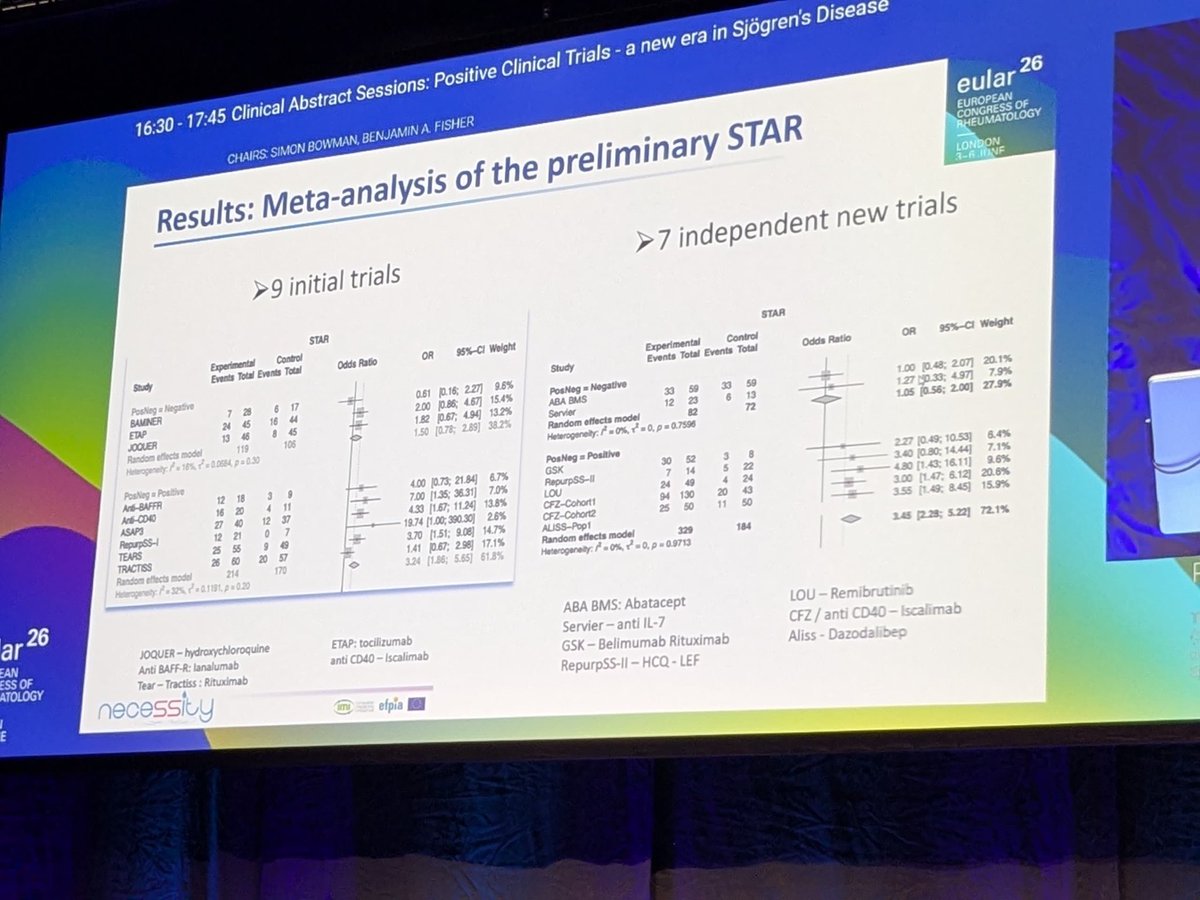


#EULAR2026 OP077 Another promising CAR-T in autoimmunity. In a Phase II study, Rap-Cel autologous CD19 CAR-T (shorter infusion time ~2d & low dose) vs traditional CAR-T showed drug-free improvement in N=6 #IIM & N=6 #SSc patients. Safety similar to other CAR-Ts @RheumNow https://t.co/byNn5X8JGh

#EULAR2026 OP076 Of 50 patients treated with autologous CAR-T, 12% relapsed; median 13 mths. More frequent in #IIM vs #SLE or #SSc. These relapses were significant. Switching to BCMA-CAR or BCMA-TCE restored response. Should BCMA instead of CD19 be targeted initially?@RheumNow https://t.co/lgdsJQm3xY




By downloading this material, I acknowledge that it may be used only for personal use and personal education and that I will accredit RheumNow.com as the source and owner of this material. Commercial use or mass reproduction of this material without permission from RheumNow (info@rheumnow.com) is prohibited.