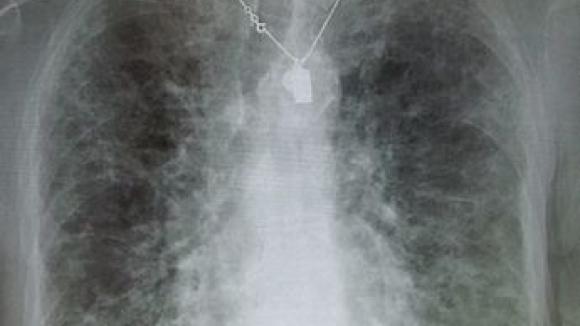
Last Friday, the US Food and Drug Administration approved Ofev (nintedanib) to slow the rate of decline in pulmonary function in adults with interstitial lung disease associated with systemic sclerosis or scleroderma, called SSc-ILD.
ILD as a complication of SSc may lead to progressive loss of lung function and may be associated with a significant mortality risk. Prior to the approval of Olev, there were no FDA approved drugs for SSc-ILD.

All News
An insurance claims based study of RA patients with COPD shows that biologics do not have an increased rate of respiratory events compared to those on conventional DMARDs.
A real world cohort of RA patients with COPD was drawn from US-based MarketScan databases. Patients on biologic DMARDs and/or targeted synthetic DMARDs (tsDMARDs) were propensity matched to those on conventional synthetic DMARDs (csDMARDs).
The ENTRACTE trial examined the risk for major adverse cardiovascular events (MACE) in RA patients and found no increased risk of MACE in patients treated with tocilizumab (TCZ) versus etanercept (ETN).
Vitamin D might not be much help for strengthening bones among healthy adults without osteoporosis, Canadian researchers reported, even at doses far higher than recommended daily allowances.
In a clinical trial assessing three levels of daily vitamin D supplementation -- 400 IU, 4,000 IU, and 10,000 IU -- radial volumetric bone mineral density was significantly lower among those (ages 55-70) taking higher doses for 3 years, according to Steven Boyd, PhD, of the University of Calgary in Canada, and colleagues.
Osteoporosis treatments were not linked with reduced overall mortality, according to a meta-analysis of placebo-controlled trial data.
Dr. Jack Cush reports the news and important journal articles from the past week on RheumNow.com.
The Journal of Bone and Mineral Research (JBMR) has published a report showing that a reduction in the rate of bone loss by nitrogen bisphosphonates was associated with a 40% lower mortality risk.
A longitudinal study from the BRASS registry shows that increase rheumatoid arthritis disease activity increases the risk of RA-associated interstitial lung disease (RA-ILD).
RA patients without RA-ILD at baseline, enrolled in the Brigham RA Sequential Study (BRASS, 2003–2016), were followed from 2003-2016 with serial clinical, DAS28, serologic and imaging assessments.
NSAIDs have been linked to an increased risk of cardiovascular disease, but does this also hold for osteoarthritis (OA) patients.
Dr. Jack Cush reviews the news and journal reports from the past week on RheumNow.com, including new SLE criteria, ULT in gout and MSU reductions, IVIG in ANCA vasculitis and non-TNF biologics outperform the TNF inhibitors.
A single-center cohort analysis shows that lung disease is increasingly seen in children with systemic juvenile idiopathic arthritis (SJIA), especially those complicated by macrophage activation syndrome.
Prior to 2013, reports of pulmonary disease in SJIA were rare, but since there have been increasing reports of alveolar hypertension, interstitial lung disease and pulmonary alveolar proteinosis; often with a high mortality rate.
As such, since 2014, the Cincinnati Children’s Hospital Medical Center has seen an increase in lung disease and severe lung disease in SJIA.
Dr. Jack Cush reviews the journal articles and news reports from the past week on RheumNow.com:
MMP-7 and Myositis-ILD; Post-surgical gout attacks; CV events and testosterone; and a Boxed warning for tofacitinib.
Part II of this series is a direct message to rheumatologists. If we’re doing such a great job in RA, then why do we need a war on RA? Why is this conflict being laid at the feet of good soldier rheumatologists, those who toil daily at winning therapeutic battles one patient at a time? The reasons are blunt and true.
The U.S. Food and Drug Administration has approved new warnings about an increased risk of blood clots and of death with the 10 mg twice daily dose of tofacitinib (Xeljanz, Xeljanz XR), which is used in patients with ulcerative colitis.
The FDA convened Arthritis Advisory Committee to consider nintedanib for the treatment of systemic sclerosis-associated interstitial lung disease (SSc-ILD) and voted 10-7 in favor of approving the drug for this new indication.
Hip and knee osteoarthritis patients have been shown to have increased mortality rates from cardiovascular events when compared to the general population.
NEJM reports on the utility of C-reactive protein (CRP) testing in chronic obstructive pulmonary disease (COPD) patients, showing that CRP guided prescribing of antibiotics for exacerbations of COPD in primary care clinics resulted in a lower percentage of patients who reported antibiotic use.
Editor's note: July 1 - 5, RheumNow is running the best of the EULAR 2019 meeting. A novel trial presented at EULAR 2019 last week assessed whether the use of urate-lowering therapy (ULT) would control hypertension in those at risk; however, results of this trial were largely negative.
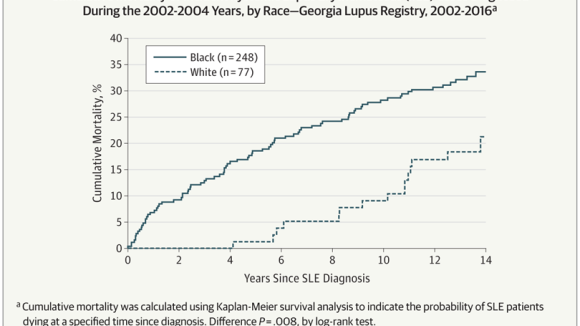
MMWR has published the outcomes from the Georgia Lupus Registry between 2002 and 2016, finding that black women were not only more likely to die from lupus than white lupus patients; but they died on average 13 years earlier (mean age 51.8 and 52.3 years, respectively) than whites (mean age 64.4 and 65.0 years, respectively).
Black women with lupus were 3.34 times more likely to die than black women in the general population, while white women with lupus were 2.43 times more likely to die than white women in the general population. None of the white women with lupus died within 5 years of diagnosis, while mortality was elevated for black women from the date of diagnosis on.
It is estimated that up to 50% of patients with idiopathic inflammatory myopathy will be complicated by interstitial lung disease, and having ILD may impart a poor prognosis. A recent review of the Johns Hopkins myositis-related ILD cohort has shown that azathioprine and mycophenolate mofetil use is associated improved lung function and less prednisone use.