

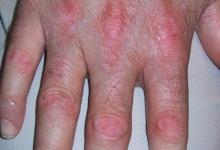
Are we failing in the treatment of RA-ILD?
Dr. Janet Pope discusses treatment of RA-ILD after attending the "How to Treat (HOT)" session on RA-ILD at EULAR 2026.
Transcription
Hi, it's Dr. Janet Pope. I'm reporting from London, England. EULAR 2026 for RheumNow. And I hope you've been following us. There's a lot of exciting reports coming out. I want to talk about treatment of RA-ILD — are we failing? And this is based on guidelines that have come out over the last two years, but also on a hot topic, which is how to treat RA-ILD, by Dr. Philip Dud, and it was on June 5th, 2026.
So I think the first question is are we failing in the treatment of RA-ILD? So why did I frame it that way? We've come a long way where ILD is sometimes being screened for patients. We can escalate the — their lungs and the lower bases. We can do PFTs. When they go on an advanced therapy, they're getting chest imaging and periodically in high-risk patients maybe we'll even be doing CT scans. So I think there's an awareness, and what is different about rheumatoid arthritis is that more people than say scleroderma-associated — more people with rheumatoid arthritis have a UIP, or a usual interstitial pneumonia, pattern. More men with RA relative to women will have ILD and they're older and often long-standing disease. So older men, smoking is a risk, more UIP pattern. They kind of look like IPF patients.
So for a long time, number one, we might have been failing because immunosuppression was not always used with the drugs that treated progressive pulmonary fibrosis such as nintedanib, although MMF can be used in RA-ILD, but it doesn't really treat the rheumatoid arthritis joints very well. Number two, the use of antifibrotics is probably not optimal. Some of it might have been from a lack of treatment tolerability. Some of it might have been access, and some of it frankly might have been not case-finding — lack of awareness from the rheumatologist or the pulmonologist.
So the antifibrotic classes of drugs currently are the PDE4B inhibitor nerandomilast, which has been approved in the US, fast-tracked, and will be approved in many other countries in the near future we think, and then nintedanib.
There were some abstracts and some of the review that we heard from the professor who gave this lecture that suggests that treating RA effectively is helpful and using concomitant immunosuppression. What I did learn, and I thought that this was maybe a failure of my understanding, is that RA disease activity might not change the pulmonary functions but it will change the overall mortality. So we need to get RA disease activity under control. I always understood that area under the curve of more rheumatoid arthritis active disease increased the chance of both getting RA-ILD and worsening, and I think a bit of a shadow was put on my understanding of that. I don't think the answer is totally clear.
The final thing is I think we have to look at the things that can prolong our patients' survival — giving oxygen if they're hypoxic and testing for that, using shared care so that the patients are vaccinated, so that they get smoking cessation, so that they get into an exercise program, and using a common-sense algorithm so we know what would be the cut point within this individual where I will trigger a change in therapy for their RA because they have ILD, and for the ILD itself — who should get on a pulmonary fibrosis drug, or are we actually putting them on too late?
Now, one area where we're not failing, and this will be my final point that was a take-home message, was once you treat the RA-ILD you often can level the worsening PFTs for at least over the next one to two years. And there was an abstract that suggested that as well in rheumatoid arthritis. So I don't think we're failing, but I do think there's a care gap and we can do better. Please again follow us at RheumNow. It's Janet Pope reporting. Thank you.
So I think the first question is are we failing in the treatment of RA-ILD? So why did I frame it that way? We've come a long way where ILD is sometimes being screened for patients. We can escalate the — their lungs and the lower bases. We can do PFTs. When they go on an advanced therapy, they're getting chest imaging and periodically in high-risk patients maybe we'll even be doing CT scans. So I think there's an awareness, and what is different about rheumatoid arthritis is that more people than say scleroderma-associated — more people with rheumatoid arthritis have a UIP, or a usual interstitial pneumonia, pattern. More men with RA relative to women will have ILD and they're older and often long-standing disease. So older men, smoking is a risk, more UIP pattern. They kind of look like IPF patients.
So for a long time, number one, we might have been failing because immunosuppression was not always used with the drugs that treated progressive pulmonary fibrosis such as nintedanib, although MMF can be used in RA-ILD, but it doesn't really treat the rheumatoid arthritis joints very well. Number two, the use of antifibrotics is probably not optimal. Some of it might have been from a lack of treatment tolerability. Some of it might have been access, and some of it frankly might have been not case-finding — lack of awareness from the rheumatologist or the pulmonologist.
So the antifibrotic classes of drugs currently are the PDE4B inhibitor nerandomilast, which has been approved in the US, fast-tracked, and will be approved in many other countries in the near future we think, and then nintedanib.
There were some abstracts and some of the review that we heard from the professor who gave this lecture that suggests that treating RA effectively is helpful and using concomitant immunosuppression. What I did learn, and I thought that this was maybe a failure of my understanding, is that RA disease activity might not change the pulmonary functions but it will change the overall mortality. So we need to get RA disease activity under control. I always understood that area under the curve of more rheumatoid arthritis active disease increased the chance of both getting RA-ILD and worsening, and I think a bit of a shadow was put on my understanding of that. I don't think the answer is totally clear.
The final thing is I think we have to look at the things that can prolong our patients' survival — giving oxygen if they're hypoxic and testing for that, using shared care so that the patients are vaccinated, so that they get smoking cessation, so that they get into an exercise program, and using a common-sense algorithm so we know what would be the cut point within this individual where I will trigger a change in therapy for their RA because they have ILD, and for the ILD itself — who should get on a pulmonary fibrosis drug, or are we actually putting them on too late?
Now, one area where we're not failing, and this will be my final point that was a take-home message, was once you treat the RA-ILD you often can level the worsening PFTs for at least over the next one to two years. And there was an abstract that suggested that as well in rheumatoid arthritis. So I don't think we're failing, but I do think there's a care gap and we can do better. Please again follow us at RheumNow. It's Janet Pope reporting. Thank you.




If you are a health practitioner, you may Login/Register to comment.
Due to the nature of these comment forums, only health practitioners are allowed to comment at this time.