Article
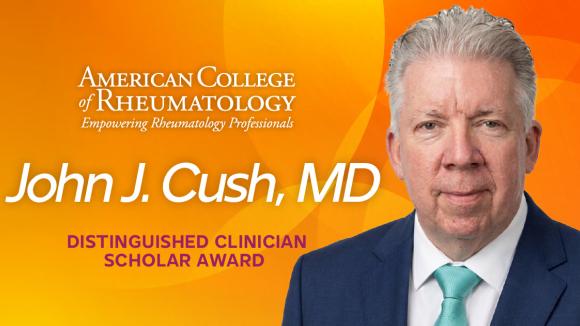
For someone who has spent so much of his career recognizing the work of others, it is fitting that Dr. John J. “Jack” Cush should have his own moment in the spotlight.

Search for Terms or Answers
For someone who has spent so much of his career recognizing the work of others, it is fitting that Dr. John J. “Jack” Cush should have his own moment in the spotlight.
Dr. Cush reviews the news and journal reports from this past week on RheumNow. This week on the podcast: hopeful guidelines for PMR; certainty about good & bad beverages in gout; mixed results in Sjogren's; non-lupus drugs saves lupus lives; and big hips sink ships in psoriatic arthritis.

An overview of calcium pyrophosphate deposition (CPPD) disease by Sara Tedeschi presents our evolving understanding of CPPD with advances affecting nomenclature, classification, imaging, genetics, long-term outcomes and potential future targeted therapies. This review builds on other important reports on CPPD.
Dr. Jack Cush reviews the journal articles and regulatory announcements from this past week on RheumNow, including: two crystals in one joint, twice the cryptococcus risk in JAKs; Myositis and Scleroderma; and Sjögren’s plus early damage = >> 2 fold risk lymphoma. Double trouble week on the RheumNow podcast.
As the leaves start changing color and spooky decorations populate neighborhood doorsteps, another autumnal tradition begins: vaccination counseling. Fall offers a golden opportunity to protect our patients before respiratory viruses fill our waiting rooms. In patients with rheumatologic diseases, vaccinations can be confusing and worrisome. For clinicians with limited bandwidth, these conversations can feel like added responsibilities in an already overfull schedule.

Aside from diarrhea, colchicine use is generally well tolerated, but its metabolism via the CYP3A4 cytochrome P450 enzyme pathway poses a potential risk of medication interaction. Statins are one of the most widely prescribed medication classes also metabolized by this pathway thus positing question of additive risk when colchicine and a statin are prescribed concurrently.

On this week's podcast, Dr. Jack Cush reviews the news: Steroids are easy to start and hard to stop; hold the MTX but not the biologic or JAK, weighing in on avacopan, and age-old messages for old-age patients.
Ambient AI documentation is being adopted as a tool for clinical documentation, with the potential to improve efficiency and patient interaction. This may be particularly well suited to rheumatology, where visits often involve complex, longitudinal histories, multiple high-risk medications, and extensive counseling. Ambient AI also introduces significant risks.

Dr. Jack Cush reviews the news and journal reports from this past week on RheumNow.com.




By downloading this material, I acknowledge that it may be used only for personal use and personal education and that I will accredit RheumNow.com as the source and owner of this material. Commercial use or mass reproduction of this material without permission from RheumNow (info@rheumnow.com) is prohibited.