Maternal and fetal outcomes during the COVID-19 pandemic have not been well studied; yet a new retrospective study from Mexico indicates that during the pandemic maternal mortality increased by nearly 57%, with COVID-19 as the cause in 23% of cases.

All News
Smartphones and diet; COVID-19 and the numbers - reassuring or not, and what about masks?; and do more drugs mean more switching, less persistence, and patient adherence goes up...or down? All this and more news and journal reports in this week's episode.
In comments submitted to the Centers for Medicare and Medicaid Services (CMS), the American College of Rheumatology (ACR) shared its perspective on the CY 2022 Medicare Physician Fee Schedule and Quality Payment Program proposed rule.
A retrospective records review of patients with periodic fever syndromes (PFS) receiving IL-1 inhibitor treatment with canakinumab (CAN), shows CAN to be effective and safe in a variety of PFS patients.
A smartphone-based symptom study of COVID-19 patients has shown that a healthy plant-based diet was associated with lower risk and severity of COVID-19, especially amongst those living in areas with higher socioeconomic deprivation.
CARRA (Childhood Arthritis and Rheumatology Research Alliance) has compared 3 different treatment strategies for polyarticular JIA to identify the optimal time to biologic regimen.
Mease and colleagues have catalogued the current practices assessed in the CORRONA registry, noting that increased DMARD switching and decreased time on a given therapy by US physicians.
This week: high science that affect future treatments; breakthrough infections in our patients, and what's up with that; and soon your radiologist is going to be replaced by AI. This and more in our review of the news and journal articles from the past week.
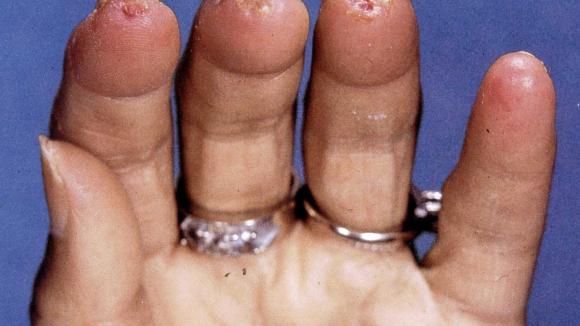
A retrospective study of systemic sclerosis patients shows that acute hospitalization and mortality were not uncommon and were often linked to SSc-related lung disease.
Lymphoma in RA: Disease Activity Matters
Among patients with rheumatoid arthritis (RA), the strongest risk factors for the development of lymphoma were disease activity and severity, French researchers found.
In a multivariate analysis, having a high Disease Activity Score in 28 joints (DAS28) at baseline conferred twice the risk for lymphoma, with an odds ratio of 2.09 (95% CI 1.41-3.38), according to Gaetane Nocturne, MD, of Hôpital Bicêtre in Ile-de-France, and colleagues.
Analysis of records from the Mass General Brigham healthcare system in the Boston area, shows that breakthrough infections (after receiving SARS-CoV-2 vaccines) in patients with systemic autoimmune rheumatic diseases (SARDs) are not uncommon, and may be severe or fatal.
A Mayo Clinic/ Olmsted County study of psoriatic arthritis (PsA) patients has shown that more than half (55%) of PsA patients had a diagnostic delay of > 2 years, and that this delay has not improved over time.
Wow! I hope you read part I of yesterday's “Greatest Rheumatologist” article. So many big names and yet, other names and stories that were equally inspirational.
If you read the comments of the part I article you can clearly see several themes emerge.
Who is the greatest rheumatologist? What makes for a great rheum? Is it clinical acumen, scientific achievement, educational prowess or years of unrivaled service or mentoring? Rheumatologists are quite opinionated on this subject and very nostalgic about their mentors and leaders. When I’ve posed this question in small groups, it’s plain to see how moved they become when discussing mentors or peers who influenced them. Thus, I posed this question to many of our leaders and mentors: who do you think of as the greatest rheumatologist?
Chronic inflammatory disease (CID) patients are urged to receive the COVID-19 vaccines; but when a cohort of CID patients treated with immunosuppressive medications were given an mRNA-based SARS-CoV-2 vaccination, only those treated with glucocorticoids and B cell depleting therapies (B