The RheumNow Week in Review discusses the past week's news, journal articles and highlights from RheumNow.com. This week's report discusses metabolic syndrome in lupus, bisphosphonate holidays, vasculitis and vascular inflammation, vaccination, and the repeated wonders of Vitamin D.

All News
Interleukin-4 has been shown to activate sensory neurons involved in pruritus, and that inhibition of IL-4 with Jak inhibition significantly alleviates itching.
The introduction of a growing number of biosimilars into the market poses a substantial change in cost of care for patients with inflammatory rheumatologic disorders.
Noe and colleagues have reported in the Journal of Investigative Dermatology that by estimating the extent of skin involvement in psoriasis (%BSA) they may assess future mortality risk.
Reuters reports that yet another adalimumab biosimilar has been approved by European Union regulators.
The new drug is named Imraldi, and is manufactured by Samsung Bioepis, a company who has several biosimilars approved or in development for worldwide use.
Non-Tuberculous Mycobacterial infections are among the most frequently reported opportunistic infections in the setting of biologic therapy. While there are hundreds of NTM species, only a minority are clinically relevant. In this review, I'll address important NTM diagnosis and management issues relevant to patients receiving biologic therapy.
Golimumab (GOL) is one of five marketed TNF inhibitors (TNFi) that is FDA approved for use in psoriatic arthritis (PsA).
Evidence from multiple studies suggests there is an increased risk of lymphoma in rheumatoid arthritis (RA) that is believed to be linked to the cumulative activity of the disease.
In this Therapeutic Update, Drs. Mease, Gibofsky and Cush answer five questions regarding the August 3rd FDA Arthritis Advisory Committee meeting that reviewed the potential approval of tofacitinib (Xeljanz) in patients with active psoriatic arthritis. The panel was nearly unanimous (10-1) in favor of the efficacy and safety profile of of tofacitinib, and similarly voted 10-1 to approve this drug for use in PsA. Final decisions on these recommendations from the AAC panel will be made at a later date by the FDA.
A population-based cohort study shows that comorbidities in psoriatic arthritis patients (PsA) were associated with higher disease activity, shorter persistence and reduced clinical response to TNF inhibitors (TNFi).
Uveitis may occur in up to 40% of spondyloarthritis patients. Metanalyses have shown that treatment with tumour necrosis factor-α inhibitor may reduce the rates of anterior uveitis. A multicenter study from Sweden and Norway has confirmed that amongst TNFi, adalimumab and infliximab offer better protection against AU than etanercept.
On Thursday, August 3, the FDA Arthritis Advisory Committee (AAC) met to consider tofacitinib for use in patients with psoriatic arthritis. The panel voted 10-1 in favor of approval.
Dr. Jack Cush reviews new FDA decisions on sirukumab and tofacitinib as well as other news items from the past week on RheumNow.com.
Comorbidity is a serious consequence or confounder in patients with inflammatory diseases. This has been well described in both psoriatic and rheumatoid disease.
While there are several reports detailing uncontrolled, observational results of biologic use during pregnancy, most are hampered by low numbers, incomplete data and too small a sample to make reliable judgements regarding the teratogenicity. A company sponsored claims data analysis has shown that etanercept exposure during pregnancy was not associated with an increase in major congenital malformations (MCMs).
Despite the approval of four anti-TNF biosimilars in 12 months, their introduction into the U.S. market has been slow and - until now - with paultry discounts compared to their introduction throughout Europe, where discounts averaged 50% and were as high as 70% (compared to the price of Remicade).
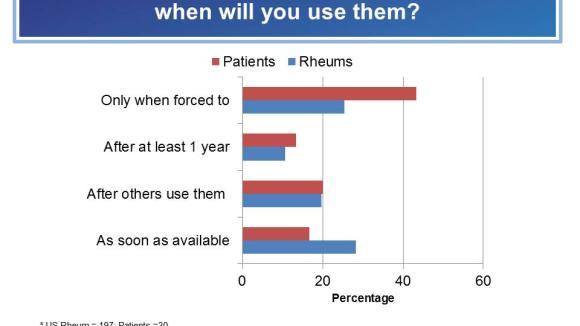
The RheumNow “Live Vote” on the use, uptake and safety of biosimilars contrasts rheumatologist and patient views. Despite FDA approval and looming introduction, there is considerable concern, knowledge gaps and hesitancy regarding their uptake in the US. The survey's primary question demonstrates that less than one-third of US rheumatologists are prepared to adopt biosimilars when they are available.
HIV infection and AIDs has been associated with numerous complications, presumably resulting from impaired immunity from infection. Sporadic cases and small cohorts of patients with rheumatic and autoimmune syndromes have been described but epidemiology data on the prevalence is scarce.
Dr. Jack Cush reviews the news from the past week on RheumNow.com:
Investigators with the Swiss Clinical Quality Management (SCQM) program have studied the effects of obesity on patients with axial spondyloarthritis (axSpA) and, specifically, their response to tumor necrosis factor inhibitors (TNFi).