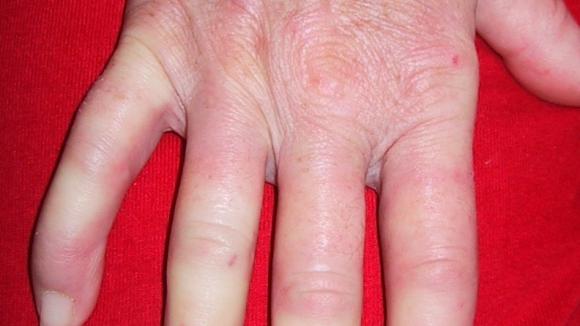
Last Friday, the US Food and Drug Administration approved Ofev (nintedanib) to slow the rate of decline in pulmonary function in adults with interstitial lung disease associated with systemic sclerosis or scleroderma, called SSc-ILD.
ILD as a complication of SSc may lead to progressive loss of lung function and may be associated with a significant mortality risk. Prior to the approval of Olev, there were no FDA approved drugs for SSc-ILD.

All News
Dr. Jack Cush reports the news and important journal articles from the past week on RheumNow.com.
Among patients with pre-existing autoimmune diseases who developed cancer and were treated with immune checkpoint inhibitors (ICI), flares of the underlying disease and other immune-related adverse events were common, a retrospective study conducted in France showed.
Dr. Jack Cush reviews the news and journal reports from the past week on RheumNow.com, including new SLE criteria, ULT in gout and MSU reductions, IVIG in ANCA vasculitis and non-TNF biologics outperform the TNF inhibitors.
The European League Against Rheumatism (EULAR) and the American College of Rheumatology (ACR) have jointly developed new classification criteria for systemic lupus erythematosus (SLE); prompted by the need for criteria that were both highly sensitive and specific. The net result is improved sensitivity and specificity, but the use of positive ANA requirement along with a longer list of weighted criteria ensures its utility in SLE research (including early or latent SLE), but not clinical practice.
A population-based claims study from Taiwan shows significantly increased incidences of depressive disorder, anxiety disorder, and sleep disorder in patients with primary Sjögren’s syndrome (pSS).
A 12‐month, Phase 2 trial has shown that subcutaneous abatacept was well tolerated in patients with diffuse cutaneous systemic sclerosis (dcSSc), but failed to significantly change the skin outcomes as measured by the change in modified Rodnan skin score (mRSS)
Dr. Jack Cush reviews the news, journal reports, and FDA releases and deliberations covered this past week on RheumNow.com
The FDA convened Arthritis Advisory Committee to consider nintedanib for the treatment of systemic sclerosis-associated interstitial lung disease (SSc-ILD) and voted 10-7 in favor of approving the drug for this new indication.
The US Food and Drug Administration (FDA) has approved apremilast (Otezla) for the treatment of oral ulcers associated with Behçet’s Disease, a rare chronic multisystem inflammatory disease that affects about 5 in 100,000 persons in the USA.
Systemic lupus erythematosus (SLE) patients who are hospitalized have an increased prevalence of atherosclerotic cardiovascular disease (ASCVD) and its individual phenotypes of coronary artery disease (CAD), peripheral artery disease (PAD), and cerebrovascular disease.
Dr. Jack Cush reviews this week's news and journal reports featured on RheumNow.com. PsA v. non-PsA pregnancies, Still's disease, lupus, nutritional supplements and dietary interventions, use of cannabis, tanezumab in OA, CBD oils and more.
Pregnancy for patients with lupus has long been considered high risk and associated with both medical and obstetric complications, but outcomes have improved over the last 2 decades and continue to improve. The large decline in in-hospital maternal mortality was greater for lupus pregnancies than for non-lupus pregnancies. Findings from a retrospective cohort study are published in Annals of Internal Medicine.
Editor's note: July 1 - 5, RheumNow is running the best of the EULAR 2019 meeting. At EULAR 2019, Madrid, several recommendations including RA, SLE, and Sjogren’s syndrome have been developed. Agreement for principles with respect to the treatment of immune mediated adverse events from cancer immunotherapy are lacking.
Editor's note: July 1 - 5, RheumNow is running the best of EULAR 2019 meeting. Hydroxychloroquine (HCQ) will decrease SLE flares improve lipids, decrease clots, improve survival, augment the response to mycophenolate and are the cornerstone of treatment as per the SLE EULAR gui
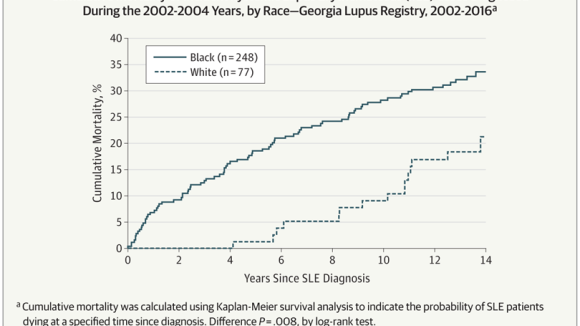
MMWR has published the outcomes from the Georgia Lupus Registry between 2002 and 2016, finding that black women were not only more likely to die from lupus than white lupus patients; but they died on average 13 years earlier (mean age 51.8 and 52.3 years, respectively) than whites (mean age 64.4 and 65.0 years, respectively).
Black women with lupus were 3.34 times more likely to die than black women in the general population, while white women with lupus were 2.43 times more likely to die than white women in the general population. None of the white women with lupus died within 5 years of diagnosis, while mortality was elevated for black women from the date of diagnosis on.
It is estimated that up to 50% of patients with idiopathic inflammatory myopathy will be complicated by interstitial lung disease, and having ILD may impart a poor prognosis. A recent review of the Johns Hopkins myositis-related ILD cohort has shown that azathioprine and mycophenolate mofetil use is associated improved lung function and less prednisone use.
Minority groups in the U.S. have differing rates of Sjögren's syndrome and exhibit distinct clinical patterns of the disease, a large cross-sectional study revealed.
The percentage of American Indians in a SS cohort of 610 patients was much higher than expected, at 25.3%, whereas the percentage of African Americans was lower, at 3.1%. In addition, American Indians had higher levels of disease activity and more extraglandular manifestations, whereas African Americans had a symptom pattern associated with subsequent lymphoma development, researchers reported in Arthritis Care & Research.
A large study of UK family practice patients shows that polymyalgia rheumatica (PMR) or giant cell arteritis (GCA) patients treated with glucocorticoids are at an increased risk of bacterial, viral, parasitic and fungal infection, even at daily doses of less than 5 mg prednisolone.
Patients with SLE are at increased risk for HF, not just of MI and stroke, with risk similar to that of patients with diabetes, researchers found in an analysis of Medicaid data.