
Article
The current issue of Arthritis & Rheumatology features an editorial and two novel articles on the herpes zoster vaccine.

Search for Terms or Answers
The current issue of Arthritis & Rheumatology features an editorial and two novel articles on the herpes zoster vaccine.
The results of a randomized, double-blind trial have shown that canakinumab (CAN), an interleukin-1β inhibitor, given as 150 mg every 3 months, resulted in a significantly lower rate of recurrent cardiovascular events (in high-risk CV patients), independent of lipid-level lowering. The results of the CANTOS studywere simultaneously published in NEJM, Lancet and were presented at the European Society of Cardiology meeting in Barcelona.

On Friday August 25th, the FDA approved another adalimumab biosimilar: Cyltezo (generic name: adalimumab-adbm).

The RheumNow Week in Review discusses the past week's news, journal articles and highlights from RheumNow.com.

Drs. Cush and Gibofsky answer 5 questions about the August 2, 2017 FDA Arthritis Advisory Committee meeting that reviewed the NDA for sirukumab use in rheumatoid arthritis. The panel voted against (1-12) the approval of sirukumab.

On Thursday, August 3, the FDA Arthritis Advisory Committee (AAC) met to consider tofacitinib for use in patients with psoriatic arthritis. The panel voted 10-1 in favor of approval.

Dr. Jack Cush reviews new FDA decisions on sirukumab and tofacitinib as well as other news items from the past week on RheumNow.com.
On Wednesday, August 2, the FDA convened the Arthritis Advisory Committee (AAC) to evaluate the safety and efficacy of Janssen’s anti-IL-6 monoclonal antibody, sirukumab.

While there are several reports detailing uncontrolled, observational results of biologic use during pregnancy, most are hampered by low numbers, incomplete data and too small a sample to make reliable judgements regarding the teratogenicity. A company sponsored claims data analysis has shown that etanercept exposure during pregnancy was not associated with an increase in major congenital malformations (MCMs).

On August 2, the US Food and Drug Administration (FDA) will convene a hearing of the Arthritis Advisory Committee (AAC) to review the safety of the novel IL-6 inhibitor, sirukumab, being developed by Janssen (Johnson & Johnson).
On May 22, Genentech received FDA approval for the use of subcutaneous (sc) tocilizumab (TCZ) in patients with giant cell arteritis (GCA) – also known as temporal arteritis.

Bone mineral density (BMD) measurement vie DEXA scan commonly used to assess bone density and fracture risk in postmenopausal osteoporosis provides us with approximate assessment of bone health while lacking sensitivity in vertebral fracture risk prediction.

Despite the approval of four anti-TNF biosimilars in 12 months, their introduction into the U.S. market has been slow and - until now - with paultry discounts compared to their introduction throughout Europe, where discounts averaged 50% and were as high as 70% (compared to the price of Remicade).

Eli Lilly and Co disclosed today that upon further discussions with the US Food and Drug Administration (FDA) there would be a delay in further regulatory decisions regarding baricitinib, a JAK inhibitor, that is being developed for use in rheumatoid arthritis (RA).

The US Food and Drug Administration (FDA) has approved a new subcutaneous formulation of Benlysta (belimumab) for use in active, autoantibody‑positive Systemic Lupus Erythematosus (SLE) patients.

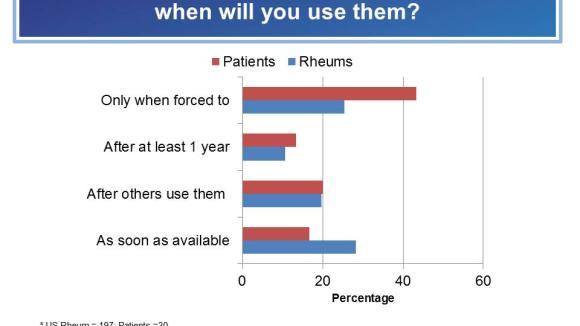
The RheumNow “Live Vote” on the use, uptake and safety of biosimilars contrasts rheumatologist and patient views. Despite FDA approval and looming introduction, there is considerable concern, knowledge gaps and hesitancy regarding their uptake in the US. The survey's primary question demonstrates that less than one-third of US rheumatologists are prepared to adopt biosimilars when they are available.
Dr. Jack Cush reviews the news from the past week on RheumNow.com:
Investigators with the Swiss Clinical Quality Management (SCQM) program have studied the effects of obesity on patients with axial spondyloarthritis (axSpA) and, specifically, their response to tumor necrosis factor inhibitors (TNFi).

Curbside Consults are cases submitted by our rheumatology colleagues as challenging therapeutic or safety issues. Answers are based on experience, with added evidence from the medical literature and published guidelines. Here are four new cases.

The 12 month POET study analyzed 817 rheumatoid arthritis (RA) patients who achieved remission or low disease activity (LDAS) for ≥6 months and then randomized 2:1 to stopping or continuing their TNF inhibitor.

By downloading this material, I acknowledge that it may be used only for personal use and personal education and that I will accredit RheumNow.com as the source and owner of this material. Commercial use or mass reproduction of this material without permission from RheumNow (info@rheumnow.com) is prohibited.