New findings from national U.S. surveys reveal the profound impact of arthritis on millions of adults, especially those facing social and economic challenges. These data will be featured in an upcoming issue of Arthritis Care & Research, an official journal of the American College of Rheumatology.

All News
In 2023, a EULAR subcommittee set out to assess the roles of nurses and Advanced Practice Nurses (APN) in the care of arthritis as outlined in published EULAR guidelines. The scope of APN practices was first proposed in 2012 and revised in 2018.
A large observational cohort study suggests that monitoring hydroxychloroquine (HCQ) blood levels is effective in systemic lupus erythematosus (SLE) patients with a target therapeutic range (for HCQ level monitoring) of 750-1150 ng/ml.
Dr. Jack Cush reviews the news, journal and regulatory reports from this past week on RheumNow.com. B cell drugs in SLE and ITP, biomarkers in GCA & PSS and great videos by APPs.
Recent research and publications have underscored the use, efficacy, safety and limitations to the use of cannabis for arthritis and pain patients.
The New England Journal of Medicine has published a phase III clinical trial showing that a B cell targeting monoclonal antibody, ianalumab, was effective in more than half of the patients with primary immune thromboc
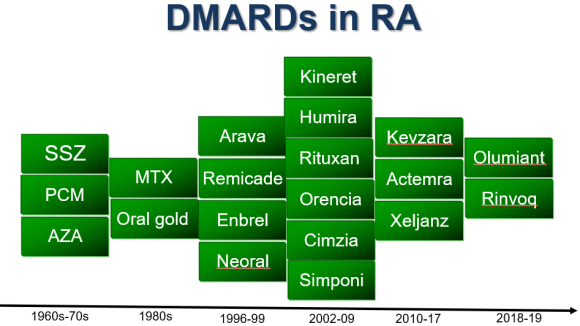
The British Society of Rheumatology has published an update to their previous 2017 BSR/BHPR guideline regarding the use and monitoring of DMARDs (disease-modifying anti-rheumatic drugs) used to treat systemic autoimmune rheumatic diseases (SARDs).
Dr. Jack Cush reviews the news and journal reports from RheumNow.com, including info on scleroderma, dermatomyositis and malignancy, rheumatologist and APP salary concerns.
Medscape recently reviewed off-label use of low dose naltrexone (LDN) in fibromyalgia (FM) and found it is deemed effective by some clinicians and patients, but 1) there is no FDA indication for LDN use in FM and 2) the data supporting its use is limited.
Use of disease-modifying anti-rheumatic drugs (DMARDs) for rheumatoid arthritis (RA) was markedly lower among all major racial-ethnic minority groups in the U.S. compared with white patients, analysis of federal survey data indicated, even after adjusting for income, education, and other factors.