


Four Decades of Gout Management Save

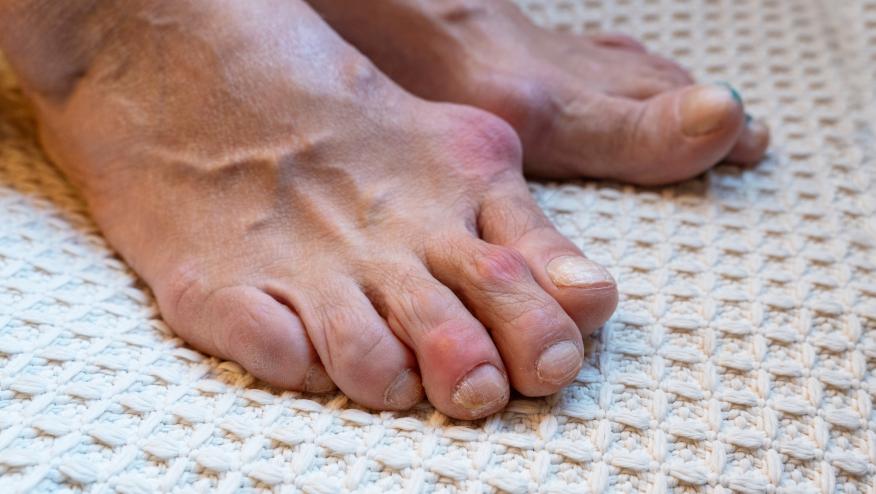
During this month-long campaign on Gout, we have documented many significant changes in our approach to gout, as well as many unmet needs and deficiencies that merit our continued, primary attention. We are all familiar with the famous 1905 quote, “Those who cannot remember the past are condemned to repeat it." (from philosopher George Santayana)
The last four decades (1985-2025) have provided a rich evolution of gout management, each with their unique focus:
- 1980 - 1990s: Gout flare management – colchicine vs. NSAID or steroids; prophylaxis;
- Urate lowering therapy - overproducer or under-excreters and when to use probenecid
- 2000 - 2010s: Treat to target – the ACR vs ACP squabble over uric acid measurements;
- New Drugs – febuxostat, pegloticase, lesinurad
- Better Imaging for Gout (US, DECT)
- 2020s: Biologics, precision therapy, and drug development
This review of three different surveys of US Rheumatologists (from 1988 to 2026) aims to show how our priorities, innovations and disappointments have either changed or remained the same.
The sources of these 3 surveys on Gout are:
- In 1988, Dr. James Fries from Stanford University surveyed U.S rheumatologists (272 surveyed, 160 responded) about clinical and treatment advances in a variety of rheumatic conditions. (For this report I’ve only included the gout data) He asked rheumatologists to consider developments between 1965 to 1985 and to rank what was most important to least important by asking these two questions:
- Which advance or treatment has led to the greatest improvement(s) in the care of patients with Gout?
- What is the most disappointing regarding the care of Gout patients?
- These survey results were originally published in a Syntex sponsored monograph (1988) and later excerpted into an article, “Advances in Management of Rheumatic Disease” (Archives of Internal Medicine May 1989)
- 2008, I surveyed 2091 rheumatologists to answer the same “milestones in rheumatology” questions posed by Dr. Fries. A total of 458 responded (22%). Respondents averaged 54 years of age, one-third were from academic settings and 54 % from private practice. On-line responses were tabulated into rankings (as shown below).
- 2026, I surveyed 325 rheumatologists and 214 responded (36% in practice 0-20 yrs.) to the same gout questions where they answered: 1) What is the greatest advance in Gout management; and 2) What is most disappointing about the care of Gout patients?
Note: Surveys from 1988 and 2008 were done by likert ranking (most important to least important) while the 2026 survey used a different response format (single-select "greatest advance"). Thus, the ranks are comparable across years, but the raw number vs. percentage is not.
What is the greatest advance(s) in the care of patients with Gout?
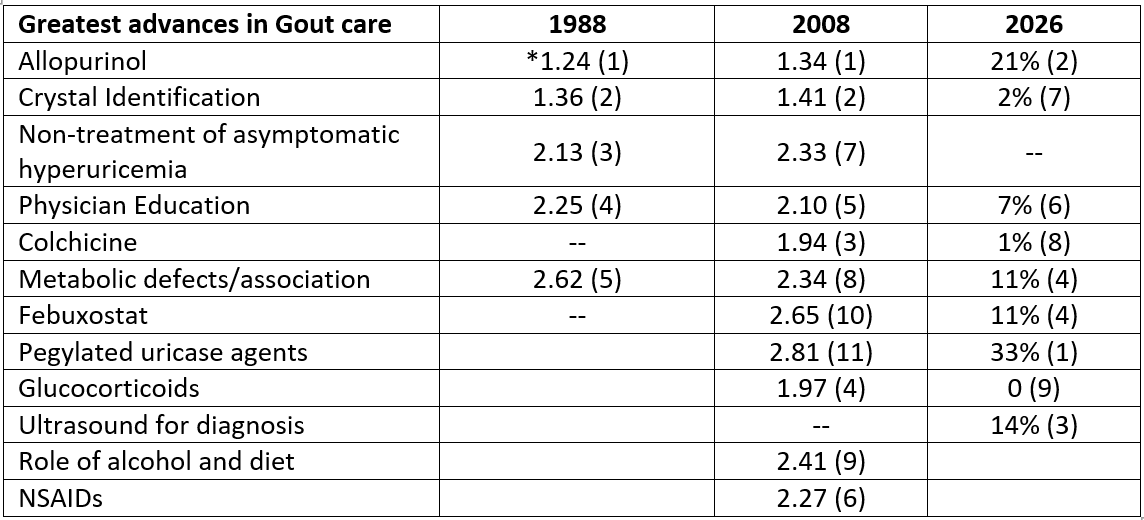
*Numeric scores in all tabulations range from 1 (very important) to 5 (unimportant). Relative rank in parentheses.
Over 4 decades we can surmise the following trends in gout advances:
- Allopurinol (and urate lowering therapies) are cornerstones in gout management.
- Previously important, crystal identification, has been replaced by clinical diagnosis and ultrasound.
- Colchicines relative importance may have dropped by 2026, but it still remains more important than NSAIDs and glucocorticoids in gout management.
- Gout is a metabolic disorder with multiple metabolic associations.
- Physician education has been a high-ranking stable deficit in the last 40 years.
- There is enthusiasm for recent drug development (e.g., pegloticase).
What is the most disappointing regarding the care of Gout patients?
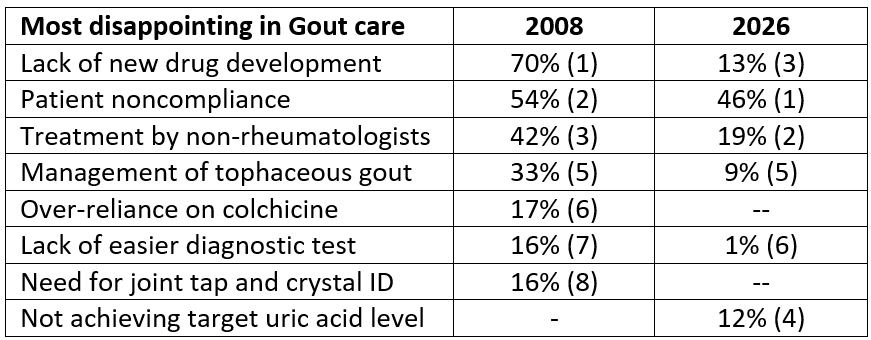
The same four-decade lens applied to disappointments in gout care reveals:
- Patient noncompliance and gout management (or mismanagement) by non-rheumatologists continue as primary challenges in managing the most common societal inflammatory arthritis.
- While most recognize the need for new drug development, fewer (12%) are bothered by the fact that clinicians (including rheumatologists) fail to achieve target uric acid levels with urate lowering therapy.
Several disappointing gout benchmarks are firmly rooted in poor education. The recurring 40-year gap in gout education is itself a Santayana-style warning". We need to address the education of patients, primary care physicians, urgent care physicians, rheumatologists and advanced practice providers.
Gout care will advance most with the introduction of easily accessed, effective gout education, novel drug development and treatment guidelines that tackle the many hard issues that still face patients and their gout doctors.
Related Content





If you are a health practitioner, you may Login/Register to comment.
Due to the nature of these comment forums, only health practitioners are allowed to comment at this time.