

Guselkumab Delivers Across the PsA Disease Spectrum: APEX Trial
Transcription
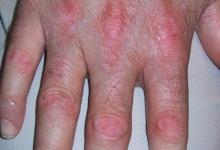
Hi, this is Jihali from Michigan reporting for RheumNow for EULAR 2026 in London. Today I'm going to talk about two posters that are actually updates to the APEX trial which involves guselkumab, which many of you may be familiar with. This is poster number 0480 and 0471 that are looking at slightly different aspects of the same trial. So this trial involves patients with psoriatic arthritis and it involved patients with active disease. If you may recall, APEX actually enrolled patients with active and erosive joint disease, meaning structural damage was already present at baseline for many of these patients. So they actually enrolled a higher-stakes population to really get at the question of is guselkumab effective in the treatment of psoriatic arthritis across joint, bone, skin, nail — and I think we're starting to get some answers regards to that, which is really nice, because especially the latter two, the skin and nail, is something that our patients are really cognizant of and it really affects their quality of life.
So just to kind of set up the trial and also just to give some reminders, although many of you may be already familiar, guselkumab is a fully human monoclonal antibody that selectively inhibits the IL-23p19 subunit. It is approved for moderate to severe plaque psoriasis and active psoriatic arthritis, and a lot of that was thanks to this APEX trial. It's currently in the phase 3b randomized double-blind placebo-controlled study phase and was specifically designed to be tested in people who are biologic-naive and, as I mentioned before, with both active joint disease but also erosive damage on radiographic changes according to the hand and foot. So the way the study was set up, the participants were randomized to either receive a fixed dose every four weeks or kind of this induction-maintenance phase where they would get it at week zero and four and then every eight weeks thereafter, and then the comparator group was pure placebo. Follow-up was at 24 weeks, and prior reports from this trial have shown that there are improvements in joint disease activity as well as structural protection.
So the two posters presented at EULAR went a little bit deeper and answered two separate questions. So the first one, poster 0480, was about subgroup analysis — and in particular subgroup analysis according to sex, BMI, number of joint involvement, and concomitant methotrexate use — and that's because male sex and higher BMI are considered risk factors for progressive disease, and also joint disease involvement shows you higher disease activity measures and its response to that, and the question of whether concomitant methotrexate adds or deters from the effectiveness of guselkumab.
So overall, the findings were pretty consistent with the overall finding in that, regardless of whether you get the fixed dose or the kind of induction ramp-up in Q8 weeks, those who got guselkumab achieved ACR20 compared to placebo, and this finding was consistent across the sex, BMI, joint counts, as well as the concomitant methotrexate use. You find similar findings again when you look at structural damage. So again, I think this is just informative in the sense that the overall benefit that you saw in the bigger trial wasn't just with particular subgroups, but in effect for those who are at higher risk for progressive disease and worse disease, this drug holds up.
I think personally what I found more interesting — and I think our patients would appreciate — was poster number 0471, because this was actually about the benefit to skin and nail. And I just want to spend a little bit of time about how they identified and set up the disease. So for those with psoriatic skin disease, they identified patients with at least 3% body surface involvement or mild disease according to the Investigator Global Assessment scale, which is a five-point scale going from zero being clear and four being severe. So they tried to find patients in the middle with at least some mild involvement if not moderate to severe. And their outcome was actually the proportion of participants achieving 100% improvement or clear skin, which I think is a really ambitious but also at the same time clinically important endpoint.
For nail disease, again they used a validated measure called the modified Nail Psoriasis Severity Index. This one goes from 0 to 130. And then there's also the five-point Physician Global Assessment of fingernail psoriasis. Similarly, again here they identified patients with at least mild disease and their endpoint goal was for patients to have clear or minimal nail disease or at least drop down two scales on that nail assessment.
In terms of the results, it was actually very striking and very reassuring and impressive, I have to say. So when it came to the skin, with the drug 38 to 40% — I should backtrack just a little bit — of all the trial enrollees, 60% met the criteria for having at least mild to severe skin
disease and of those 30 to 40% on gelab achieve the end point of having clear skin and this is compared to 12 to 15% of placebo so that's actually pretty impressive when it came to the nail 65% had nail involvement at least mild to severe again according to the definitions I shared earlier and here about 43% on the Q4 week and 36% on the Q8 week was able to achieve that mild to clear definition or at least two um valid point drop and that is compared to only 16% in the placebo group.
It's a little bit interesting that with Q8 the nail finding or nail improvement was less than Q4. So perhaps with our patients with severe nail disease that Q4 week dosing may be more benefit. But I think we're going to be seeing more guidance as more data comes through.
So kind of putting this together um as I said I think it's really reassuring to know that um this gelab is holding up its efficacy across different subgroups but more importantly showing that there is benefit both for the skin and more importantly the nails cuz I've had some patients ask um of me of what their responses may be or what drugs may be more effective and sometimes have been at a loss. So, I think I'm looking forward to seeing more follow-up data regarding this as well as um safety signals to follow and and for those since this was testing biologic naive patients. Um it'll be interesting to see if this kind of moves up in our chain of prescribing.
Um I will note in terms of the limitation, however, that 24-week follow-up is still relatively short. So, it'll be interesting to see how long this holds up for. Um and then also this is specifically just for biologic naive patients. So what does this mean? A lot of times since our patients are likely to have tried um conventional synthetic but also anti-TNF biologics and how will this finding translate or carry through in those patients as we as physicians will be having to prescribe in real world practices. But I think at least there is more to look forward to from the APEX trial. Thank you for listening. This was Jihali reporting for RheumNow for EULAR 2026 in London.
So just to kind of set up the trial and also just to give some reminders, although many of you may be already familiar, guselkumab is a fully human monoclonal antibody that selectively inhibits the IL-23p19 subunit. It is approved for moderate to severe plaque psoriasis and active psoriatic arthritis, and a lot of that was thanks to this APEX trial. It's currently in the phase 3b randomized double-blind placebo-controlled study phase and was specifically designed to be tested in people who are biologic-naive and, as I mentioned before, with both active joint disease but also erosive damage on radiographic changes according to the hand and foot. So the way the study was set up, the participants were randomized to either receive a fixed dose every four weeks or kind of this induction-maintenance phase where they would get it at week zero and four and then every eight weeks thereafter, and then the comparator group was pure placebo. Follow-up was at 24 weeks, and prior reports from this trial have shown that there are improvements in joint disease activity as well as structural protection.
So the two posters presented at EULAR went a little bit deeper and answered two separate questions. So the first one, poster 0480, was about subgroup analysis — and in particular subgroup analysis according to sex, BMI, number of joint involvement, and concomitant methotrexate use — and that's because male sex and higher BMI are considered risk factors for progressive disease, and also joint disease involvement shows you higher disease activity measures and its response to that, and the question of whether concomitant methotrexate adds or deters from the effectiveness of guselkumab.
So overall, the findings were pretty consistent with the overall finding in that, regardless of whether you get the fixed dose or the kind of induction ramp-up in Q8 weeks, those who got guselkumab achieved ACR20 compared to placebo, and this finding was consistent across the sex, BMI, joint counts, as well as the concomitant methotrexate use. You find similar findings again when you look at structural damage. So again, I think this is just informative in the sense that the overall benefit that you saw in the bigger trial wasn't just with particular subgroups, but in effect for those who are at higher risk for progressive disease and worse disease, this drug holds up.
I think personally what I found more interesting — and I think our patients would appreciate — was poster number 0471, because this was actually about the benefit to skin and nail. And I just want to spend a little bit of time about how they identified and set up the disease. So for those with psoriatic skin disease, they identified patients with at least 3% body surface involvement or mild disease according to the Investigator Global Assessment scale, which is a five-point scale going from zero being clear and four being severe. So they tried to find patients in the middle with at least some mild involvement if not moderate to severe. And their outcome was actually the proportion of participants achieving 100% improvement or clear skin, which I think is a really ambitious but also at the same time clinically important endpoint.
For nail disease, again they used a validated measure called the modified Nail Psoriasis Severity Index. This one goes from 0 to 130. And then there's also the five-point Physician Global Assessment of fingernail psoriasis. Similarly, again here they identified patients with at least mild disease and their endpoint goal was for patients to have clear or minimal nail disease or at least drop down two scales on that nail assessment.
In terms of the results, it was actually very striking and very reassuring and impressive, I have to say. So when it came to the skin, with the drug 38 to 40% — I should backtrack just a little bit — of all the trial enrollees, 60% met the criteria for having at least mild to severe skin
disease and of those 30 to 40% on gelab achieve the end point of having clear skin and this is compared to 12 to 15% of placebo so that's actually pretty impressive when it came to the nail 65% had nail involvement at least mild to severe again according to the definitions I shared earlier and here about 43% on the Q4 week and 36% on the Q8 week was able to achieve that mild to clear definition or at least two um valid point drop and that is compared to only 16% in the placebo group.
It's a little bit interesting that with Q8 the nail finding or nail improvement was less than Q4. So perhaps with our patients with severe nail disease that Q4 week dosing may be more benefit. But I think we're going to be seeing more guidance as more data comes through.
So kind of putting this together um as I said I think it's really reassuring to know that um this gelab is holding up its efficacy across different subgroups but more importantly showing that there is benefit both for the skin and more importantly the nails cuz I've had some patients ask um of me of what their responses may be or what drugs may be more effective and sometimes have been at a loss. So, I think I'm looking forward to seeing more follow-up data regarding this as well as um safety signals to follow and and for those since this was testing biologic naive patients. Um it'll be interesting to see if this kind of moves up in our chain of prescribing.
Um I will note in terms of the limitation, however, that 24-week follow-up is still relatively short. So, it'll be interesting to see how long this holds up for. Um and then also this is specifically just for biologic naive patients. So what does this mean? A lot of times since our patients are likely to have tried um conventional synthetic but also anti-TNF biologics and how will this finding translate or carry through in those patients as we as physicians will be having to prescribe in real world practices. But I think at least there is more to look forward to from the APEX trial. Thank you for listening. This was Jihali reporting for RheumNow for EULAR 2026 in London.




If you are a health practitioner, you may Login/Register to comment.
Due to the nature of these comment forums, only health practitioners are allowed to comment at this time.