





RITAZAREM: Three Things I Learned about AAV Maintenance Save


One of the most common questions I receive in my vasculitis clinic is one of the most difficult to answer: “When can we stop rituximab?” While we know everyone needs therapy for at least one year and have reasonably good data for 18 months, whether folks should continue after that remains an open question. That is why I was especially excited to see a post hoc analysis of RITAZAREM, which followed patients for up to 48 months from enrollment (Abstract 2149).
Quick reminder about RITAZAREM. This was a randomized controlled trial that compared the use of rituximab to azathioprine for maintenance therapy in AAV. Everyone in the original trial had relapsing GPA or MPA and received rituximab induction. Half received 1 g of rituximab every four months for five doses, with the last infusion at month 20. The other half received azathioprine at full dose through month 24, then tapered over three months. The results were unambiguous; rituximab cut the hazard of relapse by 59% (HR 0.41, 95% CI 0.27–0.61). The new analysis starts the clock again at month 24 and focuses on the 113 patients who had completed maintenance without a relapse (66 on rituximab and 47 on azathioprine). Notably, the protocol called for both groups to stop maintenance therapy. That makes this a great way to assess the question, “What happens if we stop therapy at the two-year visit?”
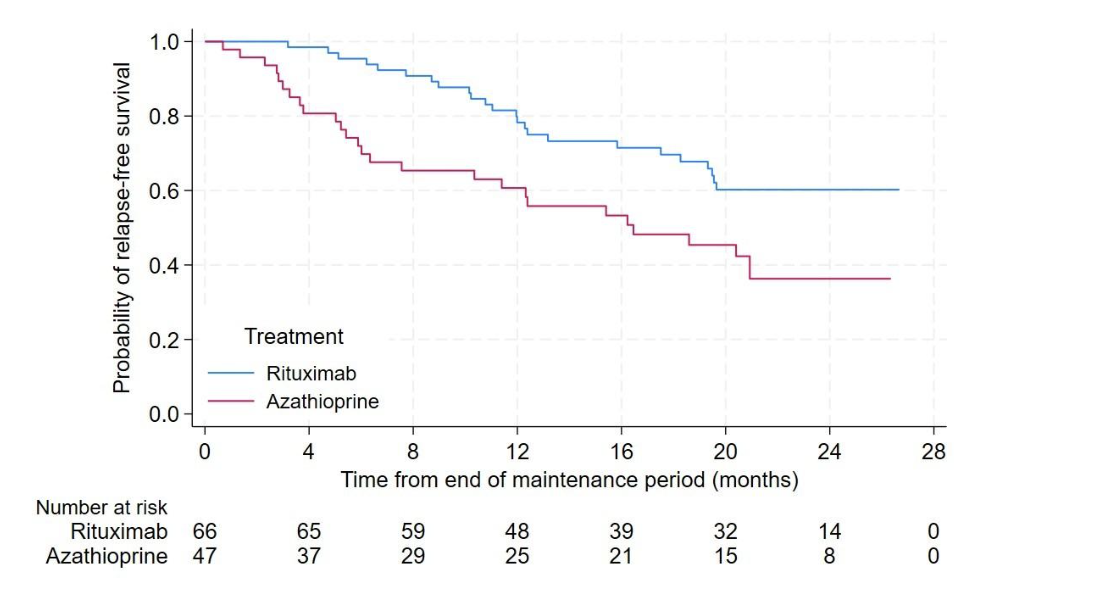
Figure 1: Reproduced from Romich E, Smith R, Cho G, Forrer P, McAlear C, Yateman N, Jayne D, Merkel P. Time to Disease Relapse After Prolonged Remission in ANCA-Associated Vasculitis [abstract]. Arthritis Rheumatol. 2026; 78 (suppl 9). Abstract 2149.
Lesson 1: Azathioprine is still not good
Among patients still relapse-free at study month 24, estimated relapse-free survival was higher after rituximab at 1 year (82% vs 61% AZA) and 2 years (60% vs 36% AZA). The curves are getting a little thin with patients (14 on the rituximab curve and 8 on the azathioprine curve still at risk at 2 years), but this result is largely concordant with the early findings from both MAINRITSAN and of course RITAZAREM itself. To put it bluntly; for every 5 people you give azathioprine to instead of rituximab, you will harm one of them. I also think the patient experience of rituximab is generally better, especially if you space infusions to every 9 or 12 months.
Lesson 2: People Flare
Assuming you believe lesson 1 above, let’s focus on the rituximab group and assume you stop therapy at month 24. What will happen? From that visit, the estimated risk of relapse or relapse-related death was roughly 1 in 5 by one year and 2 in 5 by two years. We will have to wait for the presentation (and publication) to know more details about what those flares entailed, but for patients with a reduced GFR or vasculitic neuropathy, that seems too-high a rate.
Lesson 3: Prediction is Hard
The study assessed whether various clinical parameters could predict who would flare. Among the rituximab recipients, detectable CD19 B cells at month 24 were associated with subsequent relapse (adjusted HR 8.2, 95% CI 1.5–43.7). In the azathioprine group, being ANCA positive at month 24 was associated with flares, but with a less gaudy adjusted hazard ratio of 2.69 (95% CI 1.16-6.25). For me the biggest question is not necessarily whether we can predict flares (I am skeptical that we can). Rather, it is “How much rubber to burn does this person have?” People with CKD or damage from prior vasculitis may have less reserve, so the next flare could easily have devastating consequences.
Related Content
EULAR recommends a combination of glucocorticoids with either rituximab or cyclophosphamide for remission induction in life-threatening or organ-threatening AAV, followed by gradual tapering of glucocorticoids.
Glucocorticoids are the cornerstone of initial vasculitis treatment, used to rapidly control inflammation and protect vital organs. EULAR has recommendations that cover glucocorticoid use in ANCA associated vasculitides (AAV) and large vessel vasculitis, including giant cell arteritis (GCA).1,2 But the evidence base continues to grow about their use – especially over the long term.
Avacopan (Tavneos), the complement pathway inhibitor for antineutrophil cytoplasmic antibody (ANCA)-associated vasculitis (AAV), appeared strongly effective in an Italian registry study -- a step, maybe, toward setting to rest questions about its efficacy, if not its safety.





If you are a health practitioner, you may Login/Register to comment.
Due to the nature of these comment forums, only health practitioners are allowed to comment at this time.