


APP Controversies and Misconceptions Save
In this Tuesday Night Rheumatology, panelists discuss a range of topics, including APP roles and impact; models of care; independence; seeing new patients and complex cases; and more. Panelists: Daric A. Mueller, PA-C; Lisa Carnago, PhD, MSN, BSN, RN, FNP-C; Jack Cush, MD
Transcription
Hello everyone. Welcome to Tuesday night rheumatology. This is our weekly review of all things important with advanced practice providers in the month of December. Tonight we're going to be discussing APS controversies and misconceptions. Let's begin with our panel. I'm Jack Cush in Dallas, Texas. Lisa?
Yeah. Lisa Carneg from Durham, North Carolina. And Lisa, you nurse practitioner or a PA? Yeah, I'm a nurse practitioner for the past 10 years in rheumatology.
And Derek, hey there. I'm Derek Mueller, PA. I'm out of St. Clair Shores, Michigan near Detroit. PA. I've been in practice for six years.
Excellent. All right. So, let's get into it. I want to thank our sponsors for this month on APS. That includes AbbVie, Lilly, Johnson and Johnson, Novartis, and Sanofi have been sponsoring this APS campaign where we've got a lot of content up. I hope you've been following that. It's all about how important APS can be in practice. What they do, what are the challenges for them. A lot of articles and content written by APS for APS and rheumatologists. And this is also covering all the needs in rheumatology whether you're an MD provider or an APP provider.
As you can see, we have these four weekly Tuesday night rheumatologies. Tonight it's going to be controversies and misconceptions about APS. We hope to hit on things that are important to you. I think really important for those of you who are tuning in and watching this live. You can certainly get involved in the conversation by clicking on the Q&A button and ask your questions there and we'll discuss those as they come up throughout this hour, this one-hour webinar.
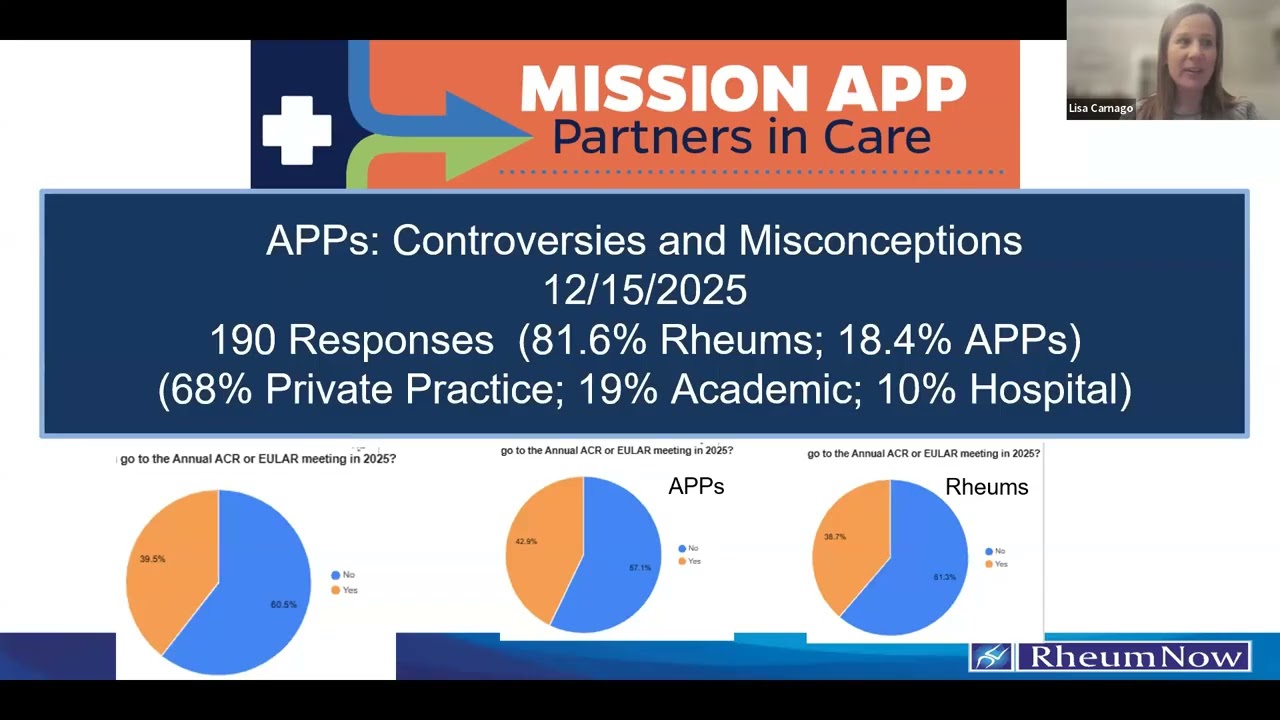
So, to help with the discussion, as we have done in the past, we usually send out a one-day survey on the topic we're going to cover and use that as a launch point for the discussion. We did a one-day survey yesterday. We had overnight 190 responses, about 20% were from nurse practitioners and physician assistants and about 80% from rheumatologists. Again, they were sort of the same distribution, the APS in the rooms, whether they're in private practice or academic or hospital-based.
So, an interesting tidbit from the survey. I asked one of the last questions: did you go to ACR or EULAR this year? 190 people who responded and look at this. The far left is everybody answering and 60% did not go, 40% did go. And I think that's about right. The question is though, when I subsetted the 20% of APS versus the rheumatologists, look, they're really the same. And I think that's encouraging to me. That means that the APS are getting the same education you're getting when we look at their attendance at ACR. I could have asked another question. Did you go to a regional meeting or a rheumatology-only meeting? And I'm sure we would have gotten the same distribution.
Derek and Lisa, what do you think — what do you see amongst your peers as far as what they go to? Do they pretty much mirror the rheumatologists or are they on a different educational track? Lisa.
Yeah. So for ACR attendance in my practice, we have about eight APS and I'm pretty much the only one who goes to ACR, but for the smaller conferences like AWARE or some go to RNS and RAP, a lot go to RAP. So I think rheumatology-specific but maybe a little smaller than ACR is where my practice typically finds itself.
And I think that's exactly what rheumatologists are doing. You know, used to be that you weren't really a rheumatologist unless you went to the ACR meeting. But that attendance has gone down over the years and people are going to the smaller meetings. RWCS and PRD's got a meeting, the West Coast has got the Pearson conference. There's the Harvard review, of course, and RheumNow Live. And people are going to those because the other meetings seem so big and so hard to navigate.
Derek, what's your impression?
I think across the board it seems like APS in our area don't attend larger national meetings like ACR and I think part of that might be limited because of cost and CME budget and then again taking that time to make that big trip. And a lot of APS in our state — there seems to be a lot of younger APS and maybe there's some intimidation about attending a large meeting like ACR. So I hope that can change in the future and APS feel like that's a meeting they can go to, because I went to my first one this past fall and it was a great experience for me.
Not really on our agenda, but I think it's a concern to me as a rheumatologist and maybe an employer in the practice. I'm a little unclear — actually, I'm not unclear, I'm pretty clear about what to recommend — but what should the APS that
work with me? My recommendation could be that they should go to a good smaller rheumatology meeting, or they could go to a meeting just for APs like AANP, or they could go to ANRS who's trying to also serve the needs of APs, or they could go to ACR where you have the ARHP, which has a much more diverse representation. I think this is what's overwhelming to any learner, especially APs. And I think if ACR wants APs to come more to ACR meeting, I think it's up to them to make the content worth their while. Anybody have a different view on that?
But I think this is important because every AP has always wanted to have a plan for their education, and I'm going to publish this week — we did two surveys of APs and we asked a lot of questions about their education. The survey responses are really interesting. 80% of APs have dedicated CME time that they need to use and want to. And what you both just said is what the results were. Some will go to national meetings, but a lot are going to more regional and smaller meetings.
The one thing I found surprising — the nurse practitioner I worked with sometimes preferred, usually like every other year, to go to an AP meeting as opposed to a rheumatology meeting, meaning one that's designed for nurse practitioners or designed for physician assistants, that may not be a rheumatology meeting but it's general medicine and whatever. And I guess the message I got was: those people understand me.
Yeah, Dr. Cush, if I may butt in. I think when I'm advising other APs as to which meeting to go to, oftentimes it'll be based upon — like for me, I go to ACR because I do research and I specialize in uveitis, and some of the smaller conferences may not have as much knowledge centrally about those topics or be as strongly research-centric. Whereas some of my more clinical APs, it makes more sense to go to the more clinical conferences. So I think it can really be tailored for the individual and where they are in their learning process as well, to really support them in that ongoing education.
And I think that's where I would advise to go. And as for the AP-centric ones, they have a lot of pharmacology-specialized CEs, which — as a nurse practitioner I need 25 pharmacology hours, which I don't get through grand rounds and other things, and oftentimes not at ACR. So that's one thing that I would go to an AP-specific conference for.
That makes sense. And you know, it makes more sense also — you'll see in some of the survey questions we have here — that the number of PAs and nurse practitioners who are involved in specialty care, specialty clinics, and I would include in that research like you're doing, it's a minority. It's about 10% or so of the total number out there, and they're going to probably get more out of the meetings that meet their needs. And that maybe instead of going to ACR, I'm going to go to ACR because you're going to present the new guidelines on whatever, right? And you want to be up to date on it.
Okay, so let's go on and get into these questions. I just put up a few that were covered in our surveys, but I want to ask Derek and Lisa: what other controversies and misconceptions should we be talking about in this webinar?
So I think the number of rheumatologists or rheumatology practices that don't employ an AP has gone down quite a bit in the last 10 years — meaning that they're being hired more and more — but it ranges somewhere between 20 and 35% in my opinion, without anyone knowing the hard number. And some people just feel, why should I spend all that money on an AP when I could spend a little more money and get me a really good rheumatology fellow? And my answer to that is: good luck with that. But it boils down to the ROI, and we'll discuss that.
Should you hire a nurse practitioner or PA? How should the APs practice? Where do they fit? What do they do? What's your practice model? Maybe with the ultimate question being: can APs practice independently? Any other controversies or misconceptions that we should probably address in this webinar, Derek?
Well, I think when we're talking about is it worth hiring an AP, I mean, we have to take into account a couple of factors. There's a monetary factor of that AP making their salary and making profit for the practice potentially, and what's that investment of time. I think that's one of the big concerns — hiring an AP right out of school, how much time is it going to take? There might be some unknown to that. But I'm hoping in our discussion we can kind of clear up why that is definitely worthy of the time and the money it takes to hire an AP.
You know, for example, I just had a patient comment today. I have a patient who's been in our practice for over a decade before
our office had an AP, APS and said, "This is a completely different practice with APS. I can get in and be seen whenever, you know, I have an acute issue. It's just a totally totally different change in the practice now that there's a" — so I'm hopefully we can highlight why that is.
Yeah. What do you think, Lisa? Yeah. I think the other one that we continue to grapple with is should an AP see new patients, um especially in a large academic medical center where things are very complicated, um and sometimes a tertiary referral um center. So I think that's one of the big ones. And um is there a specific diagnosis group or specific diagnosis that you want your AP seeing um is probably a secondary question to that, right? So certain diagnoses, certain situations, certain types of followup — are those prudent in these folks?
Um, let me ask — I think what we're going to be kind of aligned here on — um, someone who doesn't uh employ or work with an AP. Um, I think the best way to get experience with APs is you don't have to employ, you don't have to hire them, but if you work in a system where other APs are working, you'll work with them and find out how um, how good they are. I have to say that last week's TNR where we discussed cases, if anybody is not too clear about, well, what's an AP going to do for me or how good are they going to be, you need to watch or listen to that podcast. Those three APs on there were constantly bringing up stuff that I hadn't thought of, were spot-on with their clinical decisions and their diagnostic opinions and whatnot. I thought that was incredible. And I must say um I only worked with one of those people before. Two out of the three I just met for the first time and they were just fabulous. So I think that was the best evidence as to whether you should hire someone or not.
But the question, should you hire an NP or a PA? I like that both of you are representing your camps and it's okay that you can say, you know, I have to by contract say um PA first if you're Derek, or NP first — but does it matter for either of you? Lisa, you go first.
Um I really don't think so. I always recommend hiring for personality, um and then training for skills. Um and whether that's an NP or PA or a physician or your front office staff, you know, I mean, that's pretty much across the board um for me. And I think similar care — and the studies would suggest similar care around a year um for either of those uh types of practitioners. So would support fully either.
Derek, what's your advice? Yeah, I would say hire both. Um I think it's the right person for the right job. Uh I think the training differences — I mean there might be some slight differences in program training um in how there's recertification of an NP versus a PA um in our continuing medical education cycle. Uh but to be honest, our education and our potentials for what we can do in a rheumatology office are both quite vast.
Yeah. I like the idea of hiring the personality, the person, but then find out what are their expectations, what is their job, and then that has to sort of match what the job is that you're offering. But if you're a rheumatologist and listening to this and you don't currently employ an AP, your expectations are too low because you don't know what you're doing. If you're someone who's really experienced like John Tesser or Philip Me or myself or the people at Duke that Lisa works with, your expectations are really high and would shock the guy — or the gal — that's never worked with an AP. So realize you should go in with expectations, and that they are going to grow as you and your AP grow together.
So um let's get into some of the um questions. Um should you hire or not? On three of the questions in this survey I asked the question — I gave the option "I don't have an AP" — and the three answers I got: one was almost half, two are around 20%, another one I did recently was around 30%. So we really don't know that answer.
Um, I was talking to uh Betsy Kersner from the Cleveland Clinic um recently and I asked for some advice and she gave me this great quote. She says, "How would you guys answer this? My physician colleagues always ask me respectfully and with genuine puzzlement, 'How come I, the physician, had to go through residency and fellowship — meaning, you know, seven, eight years of training — before I could see patients on my own, but the AP we just hired 12 weeks ago now has his own uh panel and schedule. What's going on?'" Like that just — you know, that kind of for the inexperienced. So that's kind of why I think some people have this hesitancy in doing so.
We ask the question, what are the barriers for you in hiring an advanced practice provider into your practice? This is one of those questions where the biggest answer — second biggest answer was um "I don't have an AP," almost 24%. But the most — and I
like that it's really all over the map. Everyone's got different concerns, but return on investment 30%. I don't know if it's worth the investment. 22 and a half% say education and training. And I think what they mean by that is I'm not sure how to train them or they certainly don't come rheumatology trained. When I've asked that question in the past, somewhere between 8 and 10% of APP hires in rheumatology are pre-trained. And if that's been your situation, that's pretty lucky. Um 15% are confused about role definition. Not many people are concerned about billing issues. So, uh, Derek, do these answers um surprise you at all?
I think actually that the billing issues being such a small piece of the pie is — yeah, I I don't — that's a little surprising to me because I feel like there's a ton of questions and confusion about how encounters are billed between providers. So, that was a little bit surprising to me. Um, and then I think education and training — I think that's of course it's a barrier, but I think the office, the rheumatologist, the staff have to have the knowhow and the, you know, the drive to train someone for an extended period of time, and that can sometimes take a long time to workshop what that is going to look like for an individual person. So I understand that, but I think that's part of the investment that has to be taken.
Exactly. Anyone who's interested in how you train an APP, um, listen to our first Tuesday night rheumatology on um hiring, onboarding, and training. It was very insightful, lots of instruction, a lot of resources, um mentoring plans, you know, uh on the job training that is structured, uh outside, you know, formal training through RAP or ACR or, you know, a number of different sources — that's all out there. Um, and Derek, I was going to put a question in here, a more detailed question about billing and especially the issue of incident-to, you know, billing and whatnot, but number one, that's very unique state by state. Um and it's also unique for Medicare and for Medicaid. So that in itself could be a session that maybe we'll do in the future, but uh that's why I didn't include it here.
Lisa, what do you think? Yeah, I'm actually surprised that the biggest barrier is seen as return on investment. Um, I guess I struggle with this because all of our APPs are working at the top of their scope and have fairly autonomous independent practices in a parallel model, meaning they're practicing around other people, other rheumatologists who do this. Um, so I'm surprised by this. Um, I'm pretty sure I broke even after year one and then, you know, from there it's just up and up and up. So um I find that rather interesting actually. Um and in terms of the education and training I would say, going through the data on this, that we don't have any guidance about what is the right education or training for rheumatology APPs — how long does it need to be? What does it need to entail? Um, you know, specifics kind of like our fellowship programs that are very um regimented — and we don't really have that. At Duke, you know, we have a fellowship program that's a two-year uh proposition and um you know, we're bringing new folks in that have experience and not using that at the moment, but um figuring out how to train, onboard, and really educate and continue to train and support an APP um is an ongoing issue. So I can see why that's on here, because it's kind of a black box.
Yeah, I think Duke and there's an ANOVA that has another APP fellowship or training program in Connecticut — are the only two formal ones out there. We started with one, gosh, almost 20 years ago at UT Southwestern that ran for a little while but then sort of fizzled out. Um and I think you're right. But the ROI — so I actually put some information up on ROI in the next slide. Um, this is a no-brainer. Hiring an APP in my uh practice more than doubled my output and more than doubled the income and it did so at less than half the price. Um, so APPs in general are making starting salaries around 130,000. It varies nationwide, state by state or region. Um, and those are the hottest areas of growth um and the easiest to hire. Uh physicians — the starting salary in 2024 um are well over 200,000, as high as 260,000 for a new rheumatologist at a fellowship — um but their availability, good luck. So again, to not um consider an APP for the issues of ROI just means that you don't know what you don't know and you're afraid of change. I don't know. I think that the idea is to get people to talk about it, right? Um and to hear other practitioners. I'm always amazed at the comments that I get — like, you know, I think uh one of the rheumatologists on our program the first or second week said that they — I know Philip employs three. Another one that was on asking
questions employs seven APPs in their practice. Uh and they just have a few physicians. They have more APPs than physicians. In a lot of places, the number of physicians is matched by the number of APPs and they work in a tandem kind of way. So, um we have a question from Julie Harrington who's a Canadian APP. Um and um do they have a training program? It's affiliated with the University of Toronto and accredited. Um, it's called the ACPAC program. Um, so that's good. Um, Americans are welcome up there in Toronto as well. Um, I would ask the question, is your training in the summer or in the winter? And, um, but then again, I like hockey. I'll go anytime as long as I can see the Maple Leafs play on a regular basis.
Let's move on. This — I asked Lisa to come on here because she's written a lot about roles and um misconceptions about — I just pulled this one um published just this year in Arthritis Care and Research about the state of advanced practice providers in rheumatology. Lisa, tell us why you did this, tell us what you discussed and what your recommendations were from this work.
Yeah, some of my recent work has been around how to integrate APPs into practices. Um, and we've been doing this at Duke for a little while. Um, really going through the whole process of um, interviewing providers in leadership roles and aligning our uh, goals with our system, um as well as talking to the clinicians who are in practice um finding out what they want and what APPs want and how they want to practice and in what model would they feel most supported. Um so we came up with a blueprint and that's not the article here on the screen but um we came up with a blueprint to kind of guide other practices about how to do this kind of redesign of their models um largely because I found in our practice that people were functioning in all different kinds of models um kind of haphazardly um based upon where there was clinical space and um sometimes uh just being siloed um by location um and not really thinking through like I'm going to put Lisa with Bill and Rex and um Rob, you know, I'm intentionally going to put these folks together who have an interest in uveitis or RA or insert your specialty of choice um so that they can support each other.
So um I was asked to do this editorial largely just to share my perspectives about um integrating APPs and how important it is to really define roles for APPs as we're integrating them um and what effective communication may look like. Um additionally thinking about our structured training and what that could look like, and in different places it would look differently. Um, so in larger practices like ours, it may be a very large behemoth. Um, whereas in smaller practices, it um could be a very uh personal kind of team-based approach. Um, but thinking through all of the different things that I had been working on, um, one of my colleagues, Allison Dimsdale, who wrote this with me, um, had originally put forward this model of care, um, and had done advanced practice work within the health system for quite a while. Um so this really resonated with me, these models. Um so thinking about autonomous independent practice — um so an APP manages all the aspects of patient care and then collaborates when needed. Um which is really how I'm practicing currently. Um I happen to work with a rheumatologist as well um at times, most of the time actually, um in a parallel model. So we do that — he sees his patient, I see my patient, and if I have questions, we're in the same place. I can find them in the hall um and ask them questions. Um and then also the specialty specific which is very unique for different practices. And then the tandem model which you alluded to earlier, uh Dr. Cush, um or the kind of like the fellow model, and then the leverage model which is different in different places as well, but I like to think of it as somebody who does a lot of care coordination or does my chart messages and offloads the burden from the physicians so that they can see more patients — that's the easiest way to describe that one.
Um, so long story short, uh, this article specifically was talking through some of the issues in our um integration with APPs and how important it is and some of the keys to success. You know, as I listen to you describe this um, especially how people end up in different models, I think that sounds to me exactly what rheumatologists have done. Meaning it depends on where you work, who you work with, what the physical and/or business structure is of what you're doing defines who you're going to be and how dependent, independent, collaborative or not you're going to be. And I think that in one practice I've been in situations where these different models exist and sometimes they're based on seniority, sometimes they're based on new hires, sometimes they're based on, you know, who gets paired with who. But
um I think that the point is um the clinician needs to drive the um the impetus to learn and the impetus for independence because if they don't, things will — you'll just forever be limited. And that's what I did in all my situations. I demanded the nurse practitioner be autonomous and always, you know, said, "You come next door, knock on the door when you want me, when you see a nodule that you're not sure what in the world this is, you know, that kind of thing." And then we'll scratch heads together like, "I don't know what that is. What do you think it is?"
Um, and again just to be a little bit um hyperbolic about this, the nurse practitioner I worked with, you know, in the first year or two, you know, she would present cases to me and that I would check out, so to speak. And as she's presenting the case, I'm going, well, this is, you know, clearly a case of calcium pyrophosphate deposition disease. And I'll explain to her in the room the many different causes of this and clinical associations. And I go in the room and I greet the patient. I sit at the computer and I look at what she's already written. She's written everything I already thought about what I was going to teach her. And I'm thinking she keeps upping the game on me. And that's why it wasn't very long before that A was, you know, completely autonomous and um and really good for the practice and referred by the patients, etc.
Derek, how did your role change in your history where you work? Well, I I think going off of what you were explaining, I think it really is up to us, the APs, to know what we want. And if our goal is to see new patients and practice to the top of our scope, then we really have to make that known to who we're working with and push for that. Because otherwise, if you don't voice that and you don't move forward with that's how you're going to operate, then you're going to be stuck seeing, you know, boring follow-up patients. I mean, where you're going to, you know, do work that you don't really feel like is, you know, uh, you're practicing to the top of your license.
So, I think, um, when I first started, um, it was a tandem-like approach. Uh, you know, a fellow-attending situation. And then over time, just again, as these presentations of cases became, you know, much more mundane, it just — I was kind of off to the races and then more on my own. And um I I think that relationship and how that AP operates really changes over time. But again, I think that's really up to the AP to go into it knowing where they want to end up in the long term.
Yeah. So I want one more comment on training. Um, Leslie Sover, also from Canada, talks about the Advanced Clinician Practitioner program, uh, ACPP, in Toronto. And she finds that, you know, some of the questions about training being a holdback in some people — well, that training is what they do, and they have over 140 graduates that are out there in North America that are practicing. Uh, and for more details you go to acpacprogram.ca. Uh, ACPAC program.ca. Um, and they're all about competency-based training. I think that's really important.
Do you have that same principle in place at Duke, Lisa? Um, not in that specific kind of formula, so to speak. Uh, and I love this that she talks about competency-based programs. Um, and actually if anybody wants to reach out to me later with what your competencies are, I'd love to see them. Um, because I was actually reaching out to uh David Leins just this past week to see if he knew of anybody that would be interested in doing this work. There's one paper from China about uh nurse practitioner competencies and whatnot. Um, and I like the structure of it. Um, because it gives everybody the assurance — you know, with my uh people I've trained, I want to know that they are engaged in education on lupus and vasculitis and um laboratory testing and biologic management and safety. Um, but I'm not testing it, and I think that gets tested every day when we share patients. But I think in a training program, you know, it wouldn't be a bad idea to have competencies uh or competency evaluation.
So um, so we asked our rheumatologists — 190 um respondents, 80% were rheumatologists — how are APs utilized in your space? Again, they're either doing the same as rheumatologists in a quarter, 20% are doing follow-ups on complicated care, um, and 11% are somewhere between the rheumatology nurse and the rheumatologist. This sounds like a really low bar, right?
And then we asked the other question um, what are rheumatology APs best at providing? Um, almost 60% said collaborative team care. 22% said chronic and preventative care. And now we have like 7% each for either specialized care, comprehensive care, or basic care. So very few people are doing really basic things — they're doing what sounds like bread-and-but
rheumatology especially when it comes to chronic care patients and preventative things. But um Derek, does any of this surprise you? Um I mean I think when we get to some of the questions later it will um just the answer here — how APs are utilized — um because I think it's going to kind of depend on the disease state, the individual patients. We'll see later why that is. Um but yeah, and I think the second polling question just shows that we're all over the map in what people are doing. Um and I think so much of rheumatology is preventative care and chronic disease management. So you know, that makes sense. But how much is collaborative team care? I mean that also looks different between how often the physician and the AP are, you know, having a collaborative ongoing treatment plan with an individual patient. I think a lot of care plans are created and put forth by the AP on an ongoing basis.
Yeah. Lisa, do you think that in choosing a career path for an AP going to rheumatology, should they be encouraged to do specialized disease care or should they be a, you know, chronic and preventative care person, or should they be part of this collaborative team — if those were three separate things — or should everybody find their own level?
Yeah, that's a great question and um I think we have a great capacity to do all of those things. Right? When I'm seeing a patient with RA, for instance, I'm thinking about preventative care as well. If I have them on steroids, I'm thinking about their bone health. Um I'm talking about immunizations at every visit, you know. Cancer screening when appropriate. Um so I do think that we're doing a lot of the preventative things. We're doing complex care. I think we're doing all of these things to be honest. And um if an AP would like to do specialized disease care, I think that's wonderful. Um I know at Duke we have one AP who's specializing in myositis. I specialize in uveitis. Um we have several others that have an interest in inflammatory arthritides. Um and we really encourage that. Um and we have one that does scleroderma with Dr. Shaw. So um I do think that it's a great thing and it allows you to really feel competent and like an expert in that really rigorous area that's complicated.
You know, a big issue — I've heard this month in talking to so many PAs and NPs — is the common practice where they're assigned to the mundane, the routine, the boring, the maddening, the OAs that are not going to change, who you can't use pain medicines in, the fibromyalgia patients who don't follow instructions, um and you know, or hard to manage, and that they're not being challenged, you know, to seek their specialty interest or whatever. How do we get out of that rut?
So when I — again, I've always said that I have a vasculitis patient in room one and a fibromyalgia patient in room two and we're picking up charts — and I'm picking up the fibromyalgia because I know I need to make my nurse practitioner incredibly happy and incredibly challenged, you know, or I want to find out if she's challenged by vasculitis or a joint injection or lupus or whatever. So what can you guys do to get yourself or your colleagues out of that rut of seeing the mundane patient? Derek, you want to tackle that one?
Yeah, I think it's, you know, the onus is on us. I mean, we have to really take time to educate ourselves about these rare disease states. We have to, you know, impress our colleagues and kind of reason why we should go to educational meetings and learn about things that we're not going to see day-to-day. I mean, in private practice, you're not seeing a patient with systemic sclerosis or inflammatory myopathy walk through the door every day. When those patients do, we have to take that initiative to see them and we need to keep up on guidelines, keep up on these disease states that we're not seeing. So when we are encountered with them, we're comfortable in managing them or having that discussion about management with our colleagues. We have to show that that's what we want to see.
Lisa, yeah, I think the main thing for APs is not a lack of desire or wanting to be challenged. I think it's being somewhat scared of getting into the room and not knowing what to do and not having the support to think about that complex patient and having somebody to bounce that off of. So this is something I've really thought long and hard about when I've been thinking about designing teams — is really supporting an AP so that they can feel confident that they can go into any room, the vasculitis, scleroderma, lupus, wherever — come out and if I have a question and need somebody in the moment, I can call, I can find somebody, I can drag you into the room with me to look at
this, right? Um so, I think it's really important that we structure our practices so that we can support each other. Um whether it's me supporting the physician and saying yeah I agree that looks, that looks like vasculitis, um or the opposite, you know I think we really have to support ourselves when it gets really complicated. And then I will add to that too, I think it's important that when we are involved in care of patients who may be more complex that we're involved in the ongoing followup of that patient, because if you see, you know, one scleroderma patient a year you're not going to get very comfortable with, you know, managing or identifying that disease in general. So I think seeing these patients over time and also having an active role in deciding who are the patients that you follow. You should be able to make that call if you want to follow some osteoarthritis and fibromyalgia patients and you know sprinkle in whatever variety of patients that you feel comfortable seeing and that would make you a better clinician in the long term.
So uh I'm sure that you uh both have seen the information published just this last week about the match in rheumatology doing really really well. Again, rheumatology, you know, a lot of fellows are going into that and whatnot. Um and it's become quite competitive. That's all good, well and fine. Not so good in pediatric rheumatology where less than half the spots are matching, um and the manpower needs are even greater. There are many states that don't have a pediatric rheumatologist. So, do either of you have much insight into the um uh NPs or PAs going into pediatric rheumatology?
I don't. It's a much smaller number. I believe we have one at Duke um that's been in pediatrics for a little while. Um but to be honest, I don't know that we integrate pediatrics as well, especially APPs as well into larger structures like on the adult rheumatology footprint. Um and there may be a little bit less support there for advanced practice providers to really integrate. And um you know I think about APPs going into pediatrics and um it can be uh challenging. Right. Um, you don't want to get it wrong. You really don't want to get it wrong. Right.
Well, and I think specifically with pediatric rheumatology, I mean, if we talk about education and basic training for APPs, the rheumatology segment is usually quite narrow, but if you think about the education we get in pediatric rheumatology at a basic level, it's it's it's a real sliver. So, I think maybe that's a barrier for APPs seeking a position specifically in pediatric rheumatology. So, you know, I think that's on pediatric rheumatologists to advertise their field. Um and I think it would certainly be quite attractive to APPs if they just knew more about it.
Yeah, it's a big opportunity and a large unmet need. So I want to uh describe to you a scope of practice issue that comes up in these two questions and then get your comment. So on the first question on the left, I ask who treats psoriatic arthritis in your practice situation. Um 42% said only the rheumatologist, and I chose psoriatic arthritis — it's a little challenging, it's very common, you know, um it's something I think every rheumatologist, every fellow, and every APP should be able to easily manage. Um so 42% only rheumatologists, um uh 38% said either the rheumatologist or APP is fine. Um almost 18%, you know, it kind of depends on um the severity of the disease. So they're being a little selective, right? Like, how severe do they have to be that it's only going to be a rheumatologist? I mean, or in my case, how severe do they have to be that they're only going to see my nurse practitioner because she's better than me? So that's one thing.
Now, I changed the story. I asked a question: a patient with lupus nephritis is in the hospital and is going to be discharged. So I gave the diagnosis, it's complicated. Um and they need to get an appointment soon. Who are they going to see? And now you can see a skewing of how the respondents here look at this. Now 60% say it's got to be a rheumatologist that sees the follow-up out of the hospital, especially if it's lupus nephritis. That would not be the case in my clinic. In my clinic, it would be they go to their last clinic provider. They go back to Dr. Cush or they go back to Leilani Law, the nurse practitioner, or whoever's available first. So, um the next — so 30% whoever's available next. So in that case it could be either or, that's fine, and I think that's a reasonable answer. Um and then I think last clinic provider is a reasonable answer. But to say — so there is this skewing, like I think APPs are great but there's a but, and the question is, is that you don't know what you don't know, is that, you know, we need research on this to know what's better, you know, then how can we better define it, and right now it's being defined locally by Derek and his co-workers and by Lisa and her
co-workers. They define what your panel is going to look like and whether or not you're seeing new patients, I think. So, anyway, what what's your feeling on this, Lisa? Any any comments on this?
Yeah. Um, so I'm wondering if the 42% that said only rheumatologist um are the 40% that don't have an AP. Um, because that that would make sense to me. Otherwise, I really agree with the 38% of folks that said rheumatology, rheumatologist, or an AP. Um and that's how we do that in our practice as well. Severity doesn't factor in um at all um truthfully. And then um in terms of the lupus nephritis patient, we have a lupus clinic. We're a little lucky. Um so most of our uh lupus patients with nephritis are treated in lupus clinics, so they they would likely go back there. Um that being said, there are a few out and about um in some of our satellite clinics that the APs will see as well. Um, but we have a a thing at Duke where usually hospital follow-ups are not for the AP. Um, so okay.
So you go ahead, Derek.
I was just going to say me being in a private practice and a community based clinic. I mean this is a little bit different because you know unfortunately we we don't have that you know luxury of lupus clinics unless you know you're going to a university center like University of Michigan. But uh um when it comes to hospitalized or discharged lupus nephritis patients, I mean a lot of that visit um that followup is is is just tracking down hospital records. It's damage control. It's you know we need to to to figure out what happened in this hospitalization, at least get a game plan going, and generally that that patient's going to be back again for a very short interval follow-up thereafter if we're dealing with lupus nephritis. So I think that's a really um you know perfect role for an AP to you know get in there, look at the hospital course, you know get a game plan set up, and if they need the physician to jump in then you know it's perfectly set up either for that visit or maybe like a very short interval follow-up. So that's usually how that situation would work with us.
I think the real answer, the right answer here, is it depends on what you're doing before the patient went in the hospital. Is your AP taking care of the lupus patients and uh patients with psoriatic arthritis or patients with Behçet's or not? And if they are, there's I don't see what the problem is in them coming out, you know, if they if there's a glitch they can always have a you know consult with their peers.
So we asked the question um oh before I get into independence, uh thankfully Susan Shenoi, who's a fabulous pediatric rheumatologist from the University of Washington, um good friend, is uh been listening in and she says thanks for uh talking about peds and pediatric rheumatology. Um there are more and more APs being hired into practice and it's a very hot topic. They in the pediatric rheumatology department just hired um an AP, but she there is no clear um indication what's going on nationally with this issue. While we do know nationally there's an unmet need in training uh and with only half the positions being filled, um it'd be nice to know um if APs are taking up some of that slack and what is the effort you know to to actually address that issue.
So um the question is um what are you doing with your APs? On the right I asked the question is your AP engaged in any of these specialty things like telemedicine, 23%. That's pretty good. A disease specialty clinic, 9%, like Lisa's involved in a uveitis clinic. Um satellite clinics is less than 5%. Um but um uh health maintenance — really nobody's doing a health maintenance clinic — and the bottom line is 60% are not involved in any sort of niche areas or specialty clinics, and I don't know if that's an opportunity um that's missed.
Um, I can tell you that I've worked with nurse practitioners who were exclusively involved in research, who um ran a — or worked in a lupus clinic. Um, uh, but most of the ones I've worked with did did everything, saw everything that I saw. And the question is, I already indicated that I'm fully behind autonomous and independent in uh, your practice. How independent is your NP or PA? And the answer of autonomous and independent was only about 11%. In another survey I did recently, it was as high as 17%. Um, but that was a survey of, I believe, nurse practitioners. Um, uh, so a little bit of a skew there.
The main answer was that they were mostly independent, meaning they saw patients and they were supported with backup by MDs when needed. So that that's kind of independent, but they always have an MD and they're encouraged to do that. Um, autonomous I could almost think of as someone who's got their own satellite clinic, you know, in a rural environment, uh, and their only connection to an MD supervisor maybe by phone or, you know, meeting once a week or something. Um, the next most common answer was mostly dependent. They co-manage. That could be like
tandem care which I don't think is very efficient, maybe good in the beginning but I don't think is very efficient, and then uh as we said earlier really specialized people, specific diagnosis, specific kinds of followup, 8% full-time oversight required, like um that would be like a first-year fellow in the first month of activity in the clinic, you know, that kind of thing. So I assume a lot of those are either very worried employers or very new employees.
So, let me move on. Um, question is, and Lisa and I were talking about this earlier, who should APPs not be seeing, or and or the big question is, can they see the um uh — I have, I don't know why my — I'm hidden there. Let me go back and uh make this actually make this go away. Sent back.
So, should they be seeing new patient consults? Um, this respondent group said number one, no, they shouldn't be seeing new patient consults in 40 or 38% of situations. 20% said no to severe or difficult disease. 20% said um uh patients with complications should not be seen by APPs, and only 20% are doing what I do — an APP can see all patients. They're smart enough. They're good enough. My — again the APP I've been working with, I've been working with for over 26 years. So I have far less concern about her than, you know, a new rheumatologist I've been working with three years. So there are many factors here, but um does this surprise you, uh Lisa?
Um, I don't think it is surprising. Um and I think as APPs in rheumatology are fairly new, um we have a lot of young APPs in our practice even, um we have a few senior and um but we have a lot more new APPs. So I do wonder if this is just the trajectory of learning um and supervision needed to really train and onboard an APP all the way up to fully independent. Um so I think this could be on, you know, a continuum. Um because when I think about my practice, you know, I started off in this tandem and then progressed to parallel and then, you know, started my own uveitis multidisciplinary clinic um off by myself at the eye center, um and you know now I have a parallel model because I have — I have enough patients that I have a friend rheumatologist up there with me. Um so I think it just depends on where you are in your training and your education and, you know, that that may be reflected in these results.
So again, hesitancy maybe to hire an APP might be concern over what their roles might be, might be some real aversion to this idea of them being independent. And I think you really addressed that well.
Um Derek, what do you think about this next question where we ask the respondents um what do the studies show about um patient satisfaction with APPs or outcomes with APPs against, you know, rheumatologists? Um and they got it right in my opinion — 61% said that there's high satisfaction rates comparable to MDs. Um and you know only a few, 15%, say that patients refuse to see APPs if given a choice of APPs or MDs. Um the 15% who said there are no studies about this need to go and look at the studies. There are actually a lot of studies about this um showing that. So uh Derek, what do you think of these results?
Yeah, I think it's interesting. I mean I think the surveys show — anecdotally, studies show that patients have incredibly high satisfaction with APPs, you know, that's throughout medicine. Um I think that anecdotally that seems to be very true in rheumatology as well. I, you know, again I can't tell you how many patients are appreciative of, you know, our PAs and NPs at our office for, you know, being there to help them and, you know, take the reins on their care. Um you know patients are very comfortable with us. Patients are very used to working with PAs and NPs in all different fields of medicine. It's really no different in rheumatology. And I think that's — probably out of anything we're reviewing today, this is probably the most clear thing we know — is patient satisfaction with APPs.
It is very seldom, you know, it seems again in my experience, that a patient has refused to see, uh, you know, an APP — they want to follow up with us long term. And I'm doing a — not a survey — I'm writing an article now getting input from multiple APPs about, give me your clinic pearls, your things that you would want to teach other APPs or maybe even young practitioners about, and there's a dominant theme in the responses I've gotten. I got a lot of responses that talk about time to talk, time to listen, time to take their questions. And I think that's really distinctive.
What I can say from my own experience is hiring an APP is not like hiring you. Even though you may train them to practice like you, they are not going to be like you, the doctor. They're bringing a totally different skill set and their training — how they were trained — is different than the way you were trained. You're all about getting it right and spewing, you know, the statistics. A 42%
chance you could get, you know, a deadly infection, you know, and like they don't need to know all those facts. They want someone they can trust. So I I think you're right, Derek. I think that the the evidence here is quite overwhelming. Let's end with this issue of um of retention. Um and how can uh uh an AP be um retained in the practice? What do what should they be asking for or what should the rheumatologist be putting on the table to — I already told you what I do. I I go into room one and I send my my patient into the more interesting room two with the vasculitis patient. Um but you know I just this table says you know offering education, effective mentoring, limiting the number of doctors they work with or scenarios they work in, having dedicated feedback time and conversation time, um and being competitive salary and incentive wise.
Um Lisa, what do you think um — are the key factors here? You know, you work with a lot of them. Um, and I know why they stay because number one, there's a lot of them there. And you have a bunch of doctors who really, um, are very, you know, avid and friendly and supportive. Um, and it's got a great academic environment, you know. So, but what works in your opinion?
Yeah. So, I think at the base we have to pay well. Um, we need to have bonus structures. Um, similar to our physician colleagues, um, I I do think that one thing that we could benefit from is having a dedicated period of time like at the end of the week or over lunch, uh, you know, where we go over complicated cases just to, you know, continue to create that team environment where we can continue to learn and continue to have that communication that's open and honest and where I can say, you know, I don't know. I'm not sure what this is. What do you think it is? Right? Um because you have to have those relationships in place where where you feel like you can say I don't know. And in rheumatology I feel like there's a lot of gray. Um so kind of have to be comfortable with the I don't know and the gray to do rheumatology. Um so that supportive effective mentoring is um another piece as well. Also continuing to have mentoring from your AP colleagues um who may be in the practice for a while um as well as mentoring from physicians who believe in you and and think that you can do all of those things.
I think those are the biggest things. You know, I I often tell people that the success of RheumNow is number one, I'm curious and most of what I I do because I want to know and I just — and we share that. But I figured out for a number of years that I'm in the confidence and excellence business. You know, I put up things that make me confident about what I'm doing. Um, I try to get to black and white and certainty and it all builds, you know, a better rheumatologist and a a better nurse practitioner, a better AP in general. Um, and I think that if you provide that as a mentor and if you're not actively seeking, you know, that you're going to make them better in what they do, then yeah, they're going to be going to be leaving.
Derek, what's your advice?
Yeah, I I think um, similar to what Lisa mentioned, I think that APs, especially early on in the training course, need to feel like they have that room to grow. I don't think — I I think when when when things go awry, when the AP is being pressured to, you know, start seeing a bunch of patients all the time, and if that's what the AP wants to do, if they want to have a procedure clinic and make bonuses, that's that's a whole different situation, but I don't think uh you know — they need to have that that nurturing time to be able to feel comfortable to work through these cases mentally and even just have the time to, you know, spend with patients explaining things, um and then you know being explained how how you know various systems work. I mean, that's that's just so important in the very beginning, and I think that's where people can get burnt out easy when they just get thrown to the wolves.
All right, that's uh take us to the top of the hour. I want to thank um our speakers. I want to thank those of you who tuned in to um this great webinar. I want to acknowledge the um ACPAC program. Um and if you want training in rheumatology, you can go to the Duke Fellowship program. You can go to INOVA in Connecticut as a program and up in Toronto they have the um ACPAC program — acpac.ca — um for training. I want to acknowledge them and the great work that they're doing as well. Derek and Lisa, thanks so much for sharing your time and excellence with the audience.
Thank you. Thanks for having me. And everyone, be sure to tune in next week, our final week, um, Tuesday the 23rd. We're talking comorbidity and health management with three APs who've got a lot to say on this subject. Good night, everyone.
Yeah. Lisa Carneg from Durham, North Carolina. And Lisa, you nurse practitioner or a PA? Yeah, I'm a nurse practitioner for the past 10 years in rheumatology.
And Derek, hey there. I'm Derek Mueller, PA. I'm out of St. Clair Shores, Michigan near Detroit. PA. I've been in practice for six years.
Excellent. All right. So, let's get into it. I want to thank our sponsors for this month on APS. That includes AbbVie, Lilly, Johnson and Johnson, Novartis, and Sanofi have been sponsoring this APS campaign where we've got a lot of content up. I hope you've been following that. It's all about how important APS can be in practice. What they do, what are the challenges for them. A lot of articles and content written by APS for APS and rheumatologists. And this is also covering all the needs in rheumatology whether you're an MD provider or an APP provider.
As you can see, we have these four weekly Tuesday night rheumatologies. Tonight it's going to be controversies and misconceptions about APS. We hope to hit on things that are important to you. I think really important for those of you who are tuning in and watching this live. You can certainly get involved in the conversation by clicking on the Q&A button and ask your questions there and we'll discuss those as they come up throughout this hour, this one-hour webinar.
So, to help with the discussion, as we have done in the past, we usually send out a one-day survey on the topic we're going to cover and use that as a launch point for the discussion. We did a one-day survey yesterday. We had overnight 190 responses, about 20% were from nurse practitioners and physician assistants and about 80% from rheumatologists. Again, they were sort of the same distribution, the APS in the rooms, whether they're in private practice or academic or hospital-based.
So, an interesting tidbit from the survey. I asked one of the last questions: did you go to ACR or EULAR this year? 190 people who responded and look at this. The far left is everybody answering and 60% did not go, 40% did go. And I think that's about right. The question is though, when I subsetted the 20% of APS versus the rheumatologists, look, they're really the same. And I think that's encouraging to me. That means that the APS are getting the same education you're getting when we look at their attendance at ACR. I could have asked another question. Did you go to a regional meeting or a rheumatology-only meeting? And I'm sure we would have gotten the same distribution.
Derek and Lisa, what do you think — what do you see amongst your peers as far as what they go to? Do they pretty much mirror the rheumatologists or are they on a different educational track? Lisa.
Yeah. So for ACR attendance in my practice, we have about eight APS and I'm pretty much the only one who goes to ACR, but for the smaller conferences like AWARE or some go to RNS and RAP, a lot go to RAP. So I think rheumatology-specific but maybe a little smaller than ACR is where my practice typically finds itself.
And I think that's exactly what rheumatologists are doing. You know, used to be that you weren't really a rheumatologist unless you went to the ACR meeting. But that attendance has gone down over the years and people are going to the smaller meetings. RWCS and PRD's got a meeting, the West Coast has got the Pearson conference. There's the Harvard review, of course, and RheumNow Live. And people are going to those because the other meetings seem so big and so hard to navigate.
Derek, what's your impression?
I think across the board it seems like APS in our area don't attend larger national meetings like ACR and I think part of that might be limited because of cost and CME budget and then again taking that time to make that big trip. And a lot of APS in our state — there seems to be a lot of younger APS and maybe there's some intimidation about attending a large meeting like ACR. So I hope that can change in the future and APS feel like that's a meeting they can go to, because I went to my first one this past fall and it was a great experience for me.
Not really on our agenda, but I think it's a concern to me as a rheumatologist and maybe an employer in the practice. I'm a little unclear — actually, I'm not unclear, I'm pretty clear about what to recommend — but what should the APS that
work with me? My recommendation could be that they should go to a good smaller rheumatology meeting, or they could go to a meeting just for APs like AANP, or they could go to ANRS who's trying to also serve the needs of APs, or they could go to ACR where you have the ARHP, which has a much more diverse representation. I think this is what's overwhelming to any learner, especially APs. And I think if ACR wants APs to come more to ACR meeting, I think it's up to them to make the content worth their while. Anybody have a different view on that?
But I think this is important because every AP has always wanted to have a plan for their education, and I'm going to publish this week — we did two surveys of APs and we asked a lot of questions about their education. The survey responses are really interesting. 80% of APs have dedicated CME time that they need to use and want to. And what you both just said is what the results were. Some will go to national meetings, but a lot are going to more regional and smaller meetings.
The one thing I found surprising — the nurse practitioner I worked with sometimes preferred, usually like every other year, to go to an AP meeting as opposed to a rheumatology meeting, meaning one that's designed for nurse practitioners or designed for physician assistants, that may not be a rheumatology meeting but it's general medicine and whatever. And I guess the message I got was: those people understand me.
Yeah, Dr. Cush, if I may butt in. I think when I'm advising other APs as to which meeting to go to, oftentimes it'll be based upon — like for me, I go to ACR because I do research and I specialize in uveitis, and some of the smaller conferences may not have as much knowledge centrally about those topics or be as strongly research-centric. Whereas some of my more clinical APs, it makes more sense to go to the more clinical conferences. So I think it can really be tailored for the individual and where they are in their learning process as well, to really support them in that ongoing education.
And I think that's where I would advise to go. And as for the AP-centric ones, they have a lot of pharmacology-specialized CEs, which — as a nurse practitioner I need 25 pharmacology hours, which I don't get through grand rounds and other things, and oftentimes not at ACR. So that's one thing that I would go to an AP-specific conference for.
That makes sense. And you know, it makes more sense also — you'll see in some of the survey questions we have here — that the number of PAs and nurse practitioners who are involved in specialty care, specialty clinics, and I would include in that research like you're doing, it's a minority. It's about 10% or so of the total number out there, and they're going to probably get more out of the meetings that meet their needs. And that maybe instead of going to ACR, I'm going to go to ACR because you're going to present the new guidelines on whatever, right? And you want to be up to date on it.
Okay, so let's go on and get into these questions. I just put up a few that were covered in our surveys, but I want to ask Derek and Lisa: what other controversies and misconceptions should we be talking about in this webinar?
So I think the number of rheumatologists or rheumatology practices that don't employ an AP has gone down quite a bit in the last 10 years — meaning that they're being hired more and more — but it ranges somewhere between 20 and 35% in my opinion, without anyone knowing the hard number. And some people just feel, why should I spend all that money on an AP when I could spend a little more money and get me a really good rheumatology fellow? And my answer to that is: good luck with that. But it boils down to the ROI, and we'll discuss that.
Should you hire a nurse practitioner or PA? How should the APs practice? Where do they fit? What do they do? What's your practice model? Maybe with the ultimate question being: can APs practice independently? Any other controversies or misconceptions that we should probably address in this webinar, Derek?
Well, I think when we're talking about is it worth hiring an AP, I mean, we have to take into account a couple of factors. There's a monetary factor of that AP making their salary and making profit for the practice potentially, and what's that investment of time. I think that's one of the big concerns — hiring an AP right out of school, how much time is it going to take? There might be some unknown to that. But I'm hoping in our discussion we can kind of clear up why that is definitely worthy of the time and the money it takes to hire an AP.
You know, for example, I just had a patient comment today. I have a patient who's been in our practice for over a decade before
our office had an AP, APS and said, "This is a completely different practice with APS. I can get in and be seen whenever, you know, I have an acute issue. It's just a totally totally different change in the practice now that there's a" — so I'm hopefully we can highlight why that is.
Yeah. What do you think, Lisa? Yeah. I think the other one that we continue to grapple with is should an AP see new patients, um especially in a large academic medical center where things are very complicated, um and sometimes a tertiary referral um center. So I think that's one of the big ones. And um is there a specific diagnosis group or specific diagnosis that you want your AP seeing um is probably a secondary question to that, right? So certain diagnoses, certain situations, certain types of followup — are those prudent in these folks?
Um, let me ask — I think what we're going to be kind of aligned here on — um, someone who doesn't uh employ or work with an AP. Um, I think the best way to get experience with APs is you don't have to employ, you don't have to hire them, but if you work in a system where other APs are working, you'll work with them and find out how um, how good they are. I have to say that last week's TNR where we discussed cases, if anybody is not too clear about, well, what's an AP going to do for me or how good are they going to be, you need to watch or listen to that podcast. Those three APs on there were constantly bringing up stuff that I hadn't thought of, were spot-on with their clinical decisions and their diagnostic opinions and whatnot. I thought that was incredible. And I must say um I only worked with one of those people before. Two out of the three I just met for the first time and they were just fabulous. So I think that was the best evidence as to whether you should hire someone or not.
But the question, should you hire an NP or a PA? I like that both of you are representing your camps and it's okay that you can say, you know, I have to by contract say um PA first if you're Derek, or NP first — but does it matter for either of you? Lisa, you go first.
Um I really don't think so. I always recommend hiring for personality, um and then training for skills. Um and whether that's an NP or PA or a physician or your front office staff, you know, I mean, that's pretty much across the board um for me. And I think similar care — and the studies would suggest similar care around a year um for either of those uh types of practitioners. So would support fully either.
Derek, what's your advice? Yeah, I would say hire both. Um I think it's the right person for the right job. Uh I think the training differences — I mean there might be some slight differences in program training um in how there's recertification of an NP versus a PA um in our continuing medical education cycle. Uh but to be honest, our education and our potentials for what we can do in a rheumatology office are both quite vast.
Yeah. I like the idea of hiring the personality, the person, but then find out what are their expectations, what is their job, and then that has to sort of match what the job is that you're offering. But if you're a rheumatologist and listening to this and you don't currently employ an AP, your expectations are too low because you don't know what you're doing. If you're someone who's really experienced like John Tesser or Philip Me or myself or the people at Duke that Lisa works with, your expectations are really high and would shock the guy — or the gal — that's never worked with an AP. So realize you should go in with expectations, and that they are going to grow as you and your AP grow together.
So um let's get into some of the um questions. Um should you hire or not? On three of the questions in this survey I asked the question — I gave the option "I don't have an AP" — and the three answers I got: one was almost half, two are around 20%, another one I did recently was around 30%. So we really don't know that answer.
Um, I was talking to uh Betsy Kersner from the Cleveland Clinic um recently and I asked for some advice and she gave me this great quote. She says, "How would you guys answer this? My physician colleagues always ask me respectfully and with genuine puzzlement, 'How come I, the physician, had to go through residency and fellowship — meaning, you know, seven, eight years of training — before I could see patients on my own, but the AP we just hired 12 weeks ago now has his own uh panel and schedule. What's going on?'" Like that just — you know, that kind of for the inexperienced. So that's kind of why I think some people have this hesitancy in doing so.
We ask the question, what are the barriers for you in hiring an advanced practice provider into your practice? This is one of those questions where the biggest answer — second biggest answer was um "I don't have an AP," almost 24%. But the most — and I
like that it's really all over the map. Everyone's got different concerns, but return on investment 30%. I don't know if it's worth the investment. 22 and a half% say education and training. And I think what they mean by that is I'm not sure how to train them or they certainly don't come rheumatology trained. When I've asked that question in the past, somewhere between 8 and 10% of APP hires in rheumatology are pre-trained. And if that's been your situation, that's pretty lucky. Um 15% are confused about role definition. Not many people are concerned about billing issues. So, uh, Derek, do these answers um surprise you at all?
I think actually that the billing issues being such a small piece of the pie is — yeah, I I don't — that's a little surprising to me because I feel like there's a ton of questions and confusion about how encounters are billed between providers. So, that was a little bit surprising to me. Um, and then I think education and training — I think that's of course it's a barrier, but I think the office, the rheumatologist, the staff have to have the knowhow and the, you know, the drive to train someone for an extended period of time, and that can sometimes take a long time to workshop what that is going to look like for an individual person. So I understand that, but I think that's part of the investment that has to be taken.
Exactly. Anyone who's interested in how you train an APP, um, listen to our first Tuesday night rheumatology on um hiring, onboarding, and training. It was very insightful, lots of instruction, a lot of resources, um mentoring plans, you know, uh on the job training that is structured, uh outside, you know, formal training through RAP or ACR or, you know, a number of different sources — that's all out there. Um, and Derek, I was going to put a question in here, a more detailed question about billing and especially the issue of incident-to, you know, billing and whatnot, but number one, that's very unique state by state. Um and it's also unique for Medicare and for Medicaid. So that in itself could be a session that maybe we'll do in the future, but uh that's why I didn't include it here.
Lisa, what do you think? Yeah, I'm actually surprised that the biggest barrier is seen as return on investment. Um, I guess I struggle with this because all of our APPs are working at the top of their scope and have fairly autonomous independent practices in a parallel model, meaning they're practicing around other people, other rheumatologists who do this. Um, so I'm surprised by this. Um, I'm pretty sure I broke even after year one and then, you know, from there it's just up and up and up. So um I find that rather interesting actually. Um and in terms of the education and training I would say, going through the data on this, that we don't have any guidance about what is the right education or training for rheumatology APPs — how long does it need to be? What does it need to entail? Um, you know, specifics kind of like our fellowship programs that are very um regimented — and we don't really have that. At Duke, you know, we have a fellowship program that's a two-year uh proposition and um you know, we're bringing new folks in that have experience and not using that at the moment, but um figuring out how to train, onboard, and really educate and continue to train and support an APP um is an ongoing issue. So I can see why that's on here, because it's kind of a black box.
Yeah, I think Duke and there's an ANOVA that has another APP fellowship or training program in Connecticut — are the only two formal ones out there. We started with one, gosh, almost 20 years ago at UT Southwestern that ran for a little while but then sort of fizzled out. Um and I think you're right. But the ROI — so I actually put some information up on ROI in the next slide. Um, this is a no-brainer. Hiring an APP in my uh practice more than doubled my output and more than doubled the income and it did so at less than half the price. Um, so APPs in general are making starting salaries around 130,000. It varies nationwide, state by state or region. Um, and those are the hottest areas of growth um and the easiest to hire. Uh physicians — the starting salary in 2024 um are well over 200,000, as high as 260,000 for a new rheumatologist at a fellowship — um but their availability, good luck. So again, to not um consider an APP for the issues of ROI just means that you don't know what you don't know and you're afraid of change. I don't know. I think that the idea is to get people to talk about it, right? Um and to hear other practitioners. I'm always amazed at the comments that I get — like, you know, I think uh one of the rheumatologists on our program the first or second week said that they — I know Philip employs three. Another one that was on asking
questions employs seven APPs in their practice. Uh and they just have a few physicians. They have more APPs than physicians. In a lot of places, the number of physicians is matched by the number of APPs and they work in a tandem kind of way. So, um we have a question from Julie Harrington who's a Canadian APP. Um and um do they have a training program? It's affiliated with the University of Toronto and accredited. Um, it's called the ACPAC program. Um, so that's good. Um, Americans are welcome up there in Toronto as well. Um, I would ask the question, is your training in the summer or in the winter? And, um, but then again, I like hockey. I'll go anytime as long as I can see the Maple Leafs play on a regular basis.
Let's move on. This — I asked Lisa to come on here because she's written a lot about roles and um misconceptions about — I just pulled this one um published just this year in Arthritis Care and Research about the state of advanced practice providers in rheumatology. Lisa, tell us why you did this, tell us what you discussed and what your recommendations were from this work.
Yeah, some of my recent work has been around how to integrate APPs into practices. Um, and we've been doing this at Duke for a little while. Um, really going through the whole process of um, interviewing providers in leadership roles and aligning our uh, goals with our system, um as well as talking to the clinicians who are in practice um finding out what they want and what APPs want and how they want to practice and in what model would they feel most supported. Um so we came up with a blueprint and that's not the article here on the screen but um we came up with a blueprint to kind of guide other practices about how to do this kind of redesign of their models um largely because I found in our practice that people were functioning in all different kinds of models um kind of haphazardly um based upon where there was clinical space and um sometimes uh just being siloed um by location um and not really thinking through like I'm going to put Lisa with Bill and Rex and um Rob, you know, I'm intentionally going to put these folks together who have an interest in uveitis or RA or insert your specialty of choice um so that they can support each other.
So um I was asked to do this editorial largely just to share my perspectives about um integrating APPs and how important it is to really define roles for APPs as we're integrating them um and what effective communication may look like. Um additionally thinking about our structured training and what that could look like, and in different places it would look differently. Um, so in larger practices like ours, it may be a very large behemoth. Um, whereas in smaller practices, it um could be a very uh personal kind of team-based approach. Um, but thinking through all of the different things that I had been working on, um, one of my colleagues, Allison Dimsdale, who wrote this with me, um, had originally put forward this model of care, um, and had done advanced practice work within the health system for quite a while. Um so this really resonated with me, these models. Um so thinking about autonomous independent practice — um so an APP manages all the aspects of patient care and then collaborates when needed. Um which is really how I'm practicing currently. Um I happen to work with a rheumatologist as well um at times, most of the time actually, um in a parallel model. So we do that — he sees his patient, I see my patient, and if I have questions, we're in the same place. I can find them in the hall um and ask them questions. Um and then also the specialty specific which is very unique for different practices. And then the tandem model which you alluded to earlier, uh Dr. Cush, um or the kind of like the fellow model, and then the leverage model which is different in different places as well, but I like to think of it as somebody who does a lot of care coordination or does my chart messages and offloads the burden from the physicians so that they can see more patients — that's the easiest way to describe that one.
Um, so long story short, uh, this article specifically was talking through some of the issues in our um integration with APPs and how important it is and some of the keys to success. You know, as I listen to you describe this um, especially how people end up in different models, I think that sounds to me exactly what rheumatologists have done. Meaning it depends on where you work, who you work with, what the physical and/or business structure is of what you're doing defines who you're going to be and how dependent, independent, collaborative or not you're going to be. And I think that in one practice I've been in situations where these different models exist and sometimes they're based on seniority, sometimes they're based on new hires, sometimes they're based on, you know, who gets paired with who. But
um I think that the point is um the clinician needs to drive the um the impetus to learn and the impetus for independence because if they don't, things will — you'll just forever be limited. And that's what I did in all my situations. I demanded the nurse practitioner be autonomous and always, you know, said, "You come next door, knock on the door when you want me, when you see a nodule that you're not sure what in the world this is, you know, that kind of thing." And then we'll scratch heads together like, "I don't know what that is. What do you think it is?"
Um, and again just to be a little bit um hyperbolic about this, the nurse practitioner I worked with, you know, in the first year or two, you know, she would present cases to me and that I would check out, so to speak. And as she's presenting the case, I'm going, well, this is, you know, clearly a case of calcium pyrophosphate deposition disease. And I'll explain to her in the room the many different causes of this and clinical associations. And I go in the room and I greet the patient. I sit at the computer and I look at what she's already written. She's written everything I already thought about what I was going to teach her. And I'm thinking she keeps upping the game on me. And that's why it wasn't very long before that A was, you know, completely autonomous and um and really good for the practice and referred by the patients, etc.
Derek, how did your role change in your history where you work? Well, I I think going off of what you were explaining, I think it really is up to us, the APs, to know what we want. And if our goal is to see new patients and practice to the top of our scope, then we really have to make that known to who we're working with and push for that. Because otherwise, if you don't voice that and you don't move forward with that's how you're going to operate, then you're going to be stuck seeing, you know, boring follow-up patients. I mean, where you're going to, you know, do work that you don't really feel like is, you know, uh, you're practicing to the top of your license.
So, I think, um, when I first started, um, it was a tandem-like approach. Uh, you know, a fellow-attending situation. And then over time, just again, as these presentations of cases became, you know, much more mundane, it just — I was kind of off to the races and then more on my own. And um I I think that relationship and how that AP operates really changes over time. But again, I think that's really up to the AP to go into it knowing where they want to end up in the long term.
Yeah. So I want one more comment on training. Um, Leslie Sover, also from Canada, talks about the Advanced Clinician Practitioner program, uh, ACPP, in Toronto. And she finds that, you know, some of the questions about training being a holdback in some people — well, that training is what they do, and they have over 140 graduates that are out there in North America that are practicing. Uh, and for more details you go to acpacprogram.ca. Uh, ACPAC program.ca. Um, and they're all about competency-based training. I think that's really important.
Do you have that same principle in place at Duke, Lisa? Um, not in that specific kind of formula, so to speak. Uh, and I love this that she talks about competency-based programs. Um, and actually if anybody wants to reach out to me later with what your competencies are, I'd love to see them. Um, because I was actually reaching out to uh David Leins just this past week to see if he knew of anybody that would be interested in doing this work. There's one paper from China about uh nurse practitioner competencies and whatnot. Um, and I like the structure of it. Um, because it gives everybody the assurance — you know, with my uh people I've trained, I want to know that they are engaged in education on lupus and vasculitis and um laboratory testing and biologic management and safety. Um, but I'm not testing it, and I think that gets tested every day when we share patients. But I think in a training program, you know, it wouldn't be a bad idea to have competencies uh or competency evaluation.
So um, so we asked our rheumatologists — 190 um respondents, 80% were rheumatologists — how are APs utilized in your space? Again, they're either doing the same as rheumatologists in a quarter, 20% are doing follow-ups on complicated care, um, and 11% are somewhere between the rheumatology nurse and the rheumatologist. This sounds like a really low bar, right?
And then we asked the other question um, what are rheumatology APs best at providing? Um, almost 60% said collaborative team care. 22% said chronic and preventative care. And now we have like 7% each for either specialized care, comprehensive care, or basic care. So very few people are doing really basic things — they're doing what sounds like bread-and-but
rheumatology especially when it comes to chronic care patients and preventative things. But um Derek, does any of this surprise you? Um I mean I think when we get to some of the questions later it will um just the answer here — how APs are utilized — um because I think it's going to kind of depend on the disease state, the individual patients. We'll see later why that is. Um but yeah, and I think the second polling question just shows that we're all over the map in what people are doing. Um and I think so much of rheumatology is preventative care and chronic disease management. So you know, that makes sense. But how much is collaborative team care? I mean that also looks different between how often the physician and the AP are, you know, having a collaborative ongoing treatment plan with an individual patient. I think a lot of care plans are created and put forth by the AP on an ongoing basis.
Yeah. Lisa, do you think that in choosing a career path for an AP going to rheumatology, should they be encouraged to do specialized disease care or should they be a, you know, chronic and preventative care person, or should they be part of this collaborative team — if those were three separate things — or should everybody find their own level?
Yeah, that's a great question and um I think we have a great capacity to do all of those things. Right? When I'm seeing a patient with RA, for instance, I'm thinking about preventative care as well. If I have them on steroids, I'm thinking about their bone health. Um I'm talking about immunizations at every visit, you know. Cancer screening when appropriate. Um so I do think that we're doing a lot of the preventative things. We're doing complex care. I think we're doing all of these things to be honest. And um if an AP would like to do specialized disease care, I think that's wonderful. Um I know at Duke we have one AP who's specializing in myositis. I specialize in uveitis. Um we have several others that have an interest in inflammatory arthritides. Um and we really encourage that. Um and we have one that does scleroderma with Dr. Shaw. So um I do think that it's a great thing and it allows you to really feel competent and like an expert in that really rigorous area that's complicated.
You know, a big issue — I've heard this month in talking to so many PAs and NPs — is the common practice where they're assigned to the mundane, the routine, the boring, the maddening, the OAs that are not going to change, who you can't use pain medicines in, the fibromyalgia patients who don't follow instructions, um and you know, or hard to manage, and that they're not being challenged, you know, to seek their specialty interest or whatever. How do we get out of that rut?
So when I — again, I've always said that I have a vasculitis patient in room one and a fibromyalgia patient in room two and we're picking up charts — and I'm picking up the fibromyalgia because I know I need to make my nurse practitioner incredibly happy and incredibly challenged, you know, or I want to find out if she's challenged by vasculitis or a joint injection or lupus or whatever. So what can you guys do to get yourself or your colleagues out of that rut of seeing the mundane patient? Derek, you want to tackle that one?
Yeah, I think it's, you know, the onus is on us. I mean, we have to really take time to educate ourselves about these rare disease states. We have to, you know, impress our colleagues and kind of reason why we should go to educational meetings and learn about things that we're not going to see day-to-day. I mean, in private practice, you're not seeing a patient with systemic sclerosis or inflammatory myopathy walk through the door every day. When those patients do, we have to take that initiative to see them and we need to keep up on guidelines, keep up on these disease states that we're not seeing. So when we are encountered with them, we're comfortable in managing them or having that discussion about management with our colleagues. We have to show that that's what we want to see.
Lisa, yeah, I think the main thing for APs is not a lack of desire or wanting to be challenged. I think it's being somewhat scared of getting into the room and not knowing what to do and not having the support to think about that complex patient and having somebody to bounce that off of. So this is something I've really thought long and hard about when I've been thinking about designing teams — is really supporting an AP so that they can feel confident that they can go into any room, the vasculitis, scleroderma, lupus, wherever — come out and if I have a question and need somebody in the moment, I can call, I can find somebody, I can drag you into the room with me to look at
this, right? Um so, I think it's really important that we structure our practices so that we can support each other. Um whether it's me supporting the physician and saying yeah I agree that looks, that looks like vasculitis, um or the opposite, you know I think we really have to support ourselves when it gets really complicated. And then I will add to that too, I think it's important that when we are involved in care of patients who may be more complex that we're involved in the ongoing followup of that patient, because if you see, you know, one scleroderma patient a year you're not going to get very comfortable with, you know, managing or identifying that disease in general. So I think seeing these patients over time and also having an active role in deciding who are the patients that you follow. You should be able to make that call if you want to follow some osteoarthritis and fibromyalgia patients and you know sprinkle in whatever variety of patients that you feel comfortable seeing and that would make you a better clinician in the long term.
So uh I'm sure that you uh both have seen the information published just this last week about the match in rheumatology doing really really well. Again, rheumatology, you know, a lot of fellows are going into that and whatnot. Um and it's become quite competitive. That's all good, well and fine. Not so good in pediatric rheumatology where less than half the spots are matching, um and the manpower needs are even greater. There are many states that don't have a pediatric rheumatologist. So, do either of you have much insight into the um uh NPs or PAs going into pediatric rheumatology?
I don't. It's a much smaller number. I believe we have one at Duke um that's been in pediatrics for a little while. Um but to be honest, I don't know that we integrate pediatrics as well, especially APPs as well into larger structures like on the adult rheumatology footprint. Um and there may be a little bit less support there for advanced practice providers to really integrate. And um you know I think about APPs going into pediatrics and um it can be uh challenging. Right. Um, you don't want to get it wrong. You really don't want to get it wrong. Right.
Well, and I think specifically with pediatric rheumatology, I mean, if we talk about education and basic training for APPs, the rheumatology segment is usually quite narrow, but if you think about the education we get in pediatric rheumatology at a basic level, it's it's it's a real sliver. So, I think maybe that's a barrier for APPs seeking a position specifically in pediatric rheumatology. So, you know, I think that's on pediatric rheumatologists to advertise their field. Um and I think it would certainly be quite attractive to APPs if they just knew more about it.
Yeah, it's a big opportunity and a large unmet need. So I want to uh describe to you a scope of practice issue that comes up in these two questions and then get your comment. So on the first question on the left, I ask who treats psoriatic arthritis in your practice situation. Um 42% said only the rheumatologist, and I chose psoriatic arthritis — it's a little challenging, it's very common, you know, um it's something I think every rheumatologist, every fellow, and every APP should be able to easily manage. Um so 42% only rheumatologists, um uh 38% said either the rheumatologist or APP is fine. Um almost 18%, you know, it kind of depends on um the severity of the disease. So they're being a little selective, right? Like, how severe do they have to be that it's only going to be a rheumatologist? I mean, or in my case, how severe do they have to be that they're only going to see my nurse practitioner because she's better than me? So that's one thing.
Now, I changed the story. I asked a question: a patient with lupus nephritis is in the hospital and is going to be discharged. So I gave the diagnosis, it's complicated. Um and they need to get an appointment soon. Who are they going to see? And now you can see a skewing of how the respondents here look at this. Now 60% say it's got to be a rheumatologist that sees the follow-up out of the hospital, especially if it's lupus nephritis. That would not be the case in my clinic. In my clinic, it would be they go to their last clinic provider. They go back to Dr. Cush or they go back to Leilani Law, the nurse practitioner, or whoever's available first. So, um the next — so 30% whoever's available next. So in that case it could be either or, that's fine, and I think that's a reasonable answer. Um and then I think last clinic provider is a reasonable answer. But to say — so there is this skewing, like I think APPs are great but there's a but, and the question is, is that you don't know what you don't know, is that, you know, we need research on this to know what's better, you know, then how can we better define it, and right now it's being defined locally by Derek and his co-workers and by Lisa and her
co-workers. They define what your panel is going to look like and whether or not you're seeing new patients, I think. So, anyway, what what's your feeling on this, Lisa? Any any comments on this?
Yeah. Um, so I'm wondering if the 42% that said only rheumatologist um are the 40% that don't have an AP. Um, because that that would make sense to me. Otherwise, I really agree with the 38% of folks that said rheumatology, rheumatologist, or an AP. Um and that's how we do that in our practice as well. Severity doesn't factor in um at all um truthfully. And then um in terms of the lupus nephritis patient, we have a lupus clinic. We're a little lucky. Um so most of our uh lupus patients with nephritis are treated in lupus clinics, so they they would likely go back there. Um that being said, there are a few out and about um in some of our satellite clinics that the APs will see as well. Um, but we have a a thing at Duke where usually hospital follow-ups are not for the AP. Um, so okay.
So you go ahead, Derek.
I was just going to say me being in a private practice and a community based clinic. I mean this is a little bit different because you know unfortunately we we don't have that you know luxury of lupus clinics unless you know you're going to a university center like University of Michigan. But uh um when it comes to hospitalized or discharged lupus nephritis patients, I mean a lot of that visit um that followup is is is just tracking down hospital records. It's damage control. It's you know we need to to to figure out what happened in this hospitalization, at least get a game plan going, and generally that that patient's going to be back again for a very short interval follow-up thereafter if we're dealing with lupus nephritis. So I think that's a really um you know perfect role for an AP to you know get in there, look at the hospital course, you know get a game plan set up, and if they need the physician to jump in then you know it's perfectly set up either for that visit or maybe like a very short interval follow-up. So that's usually how that situation would work with us.
I think the real answer, the right answer here, is it depends on what you're doing before the patient went in the hospital. Is your AP taking care of the lupus patients and uh patients with psoriatic arthritis or patients with Behçet's or not? And if they are, there's I don't see what the problem is in them coming out, you know, if they if there's a glitch they can always have a you know consult with their peers.
So we asked the question um oh before I get into independence, uh thankfully Susan Shenoi, who's a fabulous pediatric rheumatologist from the University of Washington, um good friend, is uh been listening in and she says thanks for uh talking about peds and pediatric rheumatology. Um there are more and more APs being hired into practice and it's a very hot topic. They in the pediatric rheumatology department just hired um an AP, but she there is no clear um indication what's going on nationally with this issue. While we do know nationally there's an unmet need in training uh and with only half the positions being filled, um it'd be nice to know um if APs are taking up some of that slack and what is the effort you know to to actually address that issue.
So um the question is um what are you doing with your APs? On the right I asked the question is your AP engaged in any of these specialty things like telemedicine, 23%. That's pretty good. A disease specialty clinic, 9%, like Lisa's involved in a uveitis clinic. Um satellite clinics is less than 5%. Um but um uh health maintenance — really nobody's doing a health maintenance clinic — and the bottom line is 60% are not involved in any sort of niche areas or specialty clinics, and I don't know if that's an opportunity um that's missed.
Um, I can tell you that I've worked with nurse practitioners who were exclusively involved in research, who um ran a — or worked in a lupus clinic. Um, uh, but most of the ones I've worked with did did everything, saw everything that I saw. And the question is, I already indicated that I'm fully behind autonomous and independent in uh, your practice. How independent is your NP or PA? And the answer of autonomous and independent was only about 11%. In another survey I did recently, it was as high as 17%. Um, but that was a survey of, I believe, nurse practitioners. Um, uh, so a little bit of a skew there.
The main answer was that they were mostly independent, meaning they saw patients and they were supported with backup by MDs when needed. So that that's kind of independent, but they always have an MD and they're encouraged to do that. Um, autonomous I could almost think of as someone who's got their own satellite clinic, you know, in a rural environment, uh, and their only connection to an MD supervisor maybe by phone or, you know, meeting once a week or something. Um, the next most common answer was mostly dependent. They co-manage. That could be like
tandem care which I don't think is very efficient, maybe good in the beginning but I don't think is very efficient, and then uh as we said earlier really specialized people, specific diagnosis, specific kinds of followup, 8% full-time oversight required, like um that would be like a first-year fellow in the first month of activity in the clinic, you know, that kind of thing. So I assume a lot of those are either very worried employers or very new employees.
So, let me move on. Um, question is, and Lisa and I were talking about this earlier, who should APPs not be seeing, or and or the big question is, can they see the um uh — I have, I don't know why my — I'm hidden there. Let me go back and uh make this actually make this go away. Sent back.
So, should they be seeing new patient consults? Um, this respondent group said number one, no, they shouldn't be seeing new patient consults in 40 or 38% of situations. 20% said no to severe or difficult disease. 20% said um uh patients with complications should not be seen by APPs, and only 20% are doing what I do — an APP can see all patients. They're smart enough. They're good enough. My — again the APP I've been working with, I've been working with for over 26 years. So I have far less concern about her than, you know, a new rheumatologist I've been working with three years. So there are many factors here, but um does this surprise you, uh Lisa?
Um, I don't think it is surprising. Um and I think as APPs in rheumatology are fairly new, um we have a lot of young APPs in our practice even, um we have a few senior and um but we have a lot more new APPs. So I do wonder if this is just the trajectory of learning um and supervision needed to really train and onboard an APP all the way up to fully independent. Um so I think this could be on, you know, a continuum. Um because when I think about my practice, you know, I started off in this tandem and then progressed to parallel and then, you know, started my own uveitis multidisciplinary clinic um off by myself at the eye center, um and you know now I have a parallel model because I have — I have enough patients that I have a friend rheumatologist up there with me. Um so I think it just depends on where you are in your training and your education and, you know, that that may be reflected in these results.
So again, hesitancy maybe to hire an APP might be concern over what their roles might be, might be some real aversion to this idea of them being independent. And I think you really addressed that well.
Um Derek, what do you think about this next question where we ask the respondents um what do the studies show about um patient satisfaction with APPs or outcomes with APPs against, you know, rheumatologists? Um and they got it right in my opinion — 61% said that there's high satisfaction rates comparable to MDs. Um and you know only a few, 15%, say that patients refuse to see APPs if given a choice of APPs or MDs. Um the 15% who said there are no studies about this need to go and look at the studies. There are actually a lot of studies about this um showing that. So uh Derek, what do you think of these results?
Yeah, I think it's interesting. I mean I think the surveys show — anecdotally, studies show that patients have incredibly high satisfaction with APPs, you know, that's throughout medicine. Um I think that anecdotally that seems to be very true in rheumatology as well. I, you know, again I can't tell you how many patients are appreciative of, you know, our PAs and NPs at our office for, you know, being there to help them and, you know, take the reins on their care. Um you know patients are very comfortable with us. Patients are very used to working with PAs and NPs in all different fields of medicine. It's really no different in rheumatology. And I think that's — probably out of anything we're reviewing today, this is probably the most clear thing we know — is patient satisfaction with APPs.
It is very seldom, you know, it seems again in my experience, that a patient has refused to see, uh, you know, an APP — they want to follow up with us long term. And I'm doing a — not a survey — I'm writing an article now getting input from multiple APPs about, give me your clinic pearls, your things that you would want to teach other APPs or maybe even young practitioners about, and there's a dominant theme in the responses I've gotten. I got a lot of responses that talk about time to talk, time to listen, time to take their questions. And I think that's really distinctive.
What I can say from my own experience is hiring an APP is not like hiring you. Even though you may train them to practice like you, they are not going to be like you, the doctor. They're bringing a totally different skill set and their training — how they were trained — is different than the way you were trained. You're all about getting it right and spewing, you know, the statistics. A 42%
chance you could get, you know, a deadly infection, you know, and like they don't need to know all those facts. They want someone they can trust. So I I think you're right, Derek. I think that the the evidence here is quite overwhelming. Let's end with this issue of um of retention. Um and how can uh uh an AP be um retained in the practice? What do what should they be asking for or what should the rheumatologist be putting on the table to — I already told you what I do. I I go into room one and I send my my patient into the more interesting room two with the vasculitis patient. Um but you know I just this table says you know offering education, effective mentoring, limiting the number of doctors they work with or scenarios they work in, having dedicated feedback time and conversation time, um and being competitive salary and incentive wise.
Um Lisa, what do you think um — are the key factors here? You know, you work with a lot of them. Um, and I know why they stay because number one, there's a lot of them there. And you have a bunch of doctors who really, um, are very, you know, avid and friendly and supportive. Um, and it's got a great academic environment, you know. So, but what works in your opinion?
Yeah. So, I think at the base we have to pay well. Um, we need to have bonus structures. Um, similar to our physician colleagues, um, I I do think that one thing that we could benefit from is having a dedicated period of time like at the end of the week or over lunch, uh, you know, where we go over complicated cases just to, you know, continue to create that team environment where we can continue to learn and continue to have that communication that's open and honest and where I can say, you know, I don't know. I'm not sure what this is. What do you think it is? Right? Um because you have to have those relationships in place where where you feel like you can say I don't know. And in rheumatology I feel like there's a lot of gray. Um so kind of have to be comfortable with the I don't know and the gray to do rheumatology. Um so that supportive effective mentoring is um another piece as well. Also continuing to have mentoring from your AP colleagues um who may be in the practice for a while um as well as mentoring from physicians who believe in you and and think that you can do all of those things.
I think those are the biggest things. You know, I I often tell people that the success of RheumNow is number one, I'm curious and most of what I I do because I want to know and I just — and we share that. But I figured out for a number of years that I'm in the confidence and excellence business. You know, I put up things that make me confident about what I'm doing. Um, I try to get to black and white and certainty and it all builds, you know, a better rheumatologist and a a better nurse practitioner, a better AP in general. Um, and I think that if you provide that as a mentor and if you're not actively seeking, you know, that you're going to make them better in what they do, then yeah, they're going to be going to be leaving.
Derek, what's your advice?
Yeah, I I think um, similar to what Lisa mentioned, I think that APs, especially early on in the training course, need to feel like they have that room to grow. I don't think — I I think when when when things go awry, when the AP is being pressured to, you know, start seeing a bunch of patients all the time, and if that's what the AP wants to do, if they want to have a procedure clinic and make bonuses, that's that's a whole different situation, but I don't think uh you know — they need to have that that nurturing time to be able to feel comfortable to work through these cases mentally and even just have the time to, you know, spend with patients explaining things, um and then you know being explained how how you know various systems work. I mean, that's that's just so important in the very beginning, and I think that's where people can get burnt out easy when they just get thrown to the wolves.
All right, that's uh take us to the top of the hour. I want to thank um our speakers. I want to thank those of you who tuned in to um this great webinar. I want to acknowledge the um ACPAC program. Um and if you want training in rheumatology, you can go to the Duke Fellowship program. You can go to INOVA in Connecticut as a program and up in Toronto they have the um ACPAC program — acpac.ca — um for training. I want to acknowledge them and the great work that they're doing as well. Derek and Lisa, thanks so much for sharing your time and excellence with the audience.
Thank you. Thanks for having me. And everyone, be sure to tune in next week, our final week, um, Tuesday the 23rd. We're talking comorbidity and health management with three APs who've got a lot to say on this subject. Good night, everyone.






If you are a health practitioner, you may Login/Register to comment.
Due to the nature of these comment forums, only health practitioners are allowed to comment at this time.