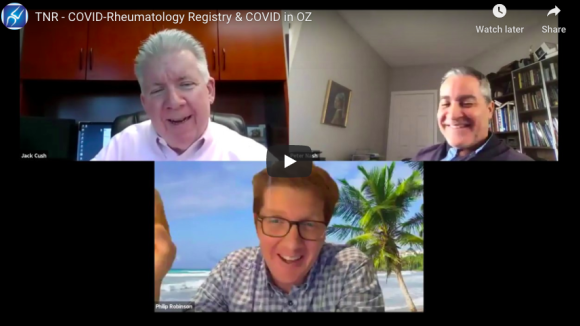
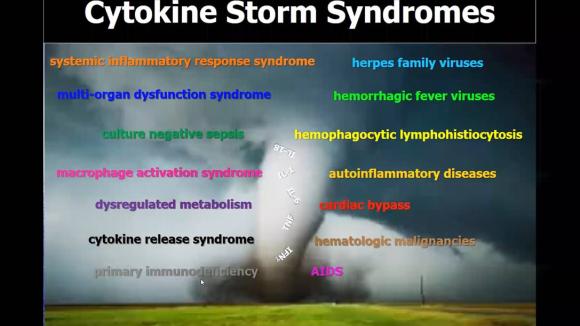
This week's Tuesday Nite Rheumatology featured Dr Randy Cron from the University of Alabama - Birmingham as he spoke and took questions on the immunology, immunopathogenesis and treatment of Cytokine Storm Syndrome, especially as they relate to COVID-19 and rheumatic disease patients. The program was moderated by Dr. Jack Cush.
All News
Two current reports from Boston and Wuhan describe cohorts of COVID-19 (+) rheumatic disease patients who generally do well but appear to have a higher risk of pulmonary involvement.
A current letter in the Annals of Rheumatic Disease details the rheumatic disease patient cohort outcomes from the University of Siena, Italy showing only 2 cases of COVID-19 among 859 patients treated with tsDMARDs and bDMARDs.
Today Lancet reported the results of another retrospective trial showing that hydroxychloroquine or chloroquine, alone or with a macrolide antibioitic, offered no additional benefits to COVID-19 patients, but was associated with higher rates of mortality and arrhythmia.
Lancet has reported COVID outcomes from NewYork-Presbyterian hospitals in NYC during March 2020 showing high rates of hospitalization, ICU admission, mechanical ventilation and death.
This week's Tuesday Nite Rheumatology features presentations and interviews with Drs. Peter Nash and Philip Robinson. Dr. Robinson presents latest data on the Rheum-Covid.org Registry, that he helped establish under the Global Rheumatology Alliance. Dr. Nash presents the impact of COVID in Australia and pragmatic COVID management.
Anakinra was studied in 29 COVID(+) patients with respiratory distress and high inflammatory markers (CRP or ferritin) and compared to non-anakinra patients, those on anakinra had better survival (90% vs. 56% ;p=0·009) and greater improvements in CRP and pulmonary function (72% vs 50%) compared to controls at day 21.
Hydroxychloroquine is one of many medications frequently used in rheumatology practice. Its remarkable versatility is attested by its routine use in lupus, in patients with an autoimmune coagulopathy, in patients with rheumatoid arthritis, as well as in those with a low-level inflammatory arthropathy.
Dr. Jack Cush reviews the news and journal articles from the past week on RheumNow.com.
The latest hazardous spinoff to the coronavirus infection is an inflammatory, Kawasaki-like syndrome unique to children or adolescents with COVID-19. Sporadic reports from around the globe of this severe pediatric COVID syndrome have littered the news with brief mentions and little detail.
As data continue to emerge about a multi-system inflammatory disorder in children apparently connected to COVID-19, evidence is growing that this is not your typical Kawasaki disease.
Annals of Rheumatic Disease reports on an analysis of lupus (SLE) patients that shows COVID-19 infection rates were similar between those lupus patients who were taking hydroxychloroquine (HCQ) and those not taking HCQ.
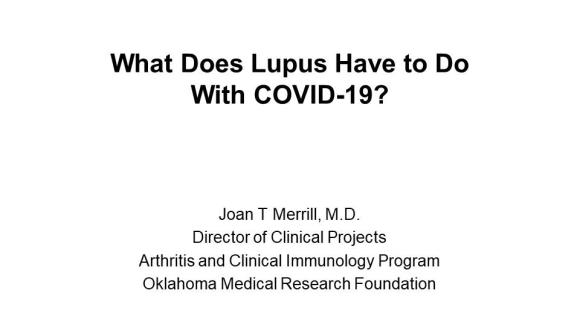
Last night's Tuesday Nite Rheumatology featured Dr. Joan Merrill (OMRF). In her lecture, "What does COVID-19 have to do with lupus?", she discusses the pathogenesis of lupus, and specifically thrombotic microangiopathy, complementopathies, catastrophic lupus syndrome and the potential overlap with the vascular pathology seen with COVID-19 infection.
MMWR reports that after attending a 2.5 hr choir practice with one COVID+ symptomatic person, 87% of the choir developed COVID 19; 3 were hospitalized, and two died.
Dr. Jack Cush reviews the news and journal reports from the past week on RheumNow.com.
Severe and fatal outcomes with coronavirus infection are often the result of the downstream damage that follows the viral infection.
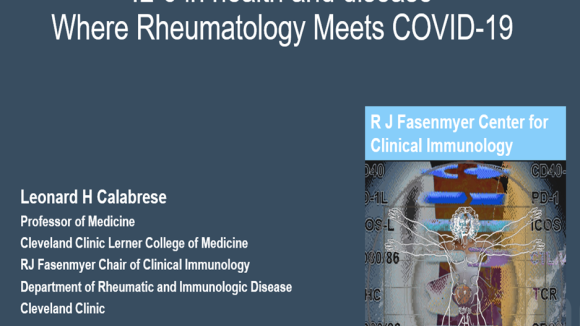
Dr. Len Calabrese from the Cleveland Clinic delivers this week's Tuesday Nite Rheumatology Grand Rounds, entitled "IL-6 in Health and Disease: Where Rheumatology Meets COVID-19".
Dr. Calabrese provides a comprehensive review of IL-6 biology, and discusses IL-6 signaling, IL-6 roles in health, exercise, infection, innate and adaptive immunity as pertains to both rheumatology and the management of coronavirus infection.
Hydroxychloroquine has been a dominant news item since the start of the COVID-19 crisis, with a great deal of misconceptions by those who don't know or use or take the drug. HCQ leaped to the headlines on March 19th when President Trump endorsed the drug as being “approved” by FDA. Of course at that time, it was still only approved for SLE, RA and malaria and it wasn't until 2 weeks later (March 31st) that the FDA issued an "emergency use authorization" allowing the use of either chloroquine or HCQ for treatment of severe, hospitalized patients with COVID-19.
To provide clarity and evidence - here are some of the facts you need to know.
JAMA Cardiology reports the risk of QT (QTc) prolongation when hydroxychloroquine (HCQ) was given to hospitalized patients with coronavirus disease 2019 (COVID-19), especially when given with azithromycin.