


Autoantibodies Anonymous Save

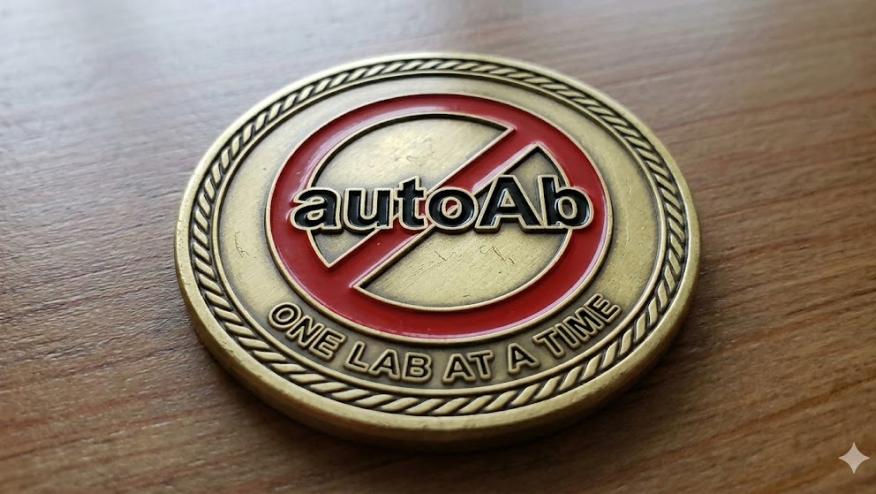
At first, it seemed similar to many other such sessions – a circle of folding chairs, a group of colleagues whose visages exuded understanding and acceptance – but this was special. I started the meeting…. “Hi, my name is Artie,”
“Hi Artie” came the reply from the group, synchronous and warm.
“It has been 1 year since I last ordered a myositis panel!” I announced, nervously. But the loud applause and earnest congratulations were quite encouraging. After all, it is not easy being an autoantibody nihilist these days. While most will admit that the use of autoantibody testing has gotten out of hand in rheumatology, the pressure to “… just check another antibody panel” is intense. Pressure comes both from patients as well as colleagues. The response of my peers assured me I had made a good choice.
I track my disillusionment with testing back to residency days. In the spirited competition between Internal Medicine and Surgery, it was natural to create nicknames. Among other monikers, our surgical colleagues derisively called internists “hummers”. I asked a surgical resident friend what that meant… she said, “you internists order all these fancy tests… then when you get the results, you go ‘hmmmmm’…. but you don’t do anything!”. Ouch! If that is true, then rheumatologists may be the biggest hummers of all!
It is a challenge to be against autoantibodies, as they have such a storied place in rheumatology. The discovery of the antinuclear antibody (ANA) helped change SLE from a mysterious condition best diagnosed at autopsy, to a systemic autoimmune disease for we have learned a tremendous amount. The discovery of Rheumatoid Factor (RF) helped spur research and developments in Rheumatoid Arthritis (RA). Autoantibodies can help define disease activity and severity and domain involvement in a number of diverse rheumatologic conditions: some are even etiologically relevant.
But several things have happened over the years. The number of autoantibody tests has expanded tremendously. It is hard to keep up with the panoply of available tests, let alone their potential utility in the clinic. Also, techniques for performing autoantibody tests have evolved. In the old days, the techniques generally required high concentrations of high affinity antibodies (remember the Farr assay? Crithidia lucillae? Ouchterlony plates?) for a positive result. As a result, the tests tended to be very specific, but not completely sensitive. Remember how we taught our primary care colleagues that “a positive anti-Smith antibody or anti-dsDNA antibody meant that the patient had lupus”? But now the tests are done mostly by ELISA; much more sensitive, but much less specific. How many referrals do we get for a chronic pain patient with an ANA of 1:40 and a dsDNA of 4.01 (where <4 is negative, but a strong positive is > 20)? Hmmmmm….
Maybe most importantly, how autoantibody tests are used has changed. I call it “when good tests go bad”. When ANCA testing was new, it was incredibly useful. The reason was that it was only ordered in patients with a reasonably high pre-test probability of having vasculitis. Now, it is obtained for patients whose clinical picture bears no semblance to vasculitis. It is ordered as a “rule out vasculitis.”. When ordered in clinical circumstances with a very low pre-test probability of vasculitis, the test is much less useful. Professor Tom Huizinga of the Netherlands, tells a story about the early days of CCP testing. He appeared on Dutch television and proclaimed the CCP test was “very specific for Rheumatoid Arthritis”. For years after, his clinic was full of CCP+ fibromyalgia patients!
What is the downside of poor autoantibody testing? Cost, for one. While individual testing may be only hundreds of dollars, if there is no clinical utility, that is completely wasted. Worse, spurious positive results often engender additional testing, which involves additional costs, anxious patients, and wasted time for rheumatologists.
So, the next time you are tempted to order a “scleroderma panel” or a “myositis panel”; please stop and think. Make sure that the results will be impactful. Last year a young trainee in the clinic saw a new patient with scleroderma. Asked what they wanted to do, they replied “I want to check an Scl-70”. I asked why, and they replied, “because it is associated with interstitial lung disease in scleroderma patients”. A correct statement, and it showed the trainee had done their reading! The only problem was that the patient had come to us from Pulmonary clinic! With a diagnosis of ILD, having had an extensive workup! So, when the results of the Scl-70 or ‘scleroderma panel’ came back…positive or negative… what would we say? Hmmmmm……
Better yet.. start a chapter of ‘Autoantibodies Anonymous’ for your local rheumatologists! I will give out the ‘1 year chip’ gladly to all who make it!
Join The Discussion
Totally agree Artie- Ordering any tests ( especially high cost eg autoantibodies) should be based on test operating characteristics and Bayesian reasoning not reflexes!
Nowadays there are an abuse of autoantibodies panel without clinical reasonings.I agree with Artie and Len..Excellent!!
It's important not to throw the baby out with the bath water. While the utility of many autoantibody tests is unknown at this time, criteria-based antibody testing is important in order to complete the diagnostic picture. In SLE work-ups, for example, anti-phospholipid antibodies are weighted criteria items (2 points) and should be tested, not only for diagnostic purposes, but also for cardiovascular risk assessment in all SLE patients. This testing often requires separate orders from standard antibody panels and should not be overlooked in SLE work-ups, even in the absence of specific SLE antibodies. Anti-phospholipid antibodies confer increased cardiovascular and thrombotic risk, especially in the presence of thrombocytopenia, in all SLE patients-- even those who do not develop APS. The best approach is to use established weighted criteria to guide auto-antibody testing.
As my learned colleague, mentor (from afar) and friend, Len Calabrese said, Bayesian reasoning is the key. This seems to have been almost completely abandoned by most if any discussion in our and other fields. As someone who runs a very large immunology laboratory I have seen and had to deal with the gross misuse of testing , instead of, as meant, tests which stratify diagnosed patients to screening tests where pre-test probability is close to zero. Simple maths says if a patient has less than 1% of having the disease , that even a 99% specific test ill yield more false positives than true.
Recently I was shocked to see in an ACR supported publication, the call to investigate young women with an ANA of 1:320 for possible Sjögren’s syndrome. This is despite lack of symptoms. The yield will damage patients in the desire for early diagnosis, despite total lack of evidence its even possible in real life.
Happy to be debated on any of the above. As an overseas ACR member, it’s dismaying to see what I have spent 25 years teaching about ignored.
Daman
Disclosures
Disclosures
The author has no conflicts of interest to disclose related to this subject





If you are a health practitioner, you may Login/Register to comment.
Due to the nature of these comment forums, only health practitioners are allowed to comment at this time.