

VEXAS Syndrome - A Review Save


Know-it-Now
- VEXAS syndrome is an acquired, UBA1-driven autoinflammatory disorder uniquely bridging rheumatology and haematology — it should be considered in any older man with unexplained treatment-refractory inflammation plus cytopenia.
- Prevalence is approximately 1 in 4,000 men over age 50; substantial underdiagnosis is expected given the breadth of rheumatological mimics (relapsing polychondritis, vasculitis, adult-onset Still's disease).
- Diagnosis requires genetic confirmation of a pathogenic UBA1 variant (exon 3 sequencing); bone marrow vacuolation is a supportive but non-specific finding.
- Glucocorticoids remain the most reliably effective anti-inflammatory agent, but chronic dependence is universal and toxicity is substantial.
- IL-6 and JAK inhibitors (especially ruxolitinib) may achieve partial inflammatory control and steroid-sparing; azacitidine can induce molecular remission but carries haematologic toxicity.
- Allogeneic haematopoietic cell transplant (HCT) is the only potentially curative option and should be considered early in eligible patients.
- Infection — including opportunistic pathogens (PJP, NTM, VZV) — contributes substantially to morbidity and mortality; prophylaxis strategies should be implemented proactively.
- Multidisciplinary care (rheumatology + haematology ± dermatology) and enrolment in registries are essential to generate the prospective evidence currently lacking.
Beck et al has published a review of the VEXAS syndrome in The Lancet, focusing on the pathogenesis, spectrum, and treatment strategies.
VEXAS = Vacuoles, E1 enzyme, X-linked, autoinflammatory, somatic (VEXAS) syndrome is a monogenic disease of adulthood caused by acquired somatic mutations in the UBA1 gene within haematopoietic cells. Characterised by treatment-refractory systemic inflammation and progressive bone marrow failure, VEXAS is uniquely challenging to rheumatologist and haematologists.
VEXAS syndrome was first described in 2020 following analysis of peripheral blood exome-sequencing data from patients enrolled at the NIH. Three of 2,560 patients harboured novel somatic UBA1 variants at the same codon, methionine-41 — all older men with severe, treatment-refractory systemic inflammation and cytopenia. The defining feature is a somatic hypomorphic mutation of UBA1, the master E1 ubiquitin-activating enzyme, arising in haematopoietic stem and progenitor cells.
UBA1 encodes the initiating enzyme of the ubiquitin-proteasome system, the cell's principal mechanism for tagging proteins for degradation. Pathogenic variants at Met-41 selectively impair the cytoplasmic isoform of UBA1 while partially preserving nuclear function. The consequence is endoplasmic reticulum (ER) stress, impaired proteasomal clearance, and activation of innate immune signalling — particularly myeloid-driven pathways — producing the characteristic cytokine profile of VEXAS. Because the mutation is restricted to hematopoietic cells, myeloid lineages bearing the variant clonally expand and dominate, while erythroid, megakaryocytic, and lymphoid output progressively decline, explaining the concurrent cytopenias and bone marrow failure.
Population-based exome sequencing studies now estimate VEXAS prevalence at approximately 1 in 4,000 men over age 50 and 1 in 26,000 women of comparable age, making it substantially more common than most recognised rare diseases. The male predominance reflects UBA1's X-linked location: men require only one somatic mutation to achieve functional haploinsufficiency, whereas women's second X chromosome provides partial protection. Nonetheless, female cases — typically presenting with more overlap with connective tissue diseases — are increasingly documented.
Age of onset is almost universally after 50 years. Risk factors beyond male sex and older age are not well characterised; co-occurring clonal hematopoiesis of indeterminate potential (CHIP) has been observed, and roughly 40–50% of patients carry concurrent myelodysplastic syndrome (MDS). The full epidemiological burden remains underestimated given the broad phenotypic overlap with conditions that frequently delay or preclude UBA1 testing.
Clinical Manifestations
VEXAS presents as a multisystem inflammatory disorder whose phenotypic breadth has led to diagnosis delays averaging several years. Systematic review data indicate the following approximate prevalence of major manifestations:
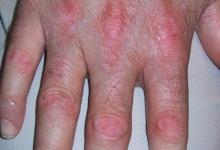
- Cutaneous (81%): neutrophilic dermatoses, including Sweet syndrome and erythematous plaques; periorbital oedema is characteristic.
- Constitutional (69%): fever, fatigue, weight loss — often the presenting complaint and driver of prolonged diagnostic odyssey.
- Respiratory (61%): tracheal and bronchial chondritis, pulmonary infiltrates, and pleural effusions.
- Musculoskeletal (47%): inflammatory arthritis, often seronegative; periostitis has been reported.
- Ocular (44%): scleritis, episcleritis, uveitis — a rheumatologically important clue.
- Haematological: macrocytic anaemia, leukopenia (especially lymphopenia and monocytopenia), thrombocytopenia; MDS in ~40–50%; venous and arterial thromboembolism.
Importantly, VEXAS is a well-established mimic of relapsing polychondritis, ANCA-associated vasculitis, adult-onset Still's disease, giant cell arteritis, and undifferentiated connective tissue disease. Rheumatologists should suspect VEXAS when these diagnoses prove refractory to standard immunosuppression, particularly in men over 50 with concurrent macrocytosis or unexplained cytopenia.
No validated classification criteria yet exist. Diagnosis requires genetic confirmation of a known pathogenic UBA1 variant alongside supporting clinical features (systemic inflammation and/or cytopenias). Targeted sequencing of UBA1 exon 3 — where the methionine-41 substitutions cluster — is the preferred first-line test. Whole-gene next-generation sequencing is reserved for atypical cases or when exon 3 testing is unrevealing. Bone marrow biopsy characteristically shows myeloid and erythroid precursor vacuolation, an important histological pointer, though this finding is not pathognomonic. Predictive models and screening algorithms are in active development to prioritise UBA1 testing within large inflammatory disease populations.
Treatment
- Glucocorticoids remain the most reliably effective agents for acute inflammation control in VEXAS. However, disease flares on dose reduction are nearly universal, and the cumulative toxicity burden in an already elderly, comorbid population is considerable. No patient should be maintained on long-term high-dose glucocorticoids without a concurrent steroid-sparing strategy.
- Cytokine-Directed Therapies: IL-6 receptor inhibition (tocilizumab) and JAK inhibition (particularly ruxolitinib) have demonstrated the most consistent steroid-sparing benefit in retrospective cohort data. A UK multicentre study of 59 patients demonstrated superior complete and partial response rates for tocilizumab over anakinra, baricitinib, or prednisolone alone. Responses are typically partial; molecular remission and haematological recovery are not achieved with immunosuppression alone.
- Hypomethylating Agents: Azacitidine targets the mutant haematopoietic clone directly and can induce clinical, biochemical, and molecular remission in a subset of patients. Reported complete response rates vary widely (0–66%) across cohorts, reflecting heterogeneous outcome definitions. Haematological toxicity — including worsening cytopenias during induction — is a significant barrier, particularly in patients with baseline bone marrow failure.
- Allogeneic Haematopoietic Cell Transplant: HCT is the only intervention capable of eradicating the UBA1-mutant clone and should be considered the treatment goal in eligible patients. Retrospective multicentre EBMT data confirm feasibility and durable responses, though transplant-related morbidity and mortality in an elderly population require careful patient selection and centre expertise. Early referral to transplant-capable centres is advisable for patients under approximately 70 years without prohibitive comorbidities.
Infectious Complications
Infection is a leading cause of morbidity and mortality in VEXAS, with systematic review data across 813 patients documenting severe infections in 40–60% of cases and infection-attributable fatality in 6–15%. Pulmonary infections predominate, followed by cutaneous infections and bacteraemia. Opportunistic organisms — Pneumocystis jirovecii, Legionella pneumophila, non-tuberculous mycobacteria, and varicella-zoster virus — are disproportionately represented, even in patients not receiving intensive immunosuppression, implicating intrinsic immunodeficiency from lymphopenia and monocyte dysfunction. Prophylactic strategies (PJP prophylaxis, VZV vaccination, judicious antimicrobial cover) should be instituted proactively and reviewed at each treatment escalation.
Prognosis
Median survival data are limited, but 5-year mortality exceeds 50% in some series, driven by disease progression, bone marrow failure, infection, and thromboembolism. Male sex, monocytopenia, and co-occurring MDS are adverse prognostic markers. The discovery of VEXAS has broader implications: it demonstrates how somatic mutations — previously considered relevant only to haematological neoplasia — can drive complex multisystem inflammatory diseases in adulthood, and likely represents the vanguard of a broader class of 'haematoinflammatory' disorders awaiting description.
Prospective registries, harmonised outcome frameworks, and dedicated clinical trials are urgently required. The absence of randomised controlled trial data means current therapeutic decisions remain empirical. Rheumatologists are uniquely positioned as first-line diagnosticians and should champion early genetic testing, multidisciplinary management, and patient enrolment in research cohorts.
ADD THE FIRST COMMENT
Disclosures
Disclosures
The author has no conflicts of interest to disclose related to this subject
The author used AI to research and organize this content, and maintains responsibility for its accuracy




If you are a health practitioner, you may Login/Register to comment.
Due to the nature of these comment forums, only health practitioners are allowed to comment at this time.