


Canada's 2025 Top 10 Funded Rheumatology Projects Save

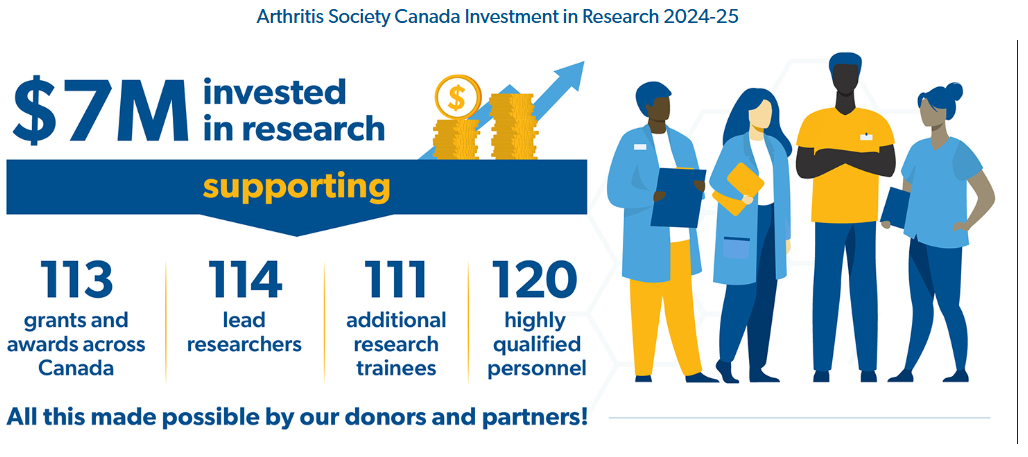
Arthritis Society Canada (ASC) is Canada’s largest charitable funder of cutting-edge arthritis research, investing more than $240 million in research projects since its founding, and over $7 million invested in 2024-2025.
ASC announced the grants they supported in 2025. Below are the investigators and projects that were funded in 2025.
- Dr. Susanne Benseler and Dr. Rae Yeung - A window of opportunity in childhood arthritis
- The finding: In the international Understanding Childhood Arthritis Network (UCAN) study of 130 children with non-systemic juvenile idiopathic arthritis (JIA), which was enabled by a first-of-its-kind partnership of Dutch and Canadian funders including Arthritis Society Canada, researchers found that starting biologic medication earlier can significantly affect treatment success. 83% of children who started biologics within 6 months of their initial symptoms achieved inactive disease, compared to 57% of those who waited 13–24 months. For every month of delay, the odds of still having active arthritis after six months of treatment increased by a relative 9%, revealing a critical “window of opportunity” to better manage childhood arthritis.
- Dr. Omar Cruz-Correa and Dr. Dafna Gladman Potential biomarkers for psoriatic arthritis development
- The finding: 30% of patients with psoriasis go on to develop psoriatic arthritis (PsA), but there is currently no reliable way to predict who will be affected. By studying microRNAs (miRNAs) – molecules that control which genes are active – researchers identified two molecular markers (miR-190a-5p and miR-26b-5p) that were consistently lower in PsA patients. When these markers are reduced, genes involved in bone formation and repair pathways are disrupted, potentially explaining how joint damage occurs in PsA.
- Dr. Lisbet Haglund and trainees Matthew Mannarino and Dr. Hosni Cherif A potential therapy for painful spine arthritis
- The finding: Researchers showed the potential of a new combination treatment for painful spine arthritis in a study of mice with low back pain resulting from deteriorated disks in the spine. The treatment, given by mouth, targets senescent cells – “zombie” cells that resist dying, build up with age, and release substances that can trigger deterioration in nearby tissues. The treatment successfully removed these cells, reduced signs of pain, and improved bone health in the mice, demonstrating a promising level of safety.
- Dr. Raffaella Carlomagno, Melissa Misztal, Dr. Linda Hiraki A deep dive into the genetics of lupus
- The finding: For the first time, two pivotal studies of the genomes of nearly 1,500 children and adults with systemic lupus erythematosus (SLE) identified specific genetic variants associated with (i) disease severity in adult-onset lupus over time, and (ii) younger age at diagnosis and risk of childhood-onset lupus.
- Dr. Luke Johnson, and Drs. Kishore Mulpuri and David Wilson Preventing hip osteoarthritis in young adults
- The finding: Researchers used a MRI technique called T1ρ (T1 rho) to compare cartilage health in young people with and without Legg-Calvé-Perthes disease (LCPD), a childhood hip condition that “heals” naturally but often leaves permanent hip deformities, which can increase risk of osteoarthritis. While hips without LCPD developed cartilage normally as teens aged, LCPD hips showed progressive cartilage deterioration through the teenage years.
- Dr. Linda Li Improving rheumatoid arthritis self-management through digital coaching
- The finding: Researchers tested whether combining Fitbits, an activity tracking app, and remote physiotherapist phone coaching could help 131 people with rheumatoid arthritis (RA) better self-manage their condition. After 27 weeks, participants showed significant improvements in their confidence to manage their RA, including improved RA disease activity and self-reported walking habits, as well as reduced fatigue and depression, compared to controls.
- Dr. Darren Mazzei and Dr. Deborah Marshall Estimating the impact of investments in education and exercise for people living with osteoarthritis
- The finding: Researchers modeled the impact of public funding for Good Life with osteoArthritis in Denmark (GLA:D), a standardized exercise and education program to help people with hip or knee osteoarthritis as they wait for an orthopedic consultation for a total joint replacement in Alberta. Public investment in this program would pose an affordable way to serve 12,500 Albertans and save $8.5 million by avoiding 1,300 joint replacement surgeries in year one.
- Dr. Addison Pacheco and Dr. Robert Inman Improving treatment response in axial spondyloarthritis
- The finding: Blood analysis of 30 people with axial spondyloarthritis revealed immune signatures that help predict whether patients will respond to secukinumab, a biologic therapy that blocks inflammation-driving IL-17A-producing cells. Non-responders had more of these cells before treatment and showed enhanced “type 1 interferon” activity (a different inflammatory pathway) after therapy, suggesting their inflammation operates through multiple pathways that secukinumab alone may not control.
- Dr. Anthony Perruccio Females with osteoarthritis are more likely to develop cardiovascular disease
- The finding: By examining data from thousands of adults with and without osteoarthritis (OA), researchers found that females with OA had a 90% higher risk of developing cardiovascular disease within six years, compared to females of the same age without OA. This increased risk was above and beyond what routine risk prediction tools would suggest and was partially linked to levels of inflammation in their bodies. This relationship was not seen for males.
- Jingyi Huang and Dr. Guangju Zhai A potential new drug target for hip osteoarthritis
- The finding: Researchers analyzed cartilage from over 100 people with and without hip osteoarthritis (OA) and identified 179 genes that behave differently in hip OA compared to healthy joints. Eight key “hub genes” were pinpointed as central players in the disease, with most involved in disrupting the normal formation and balance of collagen – the main structural protein that keeps cartilage healthy and strong. One hub gene called SDC1 emerged as a promising new drug target as it is already classified as “druggable”, with some cancer medications targeting SDC1 already in clinical trials.
Continue Reading
ADD THE FIRST COMMENT
Disclosures
The author has no conflicts of interest to disclose related to this subject






If you are a health practitioner, you may Login/Register to comment.
Due to the nature of these comment forums, only health practitioners are allowed to comment at this time.