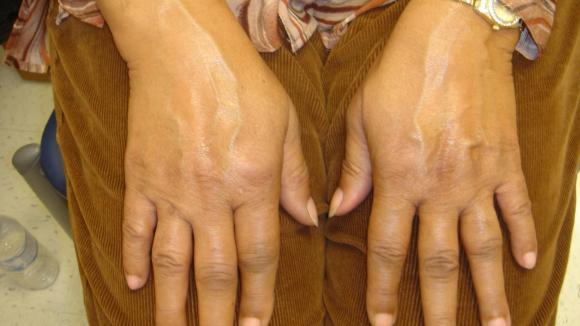
Patients with psoriatic arthritis (PsA) whose disease manifestations include enthesitis showed significantly greater responses to interleukin (IL)-23 inhibition than to blocking tumor necrosis factor (TNF), suggesting the possibility that treatment decisions in the future might be guided by speci
All News
Dr. Jack Cush reviews EULAR 2018 and the past week's news and reports from RheumNow.com, including DMARDs in OA, the price of Penicillamine, Infections when ANCA+, CV outcomes in gout, NSAIDs in Pregnancy and Seropostive vs. Seronegative Outcomes.
Novartis announced today that the US Food and Drug Administration (FDA) approved the inclusion of new evidence that Cosentyx® (secukinumab) significantly slows the progression of joint structural damage at Week 24 versus placebo in those with active psoriatic arthritis (PsA).
A study from the American Journal of Obstetrics & Gynecology analyzed pregnant women from the Kaiser Permanente healthcare system and compared newly pregnant women who took non-steroidal anti-inflammatory drugs or acetaminophen or neither showed that using NSAIDs around conception carried a more than four-fold higher risk of early miscarriage. (Citation source: http://bit.ly/2tqNWN6)
A cohort study of 241 DMARD-naive rheumatoid arthritis (RA) patients, meeting either 1987 ACR or the 2010 ACR/EULAR classification criteria for RA, compared the baseline status and long term outcomes of seronegative (SNRA) and seropositive (SPRA).
MMWR reports that approximately 46 million persons (14%) in the United States live in nonmetropolitan counties, where there is a higher prevalence of obesity-associated chronic diseases such as diabetes, coronary heart disease, and arthritis.
Obese knee osteoarthritis (OA) patients who lose > 20% of their weight were in significantly less pain, had better function and improved quality of life.
The EULAR 2018 wound down on Saturday with fewer oral presentations but many posters. In my last report I put together a collection of impressions and some thematic highlights not covered in previous reports.
Our colleagues in gastroenterology measure drug levels with certain biologics used in inflammatory bowel disease in order to increase the dose for optimal benefit if the patient has a low trough level (i.e. targeting drug level).
We are supposed to treat to a target (T2T) in RA. In other words, measure many components of the disease and its activity and calculate a score and if the patient is not in remission (or a low state if remission is not achievable) we are to make a treatment change.
Day 3 highlights include Behcet’s responds to apremilast and that biologics do not differentially affect TKR/THR post-operative infection rates. Be sure to check out today's podcast as well.
This EULAR 2018 Podcast is a compilation of audio clips from EULAR in Amsterdam.
You can also listen on iTunes, Soundcloud or Stitcher.
Highlights from Day 2 of the EULAR meeting in Amsterdam include high MBDA scores in ACPA negative RA predicts remission; characterization of difficult RA; and gender differences in psoriatic responses to TNF inhibitors.
This EULAR 2018 Podcast is a compilation of audio clips from EULAR in Amsterdam.
Abbvie press releases feature the results from 3 new trials to be presented during the Annual European Congress of Rheumatology (EULAR 2018) in Amsterdam from three Phase 3 trials evaluating upadacitinib, an investigational, once-daily oral JAK1-selective inhibitor, in adult patients with moderat
Highlights from the first day at EULAR include: canakinumab prevents acute gout; AS uveitis benefits from most TNFi; MRI does not improve T2Tor X-ray outcomes; baracitinib wins in SLE - maybe?; new lupus criteria; and lost survival in RA. Here's the RheumNow recap.
Recent shifts in the cancer treatment paradigm towards immune therapies has led to wide implementation of the novel immune check point inhibitors (ICI) in the treatment of multiple types of advanced cancer.
Beloved by gastroenterologist for treatment of inflammatory bowel disease (IBD), α4β7 integrin receptor vedolizumab (VDZ) has probably caught attention of many rheumatologist since the time it entered the market; largely for what it won't do for inflammatory arthritis.
While many autoinflammatory syndromes are driven and managed with select inhibition of IL-1, IL-18 or IL-6, a subset are driven by type I interferon and are referred to as interferonopathies. These monogenic IFN–mediated disorders present in infancy with fevers, systemic inflammation, an IFN response gene signature, inflammatory organ damage, and high mortality.
In the current issue of the New England Journal of Medicine, Drs. James Rosenbaum and Gregg Silverstein review the pathogenesis of systemic lupus erythematosus (SLE) from the viewpoint of a dysbiolsis.