New research presented this week at ACR Convergence, the American College of Rheumatology’s annual meeting, shows that Black people living with systemic sclerosis may have more severe disease and worse prognosis than patients in other racial or ethnic groups, and these worrying disparities may be driven by several socioeconomic factors (Abstract #1854). This poster will be presented Tuesday morning, November 9, 2021 in the Clinical Poster III (1836–1861) section on Systemic Sclerosis & Related Disorders.
All News
The American Society of Clinical Oncology, Inc (ASCO) has updated its guidelines and recommendations for the management of immune-related adverse events (irAEs) in patients treated with immune checkpoint inhibitor (ICPi) therapy. Below are select statements from this guideline.
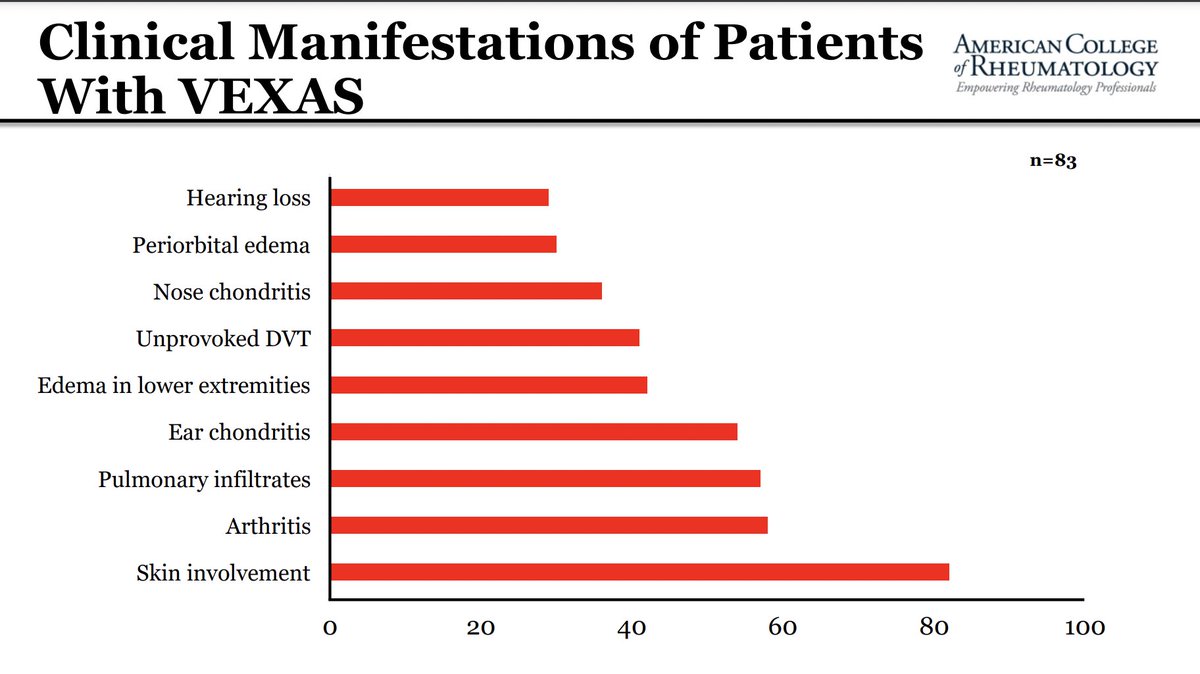
New research to be presented this week at ACR Convergence, the American College of Rheumatology’s annual meeting, shows a relationship between genotype, bone marrow failure and survival in patients with the rare autoinflammatory disease VEXAS syndrome, which was only identified in 2020.
Dr. Jack Cush reviews the FDA approvals, news and the latest journal articles from the past week on RheumNow.com.
Both systemic onset juvenile idiopathic arthritis (sJIA) and adult-onset Still’s disease are acquired autoinflammatory disorders of uncertain etiology. Yet recent reports of AOSD onset and flare following COVID-19 vaccinations may have important mechanistic implications.
While myositis-specific autoantibodies (MSAs) and myositis-associated autoantibodies (MAAs) may have prognostic value through their clinical associations, many patients will not have them and overall, they are poorly predictive of a malignancy risk.
Lupus Frailty Index Predicts Organ Damage
Patients with longstanding systemic lupus erythematosus (SLE) who were considered frail were more likely to accrue disease damage over time, a secondary analysis of data from a Chicago lupus cohort found.
A population based Swedish study of birth records shows that antibiotic exposure in first three years of life to be associated with a future risk of juvenile idiopathic arthritis (JIA), although infections during fetal life or childhood did not increase risk of JIA.
A longitudinal study from Iceland shows an increasing number of native joint infections (NJI), with iatrogenic, postarthroscopic infections being of particular concern.
Almost three years ago to the day, I did a podcast entitled, "I wanna new drug." As I go over this week's podcast, I want to say it again. I want a new drug safe enough to use during pregnancy, for PMR, for GVHD, and more. I'm going to cover these, and other topics including lupus, COVID breakthrough infections, and statin use and the risk of RA, as I review the news and journal articles from the past week on RheumNow.
This is the #1 question I get from new consults: “How did I get arthritis?”
But as the aching are asking, they are really thinking these joint complaints must be due to something.
Inclusion body myositis (IBM) patients tend to be older than those with idiopathic inflammatory myositis (IIM), but the scope of disease beyond their myositis is not appreciated.
Maternal and fetal outcomes during the COVID-19 pandemic have not been well studied; yet a new retrospective study from Mexico indicates that during the pandemic maternal mortality increased by nearly 57%, with COVID-19 as the cause in 23% of cases.
A retrospective records review of patients with periodic fever syndromes (PFS) receiving IL-1 inhibitor treatment with canakinumab (CAN), shows CAN to be effective and safe in a variety of PFS patients.
A smartphone-based symptom study of COVID-19 patients has shown that a healthy plant-based diet was associated with lower risk and severity of COVID-19, especially amongst those living in areas with higher socioeconomic deprivation.
A retrospective study of systemic sclerosis patients shows that acute hospitalization and mortality were not uncommon and were often linked to SSc-related lung disease.