


Scleroderma-Specific Autoantibodies in Early Systemic Sclerosis Save

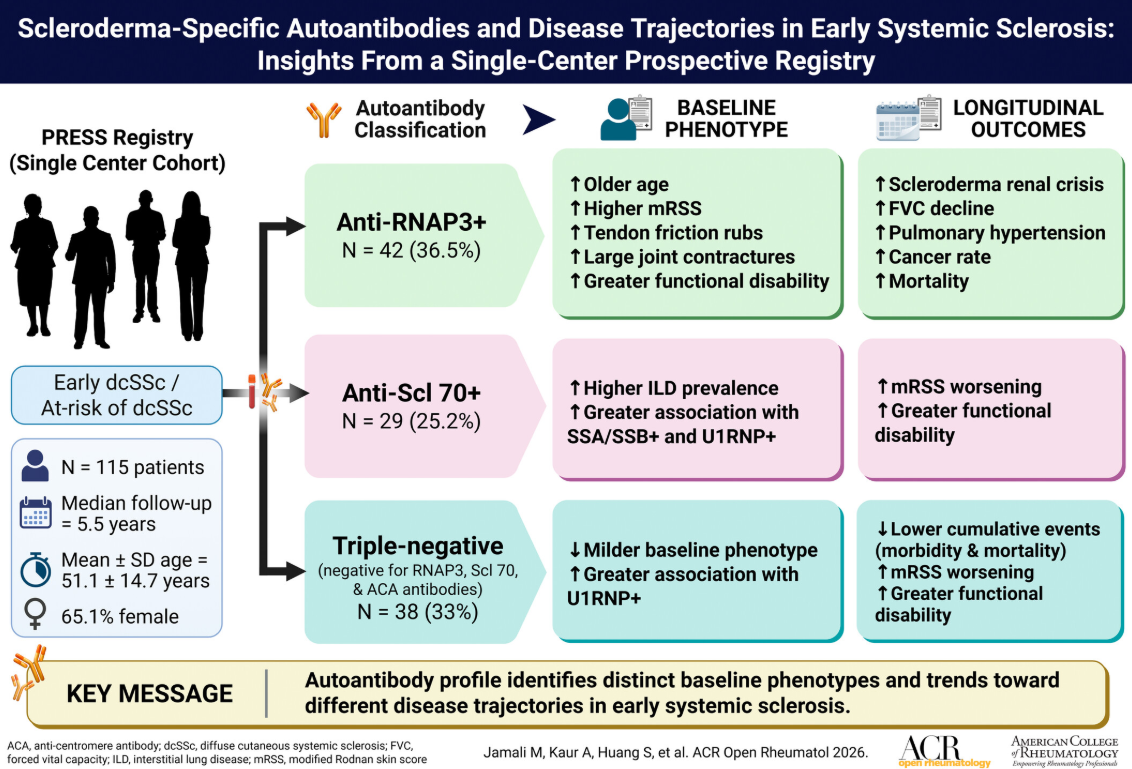
Prognostication is tenous in early scleroderma, especially in those with diffuse cutaneous systemic sclerosis (dcSSc). dcSSc has associated with substantial morbidity and disease-specific mortality. Analysis of an early SSc registry shows that anti-RNA polymerase III autoantibodies in early SSc were associated a higher risk of worse phenotypes and clinical outcomes.
While Scleroderma-specific autoantibodies (SSc-Ab) are thought to influence disease course, but their prognostic value in very early dcSSc remains unclear. This study was a retrospective analysis of prospectively collected data from a subset of patients enrolled in an early SSc registry (October 2012 and July 2021) - this included early dcSSc or individuals at risk for dcSSc (< 2 yrs of their first non-Raynaud phenomenon (RP) symptom). SSc-Abs included: anti-RNA polymerase III antibody positive (RNAP3+), anti-topoisomerase I antibody positive (Scl70+), or triple-negative (negative for RNAP3, Scl70, and anticentromere antibody [ACA]).
Cohort included 115 patients with a median follow-up, 5.5 years -- 42 were RNAP3+, 29 Scl70+, 38 triple-negative, and 6 ACA+ (these were excluded from subgroup due to small sample size).
Clinical Course Associations (92 patients).
- About half (54%) experienced new clinical events (60% RNAP3+, 57% Scl70+, 47% of triple-negative patients).
- RNAP3+ patients had more severe skin and musculoskeletal involvement, more tendon friction rubs; and a higher frequencies of:
- scleroderma renal crisis (6.3% vs 3.6% in Scl70+ and 0% in triple-negative)
- malignancy (35.7% vs 24.1% and 15.8%, respectively)
- mortality (9.4% vs 3.6% and 0%, respectively)
- FVC decline (15.6% vs 10.7% and 12.5%, respectively)
- Scl70+ patients had the highest prevalence of SSA/SSB positivity, and more SSc-ILD (P < 0.01).
- modified Rodnan skin score worsening was most frequent in triple-negative patients (15.6% vs 10.7% in Scl70+ and 9.4% in RNAP3+).
Scleroderma-specific autoantibodies in early SSc were associated with distinct baseline clinical phenotypes and showed numerical differences in longitudinal clinical outcomes in this single-center cohort.
Related Content


ADD THE FIRST COMMENT
Disclosures
Disclosures
The author has no conflicts of interest to disclose related to this subject





If you are a health practitioner, you may Login/Register to comment.
Due to the nature of these comment forums, only health practitioners are allowed to comment at this time.