


Count Your Telangiectasias (5.29.2026) Save
Transcription
May 29, 2026. This is the RheumNow podcast. Hi, I'm Dr. Jack Cush, executive editor with RheumNow.com. A lot to cover this week. We're coming up on EULAR next week in London. We'll be there covering the meeting. Hope you'll be following us. You know, one way to follow us is through either the panel discussions and videos. Read the articles, watch the tweets, or do the quizzes. You know, we do a quiz every Saturday. And last quiz, you know, didn't do so good if you ask me. A lot of people missed these two questions on lupus. True or false? An NIH lupus study said fatigue was found to correlate with disease activity. And less than half of you got that right. The right answer is false. It didn't correlate with disease activity. It's sort of like non-lupus features that drove fatigue.
Another question on a very popular topic and that is hydroxychloroquine blood levels. When monitoring hydroxychloroquine blood levels, the whole blood level that is associated with higher SLE flares and hospitalizations was less than 750 nanograms per ml. A really good article was written about that. This past week, we had a really good article by Shivani Garg and Don Thomas on why you should be doing hydroxychloroquine blood levels. You might want to check that out.
So, let's start with a study from the VA administration who looked at RA patients and the influence of RA on cancer treated with immune checkpoint inhibitors. We know immune checkpoint inhibitors give us immune related adverse events, irAEs, but that's not the point here. This is a popular immunotherapy being used to treat all kinds of cancers. What happens if you have RA on top of that? Do they have worse outcome? And the study of 301 patients compared to a large non-RA population showed no increased risk in all cause mortality. Death rates were similar and less than 1%. Cause of death was the same. Infections were rare — actually infections were less than 1%. The death rate I think was around 30% in the time that they followed up. So RA didn't — you know, your RA patients who need these therapies can go ahead and get these therapies.
A Korean study looked at fracture rates in RA. We know it's increased and that's what they found — a 68% increase in fractures in the RA population compared to non-RA based on claims data. It turns out that being treated with aggressive therapies, biologics or targeted synthetics, did not change that result. That merits further investigation. A headscratcher for me is why seropositives had more fractures than did seronegatives. And these were significant — overall a 19% increase, vertebral a 40% increase, hip fractures a 55% increase. You know, RA seronegative versus seropositive — my lecture on that is that they are both bad, but they do have different outcomes, do they not? In other ways, I don't know why that happened. I think it's interesting.
Another RA study looked at holding methotrexate when you're going to vaccinate. This is a study of 250 patients receiving the Prevnar 13 PCV13 vaccine, and either they continued the methotrexate or they held it for a month. As you know, the research by Park et al. first showed that you could hold methotrexate for two weeks and they do great. Methotrexate really hampers vaccine responses big time. Methotrexate and rituximab. So you need to plan around that. Then Park's follow-up study, also a great study, showed you only need to hold methotrexate for one dose, one week. This study must have been done before those were published, but nonetheless, 249 patients — they held the methotrexate for four weeks. They proved that holding it for four weeks gave the best humoral responses. But then in this study they had an extension of one year, whether holding the methotrexate for four weeks was going to hurt the patient — you know, they were going to flare and do worse. And it turns out they did not. So hold the methotrexate one week, two if you must. You don't need to hold it for four.
A study of JAK inhibitors in Still's disease with macrophage activation syndrome — I've talked about that before. We don't have a lot of data. So I found it interesting that there was a small series of seven patients treated with ruxolitinib — a JAK inhibitor usually used for myelofibrosis and other indications, not indicated in rheumatology. Nonetheless it was used in seven patients, one and a half to 11 years of age, male female equal. Five of the seven had complete remission, the other two partial remission. Two relapsed when they stopped the steroids. Looks good. Think about it when you don't know what to do when systemic JIA is complicated by MAS.
Hopkins looked at the safety features of hydroxychloroquine used in their cohort of 106 chronic DLE discoid lupus patients — 5-year outcomes in their cohort. The patients who were treated with hydroxychloroquine compared to those who were not had less hyperlipidemia, less peripheral arterial disease, less angina, and less
coronary artery disease. They follow that up with a trietics large EMR analysis showing basically the same results in in DLE — hydroxychloroquine associated with significantly less hypertension, hyperlipidemia, diabetes, coronary artery disease, and stroke. Again, everyone in lupus has got to be on Plaquenil, but really everyone in RA should be on hydroxychloroquine as well. I know you can probably find some old videos that I did where I was sort of, you know, saying don't use hydroxychloroquine as your sole drug or your only drug or your first drug. I think it's an add-on drug that has tremendous value, especially in RA, especially in lupus.
A study of extracellular traps, anti-neutrophil extracellular traps or NETs, was studied in 349 autoimmune patients — RA and scleroderma. Antibodies to NETs were found in 37%. NETs by the way are sort of the phenomena involved in the LE cell, you know, grabbing a nucleus and engulfing it. That's all NET driven. Okay. NETs were found in over a third of lupus patients. But the important thing here is that when they were there, it was associated with higher rates of anti-phospholipid syndrome, arterial thrombosis. Hm. What about if it was found in RA? It was found in 40% of RA, where it was associated with higher levels of ACA or more ACPA positivity. Both those findings were significant.
A retrospective study of hydroxychloroquine and leflunomide in Sjogren's. Oh boy, this is, you know, great excitement for the rheumatology community. It's called the Repurposed 2 study. The problem with this study is it's only like, you know, a few patients — you know, 25 in each group. Actually, I'm sorry, this is a phase two trial of patients who were treated with hydroxychloroquine and leflunomide versus just, I think, one of those, in patients with active Sjogren's, and it was shown to be effective. But there are plenty of studies showing that DMARDs don't work, including hydroxychloroquine does not work in Sjogren's. This is a small study. I wouldn't change my treatment because of it. We need better drugs. We need better treatments — that's coming up. We've got a lot of good studies that are in play right now that look very promising.
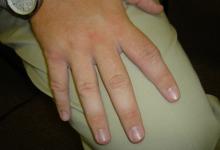
I like the study about — not Sjogren's — scleroderma, and how you can maybe assess patients with scleroderma. A retrospective international study looked at telangiectasia counts, either done by the physician or done by the patient. This has been out there a while — that you can count the telangiectasias on the face and on the hands and arms. And in this study the counts were clearly, significantly associated with pulmonary artery hypertension and digital ulcers. Then more importantly — well, moderately important — was a moderate agreement between MD telangiectasia counts and patient telangiectasia counts. The kappa statistic there is 0.6. It's an agreement, and so it's not too bad — moderate agreement. But you know, on all my scleroderma patients I do a modified Rodnan skin score. I score skin tightness in, I think, 18 areas from the fingers down to the toes, bilaterally, and I record that at every visit, just like I record a DAS or a GAS score at every visit in RA. Maybe we should be doing telangiectasia counts. It's pretty simple. They're easy to spot — again, face, hands, and forearms. And their categories were none, 1 to 6, 7 to 15, or greater than 15. Sounds like greater than 15 may not be a good thing.
Another study in autoimmune disease looked at adverse drug events. And you know what? It's high in autoimmune disease. Which one of our autoimmune diseases had the greatest number of one or more adverse drug events? In the study of 10,000 patients, it was systemic sclerosis at 36%. Contributors to adverse drug events were polypharmacy. Yeah, polypharmacy. I'm going to talk about that later. And interestingly, you would think that, well, these are autoimmune patients on a lot of aggressive medicines — you know, bad things happen. Turns out that there were more adverse drug events from non-autoimmune drugs, not from DMARDs and steroids. A lot of them were from antacids and H2 blockers for the stomach, acetaminophen, and other pain medicines, and medicines for depression and anxiety were more likely to give adverse drug events.
Now this next one may be the goofy study of the week. I don't know what to make of it. It's a very large biobank study — 480,000 people — looked at the influence of mobile phone use on rheumatoid arthritis. They followed these people over 13 years. In this 480K population study there were 6,000 new RA cases. And yes, cell phone use was associated with an increase in incident RA, hazard ratio 1.14. That was significant. That's a 14% increase. And it was 8% if you used your cell phone only 30 minutes or more a week. Turns out that going hands-free and using a speakerphone
was not associated with it. Now, am I going to say that cell phones are going to cause RA? You know, no, cell phones have been around a long time. I don't think we're seeing more RA because of all the cell phone use, but this is a much talked about association. Other studies have been done looking at the effects of maybe radiation and 5G mobile phones on things like cancer and chronic diseases, not necessarily autoimmune, and they mainly debunked that possibility. I put it out there, let you know, well there is a study, you know, but I think we need more research on this to know how to handle this or whether this is something worth counseling your patients on. I think you should spend your time counseling patients on weight loss, smoking cessation, healthier lifestyles — if you want to avoid RA, that might be the way to go.
A population study again, this time from the UK Clinical Practice Research Datalink. It's a very large study from which a lot of good population studies are drawn. They looked at 5.2 million pregnancies, 2 and a half million births. And they found that amongst our autoimmune patients there's a lot of problems, but we know that, but I thought I would delineate those for you. What they found — I thought the surprising one — was that there was an increased relative risk of miscarriage in Sjögren's. I didn't know that. I know plenty about pregnancy and RA and lupus and other inflammatory conditions. I wouldn't consider Sjögren's autoimmune — I don't know if — I consider it inflammatory because anti-inflammatory therapy doesn't work, pure and simple. But a 66% increase. C-sections are increased in IBD 27%, small for gestational age increased two-and-a-half-fold in lupus, as was pre-term birth — 53% increase — stillbirth increased in lupus, this has all been reported before, and more anxiety and depression in lupus patients during pregnancy.
So again, another quiz question that I put out this week that a lot of you didn't get right. It said, you know, according to — oh no — after treating an infection, after treating which infection can you safely resume anti-TNF therapy? And the right choice here that most people didn't get right was zoster. The bottom line is that you can't resume TNF inhibitors with either an invasive fungal infection — histo and cocci — or invasive candidiasis, not oral candidiasis. And you can't resume TNFs with atypical mycobacterial infections, or NTMs, non-tuberculous mycobacterial, because you never fully eradicate — you treat those, they get better, that's great, but you never fully eradicate that, and if you give back the TNF inhibitor they're going to break down more granulomas, they're going to again recur. So you never do that. You should also never do that with BCG, right, especially if they've had recurrence of TB from BCG.
The one that you can restart is herpes zoster. Many people, when they get zoster on a TNF, they stop the TNF, they treat the zoster, and they restart the TNF, and there are studies to show that there's no further recurrence. Why did they get it on a TNF? Well, they got RA, they're old enough, they're on other drugs and steroids, and they may also be on JAK inhibitors — that drives zoster risk. So, and then there was a comment about, well, vagal nerve stimulation would be good here. Well, no. Vagal nerve stimulation would not be an alternative in someone with an infection. Vagal nerve stimulation works through the cholinergic reflex and whatnot, but basically by inhibiting TNF as its main mechanism — got one number of different mechanisms — but I think the main mechanism is TNF inhibition, you'd still get the same issue as if you restarted, you know, etanercept. That was an erroneous comment that came across.
From this last report, from Dr. Asdanny and colleagues, they looked at polypharmacy and lupus. This is a population-based study from Atlanta of 451 verified SLE patients, and they showed that half of their patients had polypharmacy. I've talked about polypharmacy. I worry about polypharmacy. I think you should too. Polypharmacy is bad if your patient is on 10 drugs or more. I call that the 10-run rule. If you're playing softball, if you get 10 runs ahead, quit the game, let's go have a beer. Right? If your patient's on 10 drugs, your patient's in big trouble, and you're adding to it as a prescriber of medicines. In this — I think it's a validated number of five or more drugs — you're guilty of polypharmacy. And they showed an age relationship: as the age went up, the risk of polypharmacy went up, and it was over 15% in those over 60. Most of their patients were women. Most of the patients were African American. So the number with polypharmacy was 68% over age 60. It was 15% in young lupus. So it increases with age, and especially with older age. It increases with higher disease activity compared to lower — 66 versus
46. It increases with those who have SLE-related damage versus those without — 69% versus 42%. It's higher with longer disease duration. That makes sense, right? And the more immunosuppressives you are on, the more likely you are to have polypharmacy. If you're on three or more immunosuppressives like hydroxychloroquine, etc., 80% incidence of polypharmacy. If you're on zero or only one immunosuppressive, only about 38% polypharmacy.
The other important thing in this study was that most patients — about 80% — were on hydroxychloroquine and 44% were on corticosteroids. It turns out that most of the polypharmacy was contributed by non-lupus medicines: anti-hypertensives in two-thirds, nonopioid pain relievers 52%, allergy drugs 22%, antidepressants 22%, gastric reflux medicines 22%.
This is a big problem. Patients come to you — you're a rheumatologist, you're a believer in FDA-approved drugs and that's what you do, often. The problem is patients who are sick go to more doctors. The more doctors they go to, the more prescriptions they get. And that's kind of a "you got a problem, I got a drug" situation. But when they're in a polypharmacy situation, the outcomes are bad. There's more hospitalizations, there's more deaths. They did not look at that in this cohort study, but there are other studies I've talked about before.
So your job is to identify polypharmacy, and if you're going to prescribe a drug, you've got to stop a drug. If you can't stop a drug, then don't prescribe a drug. If you've got to prescribe a drug and one needs to be stopped, you've got to call the person who started the antidepressant or their drug for asthma or whatever. Again, I think it's really our responsibility to make sure that the things we do are safe for our patients.
All right, so that's it for this week on the podcast. Next week — be there, be square. Our coverage of EULAR 2026 from London will start on Wednesday. Every Saturday, you know, you get that RheumNow IQ quiz in your inbox. We'll be expanding the number of quiz questions — usually we do about seven questions, but it'll probably be up to 20 questions during EULAR. And that's a good way to also catch up on what you may have missed at EULAR. By taking the quiz, you learn the point — you learn in the true-false questions, you learn in the multiple-choice questions — and there's a link so you can further research if you like. That's it for the podcast. Take care. Talk next week.
Another question on a very popular topic and that is hydroxychloroquine blood levels. When monitoring hydroxychloroquine blood levels, the whole blood level that is associated with higher SLE flares and hospitalizations was less than 750 nanograms per ml. A really good article was written about that. This past week, we had a really good article by Shivani Garg and Don Thomas on why you should be doing hydroxychloroquine blood levels. You might want to check that out.
So, let's start with a study from the VA administration who looked at RA patients and the influence of RA on cancer treated with immune checkpoint inhibitors. We know immune checkpoint inhibitors give us immune related adverse events, irAEs, but that's not the point here. This is a popular immunotherapy being used to treat all kinds of cancers. What happens if you have RA on top of that? Do they have worse outcome? And the study of 301 patients compared to a large non-RA population showed no increased risk in all cause mortality. Death rates were similar and less than 1%. Cause of death was the same. Infections were rare — actually infections were less than 1%. The death rate I think was around 30% in the time that they followed up. So RA didn't — you know, your RA patients who need these therapies can go ahead and get these therapies.
A Korean study looked at fracture rates in RA. We know it's increased and that's what they found — a 68% increase in fractures in the RA population compared to non-RA based on claims data. It turns out that being treated with aggressive therapies, biologics or targeted synthetics, did not change that result. That merits further investigation. A headscratcher for me is why seropositives had more fractures than did seronegatives. And these were significant — overall a 19% increase, vertebral a 40% increase, hip fractures a 55% increase. You know, RA seronegative versus seropositive — my lecture on that is that they are both bad, but they do have different outcomes, do they not? In other ways, I don't know why that happened. I think it's interesting.
Another RA study looked at holding methotrexate when you're going to vaccinate. This is a study of 250 patients receiving the Prevnar 13 PCV13 vaccine, and either they continued the methotrexate or they held it for a month. As you know, the research by Park et al. first showed that you could hold methotrexate for two weeks and they do great. Methotrexate really hampers vaccine responses big time. Methotrexate and rituximab. So you need to plan around that. Then Park's follow-up study, also a great study, showed you only need to hold methotrexate for one dose, one week. This study must have been done before those were published, but nonetheless, 249 patients — they held the methotrexate for four weeks. They proved that holding it for four weeks gave the best humoral responses. But then in this study they had an extension of one year, whether holding the methotrexate for four weeks was going to hurt the patient — you know, they were going to flare and do worse. And it turns out they did not. So hold the methotrexate one week, two if you must. You don't need to hold it for four.
A study of JAK inhibitors in Still's disease with macrophage activation syndrome — I've talked about that before. We don't have a lot of data. So I found it interesting that there was a small series of seven patients treated with ruxolitinib — a JAK inhibitor usually used for myelofibrosis and other indications, not indicated in rheumatology. Nonetheless it was used in seven patients, one and a half to 11 years of age, male female equal. Five of the seven had complete remission, the other two partial remission. Two relapsed when they stopped the steroids. Looks good. Think about it when you don't know what to do when systemic JIA is complicated by MAS.
Hopkins looked at the safety features of hydroxychloroquine used in their cohort of 106 chronic DLE discoid lupus patients — 5-year outcomes in their cohort. The patients who were treated with hydroxychloroquine compared to those who were not had less hyperlipidemia, less peripheral arterial disease, less angina, and less
coronary artery disease. They follow that up with a trietics large EMR analysis showing basically the same results in in DLE — hydroxychloroquine associated with significantly less hypertension, hyperlipidemia, diabetes, coronary artery disease, and stroke. Again, everyone in lupus has got to be on Plaquenil, but really everyone in RA should be on hydroxychloroquine as well. I know you can probably find some old videos that I did where I was sort of, you know, saying don't use hydroxychloroquine as your sole drug or your only drug or your first drug. I think it's an add-on drug that has tremendous value, especially in RA, especially in lupus.
A study of extracellular traps, anti-neutrophil extracellular traps or NETs, was studied in 349 autoimmune patients — RA and scleroderma. Antibodies to NETs were found in 37%. NETs by the way are sort of the phenomena involved in the LE cell, you know, grabbing a nucleus and engulfing it. That's all NET driven. Okay. NETs were found in over a third of lupus patients. But the important thing here is that when they were there, it was associated with higher rates of anti-phospholipid syndrome, arterial thrombosis. Hm. What about if it was found in RA? It was found in 40% of RA, where it was associated with higher levels of ACA or more ACPA positivity. Both those findings were significant.
A retrospective study of hydroxychloroquine and leflunomide in Sjogren's. Oh boy, this is, you know, great excitement for the rheumatology community. It's called the Repurposed 2 study. The problem with this study is it's only like, you know, a few patients — you know, 25 in each group. Actually, I'm sorry, this is a phase two trial of patients who were treated with hydroxychloroquine and leflunomide versus just, I think, one of those, in patients with active Sjogren's, and it was shown to be effective. But there are plenty of studies showing that DMARDs don't work, including hydroxychloroquine does not work in Sjogren's. This is a small study. I wouldn't change my treatment because of it. We need better drugs. We need better treatments — that's coming up. We've got a lot of good studies that are in play right now that look very promising.
I like the study about — not Sjogren's — scleroderma, and how you can maybe assess patients with scleroderma. A retrospective international study looked at telangiectasia counts, either done by the physician or done by the patient. This has been out there a while — that you can count the telangiectasias on the face and on the hands and arms. And in this study the counts were clearly, significantly associated with pulmonary artery hypertension and digital ulcers. Then more importantly — well, moderately important — was a moderate agreement between MD telangiectasia counts and patient telangiectasia counts. The kappa statistic there is 0.6. It's an agreement, and so it's not too bad — moderate agreement. But you know, on all my scleroderma patients I do a modified Rodnan skin score. I score skin tightness in, I think, 18 areas from the fingers down to the toes, bilaterally, and I record that at every visit, just like I record a DAS or a GAS score at every visit in RA. Maybe we should be doing telangiectasia counts. It's pretty simple. They're easy to spot — again, face, hands, and forearms. And their categories were none, 1 to 6, 7 to 15, or greater than 15. Sounds like greater than 15 may not be a good thing.
Another study in autoimmune disease looked at adverse drug events. And you know what? It's high in autoimmune disease. Which one of our autoimmune diseases had the greatest number of one or more adverse drug events? In the study of 10,000 patients, it was systemic sclerosis at 36%. Contributors to adverse drug events were polypharmacy. Yeah, polypharmacy. I'm going to talk about that later. And interestingly, you would think that, well, these are autoimmune patients on a lot of aggressive medicines — you know, bad things happen. Turns out that there were more adverse drug events from non-autoimmune drugs, not from DMARDs and steroids. A lot of them were from antacids and H2 blockers for the stomach, acetaminophen, and other pain medicines, and medicines for depression and anxiety were more likely to give adverse drug events.
Now this next one may be the goofy study of the week. I don't know what to make of it. It's a very large biobank study — 480,000 people — looked at the influence of mobile phone use on rheumatoid arthritis. They followed these people over 13 years. In this 480K population study there were 6,000 new RA cases. And yes, cell phone use was associated with an increase in incident RA, hazard ratio 1.14. That was significant. That's a 14% increase. And it was 8% if you used your cell phone only 30 minutes or more a week. Turns out that going hands-free and using a speakerphone
was not associated with it. Now, am I going to say that cell phones are going to cause RA? You know, no, cell phones have been around a long time. I don't think we're seeing more RA because of all the cell phone use, but this is a much talked about association. Other studies have been done looking at the effects of maybe radiation and 5G mobile phones on things like cancer and chronic diseases, not necessarily autoimmune, and they mainly debunked that possibility. I put it out there, let you know, well there is a study, you know, but I think we need more research on this to know how to handle this or whether this is something worth counseling your patients on. I think you should spend your time counseling patients on weight loss, smoking cessation, healthier lifestyles — if you want to avoid RA, that might be the way to go.
A population study again, this time from the UK Clinical Practice Research Datalink. It's a very large study from which a lot of good population studies are drawn. They looked at 5.2 million pregnancies, 2 and a half million births. And they found that amongst our autoimmune patients there's a lot of problems, but we know that, but I thought I would delineate those for you. What they found — I thought the surprising one — was that there was an increased relative risk of miscarriage in Sjögren's. I didn't know that. I know plenty about pregnancy and RA and lupus and other inflammatory conditions. I wouldn't consider Sjögren's autoimmune — I don't know if — I consider it inflammatory because anti-inflammatory therapy doesn't work, pure and simple. But a 66% increase. C-sections are increased in IBD 27%, small for gestational age increased two-and-a-half-fold in lupus, as was pre-term birth — 53% increase — stillbirth increased in lupus, this has all been reported before, and more anxiety and depression in lupus patients during pregnancy.
So again, another quiz question that I put out this week that a lot of you didn't get right. It said, you know, according to — oh no — after treating an infection, after treating which infection can you safely resume anti-TNF therapy? And the right choice here that most people didn't get right was zoster. The bottom line is that you can't resume TNF inhibitors with either an invasive fungal infection — histo and cocci — or invasive candidiasis, not oral candidiasis. And you can't resume TNFs with atypical mycobacterial infections, or NTMs, non-tuberculous mycobacterial, because you never fully eradicate — you treat those, they get better, that's great, but you never fully eradicate that, and if you give back the TNF inhibitor they're going to break down more granulomas, they're going to again recur. So you never do that. You should also never do that with BCG, right, especially if they've had recurrence of TB from BCG.
The one that you can restart is herpes zoster. Many people, when they get zoster on a TNF, they stop the TNF, they treat the zoster, and they restart the TNF, and there are studies to show that there's no further recurrence. Why did they get it on a TNF? Well, they got RA, they're old enough, they're on other drugs and steroids, and they may also be on JAK inhibitors — that drives zoster risk. So, and then there was a comment about, well, vagal nerve stimulation would be good here. Well, no. Vagal nerve stimulation would not be an alternative in someone with an infection. Vagal nerve stimulation works through the cholinergic reflex and whatnot, but basically by inhibiting TNF as its main mechanism — got one number of different mechanisms — but I think the main mechanism is TNF inhibition, you'd still get the same issue as if you restarted, you know, etanercept. That was an erroneous comment that came across.
From this last report, from Dr. Asdanny and colleagues, they looked at polypharmacy and lupus. This is a population-based study from Atlanta of 451 verified SLE patients, and they showed that half of their patients had polypharmacy. I've talked about polypharmacy. I worry about polypharmacy. I think you should too. Polypharmacy is bad if your patient is on 10 drugs or more. I call that the 10-run rule. If you're playing softball, if you get 10 runs ahead, quit the game, let's go have a beer. Right? If your patient's on 10 drugs, your patient's in big trouble, and you're adding to it as a prescriber of medicines. In this — I think it's a validated number of five or more drugs — you're guilty of polypharmacy. And they showed an age relationship: as the age went up, the risk of polypharmacy went up, and it was over 15% in those over 60. Most of their patients were women. Most of the patients were African American. So the number with polypharmacy was 68% over age 60. It was 15% in young lupus. So it increases with age, and especially with older age. It increases with higher disease activity compared to lower — 66 versus
46. It increases with those who have SLE-related damage versus those without — 69% versus 42%. It's higher with longer disease duration. That makes sense, right? And the more immunosuppressives you are on, the more likely you are to have polypharmacy. If you're on three or more immunosuppressives like hydroxychloroquine, etc., 80% incidence of polypharmacy. If you're on zero or only one immunosuppressive, only about 38% polypharmacy.
The other important thing in this study was that most patients — about 80% — were on hydroxychloroquine and 44% were on corticosteroids. It turns out that most of the polypharmacy was contributed by non-lupus medicines: anti-hypertensives in two-thirds, nonopioid pain relievers 52%, allergy drugs 22%, antidepressants 22%, gastric reflux medicines 22%.
This is a big problem. Patients come to you — you're a rheumatologist, you're a believer in FDA-approved drugs and that's what you do, often. The problem is patients who are sick go to more doctors. The more doctors they go to, the more prescriptions they get. And that's kind of a "you got a problem, I got a drug" situation. But when they're in a polypharmacy situation, the outcomes are bad. There's more hospitalizations, there's more deaths. They did not look at that in this cohort study, but there are other studies I've talked about before.
So your job is to identify polypharmacy, and if you're going to prescribe a drug, you've got to stop a drug. If you can't stop a drug, then don't prescribe a drug. If you've got to prescribe a drug and one needs to be stopped, you've got to call the person who started the antidepressant or their drug for asthma or whatever. Again, I think it's really our responsibility to make sure that the things we do are safe for our patients.
All right, so that's it for this week on the podcast. Next week — be there, be square. Our coverage of EULAR 2026 from London will start on Wednesday. Every Saturday, you know, you get that RheumNow IQ quiz in your inbox. We'll be expanding the number of quiz questions — usually we do about seven questions, but it'll probably be up to 20 questions during EULAR. And that's a good way to also catch up on what you may have missed at EULAR. By taking the quiz, you learn the point — you learn in the true-false questions, you learn in the multiple-choice questions — and there's a link so you can further research if you like. That's it for the podcast. Take care. Talk next week.





If you are a health practitioner, you may Login/Register to comment.
Due to the nature of these comment forums, only health practitioners are allowed to comment at this time.